Yilang Yao, Dun Wang, Xiaoke Wang, Xianbin Kuang, Xiangyong Zhang, Cuiping Han
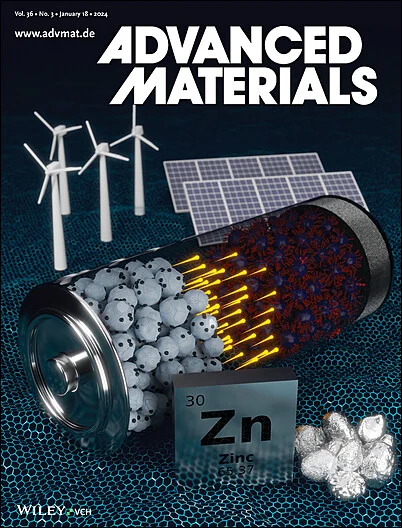
{"title":"\"Water-in-Water\" Biphasic Electrolyte for Aqueous Zinc-ion Batteries.","authors":"Yilang Yao, Dun Wang, Xiaoke Wang, Xianbin Kuang, Xiangyong Zhang, Cuiping Han","doi":"10.1002/adma.75382","DOIUrl":null,"url":null,"abstract":"<p><p>Aqueous zinc-ion batteries (AZIBs) are constrained by unstable Zn metal interfaces, where nonuniform Zn<sup>2+</sup> transport induces concentration polarization and accelerates parasitic reactions. Here we show that Zn<sup>2+</sup> flux can instead be regulated by aqueous-aqueous interfaces. A fully aqueous \"water-in-water\" (W/W) biphasic electrolyte, comprising dextran (Dex)-rich phase droplets (∼10 µm) suspended in a polyethylene glycol (PEG)-rich aqueous phase, creates phase boundaries that continuously buffer local Zn<sup>2+</sup> accumulation and redistribute ions during plating and stripping. As a result, Zn||Zn cells cycle stably for 1100 h at 10 mA cm<sup>-2</sup> and 10 mAh cm<sup>-2</sup>, and Ah-level Zn||NaV<sub>3</sub>O<sub>8</sub> pouch cells sustain long-term operation. This work demonstrates an aqueous electrolyte architecture in which interfacial electrostatics, rather than solvent chemistry, governs Zn<sup>2+</sup> transport.</p>","PeriodicalId":114,"journal":{"name":"Advanced Materials","volume":" ","pages":"e75382"},"PeriodicalIF":29.1000,"publicationDate":"2026-10-15","publicationTypes":"Journal Article","fieldsOfStudy":null,"isOpenAccess":false,"openAccessPdf":"","citationCount":"0","resultStr":null,"platform":"Semanticscholar","paperid":null,"PeriodicalName":"Advanced Materials","FirstCategoryId":"88","ListUrlMain":"https://doi.org/10.1002/adma.75382","RegionNum":1,"RegionCategory":"材料科学","ArticlePicture":[],"TitleCN":null,"AbstractTextCN":null,"PMCID":null,"EPubDate":"","PubModel":"","JCR":"Q1","JCRName":"CHEMISTRY, MULTIDISCIPLINARY","Score":null,"Total":0}
引用次数: 0
Abstract
Aqueous zinc-ion batteries (AZIBs) are constrained by unstable Zn metal interfaces, where nonuniform Zn2+ transport induces concentration polarization and accelerates parasitic reactions. Here we show that Zn2+ flux can instead be regulated by aqueous-aqueous interfaces. A fully aqueous "water-in-water" (W/W) biphasic electrolyte, comprising dextran (Dex)-rich phase droplets (∼10 µm) suspended in a polyethylene glycol (PEG)-rich aqueous phase, creates phase boundaries that continuously buffer local Zn2+ accumulation and redistribute ions during plating and stripping. As a result, Zn||Zn cells cycle stably for 1100 h at 10 mA cm-2 and 10 mAh cm-2, and Ah-level Zn||NaV3O8 pouch cells sustain long-term operation. This work demonstrates an aqueous electrolyte architecture in which interfacial electrostatics, rather than solvent chemistry, governs Zn2+ transport.
水溶液锌离子电池(azib)受到不稳定Zn金属界面的限制,其中不均匀的Zn2+输运引起浓度极化并加速寄生反应。我们发现Zn2+的通量可以由水-水界面调节。一种完全含水的“水包水”(W/W)双相电解质,包括悬浮在富含聚乙二醇(PEG)的水相中富含葡聚糖(Dex)的相滴(~ 10 μ m),形成相边界,在电镀和剥离过程中连续缓冲局部Zn2+的积累和再分配离子。结果表明,Zn||锌电池在10 mA cm-2和10 mAh cm-2下稳定循环1100 h, ah级Zn||NaV3O8袋状电池维持长期运行。这项工作展示了一种水电解质结构,其中界面静电,而不是溶剂化学,控制着Zn2+的传输。
期刊介绍:
Advanced Materials, one of the world's most prestigious journals and the foundation of the Advanced portfolio, is the home of choice for best-in-class materials science for more than 30 years. Following this fast-growing and interdisciplinary field, we are considering and publishing the most important discoveries on any and all materials from materials scientists, chemists, physicists, engineers as well as health and life scientists and bringing you the latest results and trends in modern materials-related research every week.

 求助内容:
 应助结果提醒方式:


 京公网安备 11010802042870号


