{"title":"Type I autoimmunity in chronic spontaneous urticaria: Evidence, limits, and endotype overlap.","authors":"George N Konstantinou, Clive E H Grattan","doi":"10.1016/j.jaci.2026.10.001","DOIUrl":null,"url":null,"abstract":"<p><p>Chronic spontaneous urticaria (CSU) is a mast cell-driven disorder with basophil involvement and several possible upstream mechanisms. Type IIb autoimmune CSU, mediated by functional IgG autoantibodies against FcεRIα or IgE, is the best-validated endotype. Evidence for type I autoimmune (autoallergic) CSU is less complete, but findings involving IgE autoantibodies to thyroid peroxidase (TPO), IL-24, and other self-antigens suggest that IgE-dependent autoreactivity may be relevant in some patients. However, total IgE level, atopy, allergic disease, and timing of the response to omalizumab are not diagnostic of this mechanism. Rather than viewing type I and type IIb CSU as competing categories, we hypothesize 2 potentially overlapping immunologic axes: an IgE-autoantibody axis and an IgG/complement axis. Patients may lie closer to one axis, show markers of both, or remain provisionally idiopathic because current biomarkers cannot classify them with confidence. Progress will require harmonized functional assays; skin, mast cell, and basophil readouts, as well as longitudinal treatment studies. The central question is when an IgE autoantibody is only a passenger, when it is a partner, and when it is the driver of the wheal.</p>","PeriodicalId":14936,"journal":{"name":"Journal of Allergy and Clinical Immunology","volume":" ","pages":""},"PeriodicalIF":11.7000,"publicationDate":"2026-10-13","publicationTypes":"Journal Article","fieldsOfStudy":null,"isOpenAccess":false,"openAccessPdf":"","citationCount":"0","resultStr":null,"platform":"Semanticscholar","paperid":null,"PeriodicalName":"Journal of Allergy and Clinical Immunology","FirstCategoryId":"3","ListUrlMain":"https://doi.org/10.1016/j.jaci.2026.10.001","RegionNum":1,"RegionCategory":"医学","ArticlePicture":[],"TitleCN":null,"AbstractTextCN":null,"PMCID":null,"EPubDate":"","PubModel":"","JCR":"Q1","JCRName":"ALLERGY","Score":null,"Total":0}
引用次数: 0
Abstract
Chronic spontaneous urticaria (CSU) is a mast cell-driven disorder with basophil involvement and several possible upstream mechanisms. Type IIb autoimmune CSU, mediated by functional IgG autoantibodies against FcεRIα or IgE, is the best-validated endotype. Evidence for type I autoimmune (autoallergic) CSU is less complete, but findings involving IgE autoantibodies to thyroid peroxidase (TPO), IL-24, and other self-antigens suggest that IgE-dependent autoreactivity may be relevant in some patients. However, total IgE level, atopy, allergic disease, and timing of the response to omalizumab are not diagnostic of this mechanism. Rather than viewing type I and type IIb CSU as competing categories, we hypothesize 2 potentially overlapping immunologic axes: an IgE-autoantibody axis and an IgG/complement axis. Patients may lie closer to one axis, show markers of both, or remain provisionally idiopathic because current biomarkers cannot classify them with confidence. Progress will require harmonized functional assays; skin, mast cell, and basophil readouts, as well as longitudinal treatment studies. The central question is when an IgE autoantibody is only a passenger, when it is a partner, and when it is the driver of the wheal.
期刊介绍:
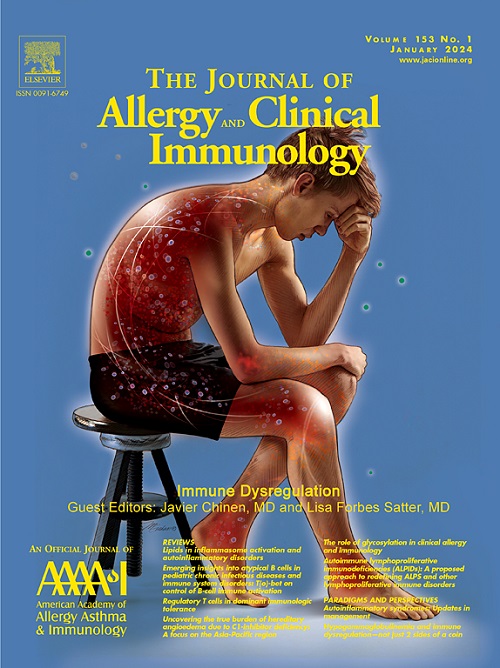
The Journal of Allergy and Clinical Immunology is a prestigious publication that features groundbreaking research in the fields of Allergy, Asthma, and Immunology. This influential journal publishes high-impact research papers that explore various topics, including asthma, food allergy, allergic rhinitis, atopic dermatitis, primary immune deficiencies, occupational and environmental allergy, and other allergic and immunologic diseases. The articles not only report on clinical trials and mechanistic studies but also provide insights into novel therapies, underlying mechanisms, and important discoveries that contribute to our understanding of these diseases. By sharing this valuable information, the journal aims to enhance the diagnosis and management of patients in the future.

 求助内容:
 应助结果提醒方式:


 京公网安备 11010802042870号


