Zirui Lin, Dan Liu, Jiangmin Jiang, Fengcui Cheng, Xiang Cai
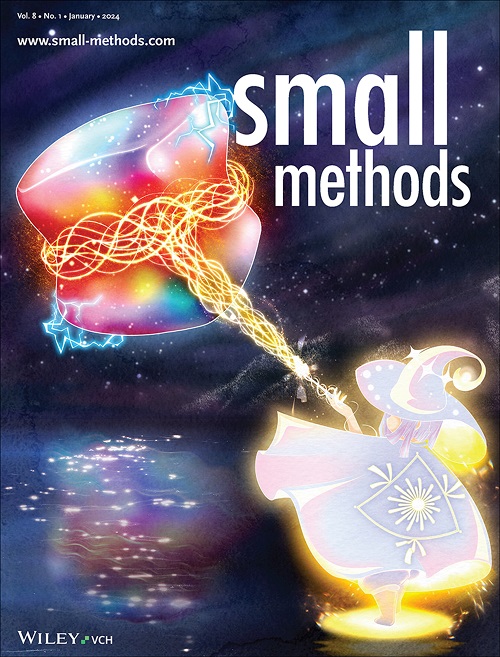
{"title":"A π-Conjugated Polymer Anode With Railway-Like NH<sub>4</sub> <sup>+</sup> Pathways for High-Rate Aqueous Ammonium-Ion Batteries.","authors":"Zirui Lin, Dan Liu, Jiangmin Jiang, Fengcui Cheng, Xiang Cai","doi":"10.1002/smtd.71131","DOIUrl":null,"url":null,"abstract":"<p><p>Aqueous ammonium-ion batteries (AAIBs) are promising energy storage systems, while the relatively large size and tetrahedral geometry of NH<sub>4</sub> <sup>+</sup> present challenges for its transport within electrodes. Herein, poly(5,8-diaza-1,4-naphthoquinone) (PANQ) has been synthesized to facilitate NH<sub>4</sub> <sup>+</sup> transport in AAIBs. The π-conjugated PANQ possesses a rigid, linear molecular structure. The straight intermolecular slits with uniformly distributed carbonyl sites form railway-like NH<sub>4</sub> <sup>+</sup> pathways, enabling rapid ion transport through the dynamic formation and disruption of hydrogen bonds. The PANQ electrode delivers a high capacity of 286.8 mAh g<sup>-1</sup> at 1 A g<sup>-1</sup> in a 2 mol L<sup>-1</sup> ammonium acetate electrolyte. Thanks to the rapid NH<sub>4</sub> <sup>+</sup> transport pathways, the electrode displays an excellent rate capability, retaining 161.7 mAh g<sup>-1</sup> at 80 A g<sup>-1</sup>. Moreover, it displays exceptional cycling stability over 10 000 cycles at 20 A g<sup>-1</sup>. The PANQ electrode was employed as the anode in a PANQ//NiCo-LDH AAIB (NiCo-LDH represents the Ni-Co layered double hydroxide cathode), retaining an energy density of 25.2 Wh kg<sup>-1</sup> even at an ultrahigh power density of 23 320.2 W kg<sup>-1</sup>. This study provides a high-performance electrode candidate for AAIBs and a strategy for constructing rapid ion-transport pathways to enable efficient NH<sub>4</sub> <sup>+</sup> storage and superior electrochemical kinetics.</p>","PeriodicalId":229,"journal":{"name":"Small Methods","volume":" ","pages":"e71131"},"PeriodicalIF":8.7000,"publicationDate":"2026-10-14","publicationTypes":"Journal Article","fieldsOfStudy":null,"isOpenAccess":false,"openAccessPdf":"","citationCount":"0","resultStr":null,"platform":"Semanticscholar","paperid":null,"PeriodicalName":"Small Methods","FirstCategoryId":"88","ListUrlMain":"https://doi.org/10.1002/smtd.71131","RegionNum":2,"RegionCategory":"材料科学","ArticlePicture":[],"TitleCN":null,"AbstractTextCN":null,"PMCID":null,"EPubDate":"","PubModel":"","JCR":"Q1","JCRName":"CHEMISTRY, PHYSICAL","Score":null,"Total":0}
引用次数: 0
Abstract
Aqueous ammonium-ion batteries (AAIBs) are promising energy storage systems, while the relatively large size and tetrahedral geometry of NH4+ present challenges for its transport within electrodes. Herein, poly(5,8-diaza-1,4-naphthoquinone) (PANQ) has been synthesized to facilitate NH4+ transport in AAIBs. The π-conjugated PANQ possesses a rigid, linear molecular structure. The straight intermolecular slits with uniformly distributed carbonyl sites form railway-like NH4+ pathways, enabling rapid ion transport through the dynamic formation and disruption of hydrogen bonds. The PANQ electrode delivers a high capacity of 286.8 mAh g-1 at 1 A g-1 in a 2 mol L-1 ammonium acetate electrolyte. Thanks to the rapid NH4+ transport pathways, the electrode displays an excellent rate capability, retaining 161.7 mAh g-1 at 80 A g-1. Moreover, it displays exceptional cycling stability over 10 000 cycles at 20 A g-1. The PANQ electrode was employed as the anode in a PANQ//NiCo-LDH AAIB (NiCo-LDH represents the Ni-Co layered double hydroxide cathode), retaining an energy density of 25.2 Wh kg-1 even at an ultrahigh power density of 23 320.2 W kg-1. This study provides a high-performance electrode candidate for AAIBs and a strategy for constructing rapid ion-transport pathways to enable efficient NH4+ storage and superior electrochemical kinetics.
水铵离子电池(AAIBs)是一种很有前途的储能系统,但相对较大的尺寸和四面体的几何结构对NH4 +在电极内的传输提出了挑战。本文合成了聚(5,8-二氮杂-1,4-萘醌)(PANQ),以促进NH4 +在AAIBs中的转运。π共轭PANQ具有刚性的线性分子结构。具有均匀分布的羰基位点的分子间直缝形成了类似铁路的NH4 +通路,通过氢键的动态形成和破坏实现了离子的快速运输。PANQ电极在2 mol L-1醋酸铵电解质中,在1 a g-1下提供286.8 mAh g-1的高容量。由于NH4 +的快速传输途径,电极显示出优异的速率能力,在80 A g-1时保持161.7 mAh g-1。此外,它在20 A g-1下显示出超过10,000次循环的卓越循环稳定性。在PANQ//NiCo-LDH AAIB (NiCo-LDH代表Ni-Co层状双氢氧化物阴极)中,PANQ电极作为阳极,在23320.2 W kg-1的超高功率密度下仍保持25.2 Wh kg-1的能量密度。该研究为AAIBs提供了一种高性能的候选电极,并为构建快速离子传输途径提供了一种策略,以实现高效的NH4 +存储和优越的电化学动力学。
Small MethodsMaterials Science-General Materials Science
CiteScore
17.40
自引率
1.60%
发文量
347
期刊介绍:
Small Methods is a multidisciplinary journal that publishes groundbreaking research on methods relevant to nano- and microscale research. It welcomes contributions from the fields of materials science, biomedical science, chemistry, and physics, showcasing the latest advancements in experimental techniques.
With a notable 2022 Impact Factor of 12.4 (Journal Citation Reports, Clarivate Analytics, 2023), Small Methods is recognized for its significant impact on the scientific community.
The online ISSN for Small Methods is 2366-9608.

 求助内容:
 应助结果提醒方式:


 京公网安备 11010802042870号


