{"title":"On the Dynamics of Noncovalent Interactions Modulating Passive Diffusion of Cisplatin Across a Human Breast Cancer Cell Membrane: An amIGM + GLED View","authors":"Costantino Zazza, Daniele Belletto, Stefano Scoditti, Nico Sanna, Stefano Borocci, Emilia Sicilia","doi":"10.1002/cplu.70258","DOIUrl":null,"url":null,"abstract":"<p>Passive permeation across biological membranes is governed by a delicate balance of transient noncovalent interactions that are difficult to resolve experimentally or through conventional molecular dynamics (MD) analyses alone. Here, we present a perspective on the integration of the averaged modified independent gradient model (amIGM) based on promolecular density approximation and the graphic representation of the local electron energy density (GLED) with classical MD simulations to investigate the passive translocation of the cisplatin (cisPt) anticancer drug across a model membrane representative of the lipid composition of breast cancer cells. This multiscale framework combines atomistic sampling with real-space descriptors, enabling the dynamic characterization of hydrogen bonding, dispersion forces, steric effects, and local electronic stabilization trends along the permeation pathway. As a proof of concept, we analyze the supramolecular nanosolvation environment of cisPt at finite temperature in two representative states: bulk aqueous solution and membrane center, corresponding to the maximum of the potential of mean force (+16 kcal mol<sup>−1</sup>). The combined amIGM/GLED approach reveals how the nature and spatial distribution of drug–water interactions evolve in response to the local membrane environment, providing mechanistic insight into the electronic and supramolecular factors that shape the free-energy landscape of passive permeation.</p>","PeriodicalId":148,"journal":{"name":"ChemPlusChem","volume":"91 10","pages":""},"PeriodicalIF":3.1000,"publicationDate":"2026-10-13","publicationTypes":"Journal Article","fieldsOfStudy":null,"isOpenAccess":false,"openAccessPdf":"https://www.ncbi.nlm.nih.gov/pmc/articles/PMC13661178/pdf/","citationCount":"0","resultStr":null,"platform":"Semanticscholar","paperid":null,"PeriodicalName":"ChemPlusChem","FirstCategoryId":"92","ListUrlMain":"https://onlinelibrary.wiley.com/doi/10.1002/cplu.70258","RegionNum":4,"RegionCategory":"化学","ArticlePicture":[],"TitleCN":null,"AbstractTextCN":null,"PMCID":null,"EPubDate":"","PubModel":"","JCR":"Q2","JCRName":"CHEMISTRY, MULTIDISCIPLINARY","Score":null,"Total":0}
引用次数: 0
Abstract
Passive permeation across biological membranes is governed by a delicate balance of transient noncovalent interactions that are difficult to resolve experimentally or through conventional molecular dynamics (MD) analyses alone. Here, we present a perspective on the integration of the averaged modified independent gradient model (amIGM) based on promolecular density approximation and the graphic representation of the local electron energy density (GLED) with classical MD simulations to investigate the passive translocation of the cisplatin (cisPt) anticancer drug across a model membrane representative of the lipid composition of breast cancer cells. This multiscale framework combines atomistic sampling with real-space descriptors, enabling the dynamic characterization of hydrogen bonding, dispersion forces, steric effects, and local electronic stabilization trends along the permeation pathway. As a proof of concept, we analyze the supramolecular nanosolvation environment of cisPt at finite temperature in two representative states: bulk aqueous solution and membrane center, corresponding to the maximum of the potential of mean force (+16 kcal mol−1). The combined amIGM/GLED approach reveals how the nature and spatial distribution of drug–water interactions evolve in response to the local membrane environment, providing mechanistic insight into the electronic and supramolecular factors that shape the free-energy landscape of passive permeation.
期刊介绍:
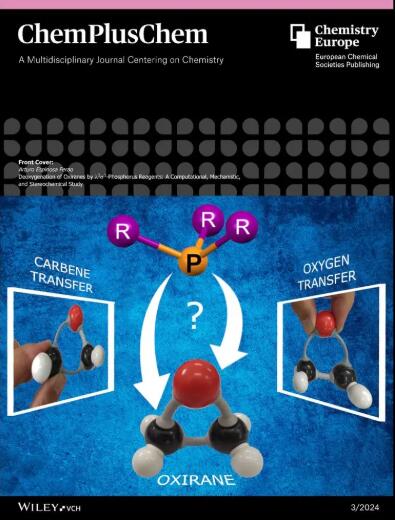
ChemPlusChem is a peer-reviewed, general chemistry journal that brings readers the very best in multidisciplinary research centering on chemistry. It is published on behalf of Chemistry Europe, an association of 16 European chemical societies.
Fully comprehensive in its scope, ChemPlusChem publishes articles covering new results from at least two different aspects (subfields) of chemistry or one of chemistry and one of another scientific discipline (one chemistry topic plus another one, hence the title ChemPlusChem). All suitable submissions undergo balanced peer review by experts in the field to ensure the highest quality, originality, relevance, significance, and validity.

 求助内容:
 应助结果提醒方式:


 京公网安备 11010802042870号


