Cong Wang, Junhang Xu, Hong Zhang, Peng Wang, Shudi Zhang, Yingwen Cheng, Ke Lu, Chun Cheng Yang, Qing Jiang
{"title":"Dynamic Proton-Coordination Equilibrium Enables Nonfreezing Ion Transport for Ultralow-Temperature Zinc Batteries.","authors":"Cong Wang, Junhang Xu, Hong Zhang, Peng Wang, Shudi Zhang, Yingwen Cheng, Ke Lu, Chun Cheng Yang, Qing Jiang","doi":"10.1002/adma.75379","DOIUrl":null,"url":null,"abstract":"<p><p>Hydrogel electrolytes (HEs) are promising for aqueous zinc batteries, yet suffer from freezing-induced loss of ionic transport and interfacial instability at subzero temperatures. Here we report a proton-mediated coordination equilibrium that enables nonfreezing Zn<sup>2+</sup> transport in hydrogel electrolytes under ultralow-temperature conditions. By coupling phytic acid with zinc phytate, proton activity and Zn-O coordination are dynamically balanced, continuously reconstructing the local hydration environment to suppress hydrogen-bond ordering, stabilize bound water, and prevent water crystallization. Simultaneously, reversible coordination exchange sustains Zn<sup>2+</sup> dissociation and migration through a hopping transport mechanism. At the Zn anode, proton-mediated interfacial evolution drives the formation of a ZnS/Zn<sub>3</sub>(PO<sub>4</sub>)<sub>2</sub>-rich hybrid interphase that accelerates interfacial kinetics and suppresses degradation. Consequently, the optimized electrolyte achieves an ionic conductivity of 2.4 mS cm<sup>-</sup> <sup>1</sup> and an apparent Zn<sup>2+</sup> transference number of 0.24 at -60°C, enabling Zn||Zn cells to cycle stably for over 3400 h and Zn||PANI full cells to retain 60.1% of their capacity after 4000 cycles at -60°C. These findings identify proton-mediated coordination equilibrium as a general mechanism for preserving ionic transport in frozen aqueous environments and provide a blueprint for low-temperature electrochemical energy storage.</p>","PeriodicalId":114,"journal":{"name":"Advanced Materials","volume":" ","pages":"e75379"},"PeriodicalIF":29.1000,"publicationDate":"2026-10-13","publicationTypes":"Journal Article","fieldsOfStudy":null,"isOpenAccess":false,"openAccessPdf":"","citationCount":"0","resultStr":null,"platform":"Semanticscholar","paperid":null,"PeriodicalName":"Advanced Materials","FirstCategoryId":"88","ListUrlMain":"https://doi.org/10.1002/adma.75379","RegionNum":1,"RegionCategory":"材料科学","ArticlePicture":[],"TitleCN":null,"AbstractTextCN":null,"PMCID":null,"EPubDate":"","PubModel":"","JCR":"Q1","JCRName":"CHEMISTRY, MULTIDISCIPLINARY","Score":null,"Total":0}
引用次数: 0
Abstract
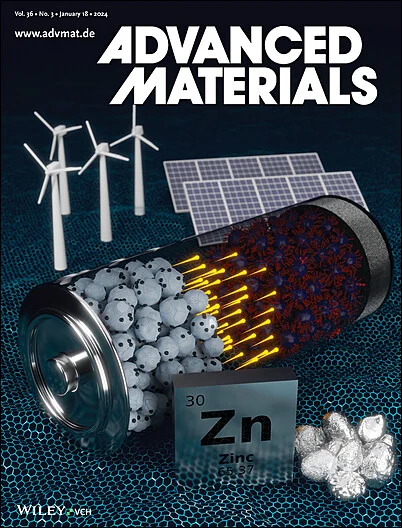
Hydrogel electrolytes (HEs) are promising for aqueous zinc batteries, yet suffer from freezing-induced loss of ionic transport and interfacial instability at subzero temperatures. Here we report a proton-mediated coordination equilibrium that enables nonfreezing Zn2+ transport in hydrogel electrolytes under ultralow-temperature conditions. By coupling phytic acid with zinc phytate, proton activity and Zn-O coordination are dynamically balanced, continuously reconstructing the local hydration environment to suppress hydrogen-bond ordering, stabilize bound water, and prevent water crystallization. Simultaneously, reversible coordination exchange sustains Zn2+ dissociation and migration through a hopping transport mechanism. At the Zn anode, proton-mediated interfacial evolution drives the formation of a ZnS/Zn3(PO4)2-rich hybrid interphase that accelerates interfacial kinetics and suppresses degradation. Consequently, the optimized electrolyte achieves an ionic conductivity of 2.4 mS cm-1 and an apparent Zn2+ transference number of 0.24 at -60°C, enabling Zn||Zn cells to cycle stably for over 3400 h and Zn||PANI full cells to retain 60.1% of their capacity after 4000 cycles at -60°C. These findings identify proton-mediated coordination equilibrium as a general mechanism for preserving ionic transport in frozen aqueous environments and provide a blueprint for low-temperature electrochemical energy storage.
期刊介绍:
Advanced Materials, one of the world's most prestigious journals and the foundation of the Advanced portfolio, is the home of choice for best-in-class materials science for more than 30 years. Following this fast-growing and interdisciplinary field, we are considering and publishing the most important discoveries on any and all materials from materials scientists, chemists, physicists, engineers as well as health and life scientists and bringing you the latest results and trends in modern materials-related research every week.

 求助内容:
 应助结果提醒方式:


 京公网安备 11010802042870号


