Zixuan Tang, Shan Lu, Hongjing Sui, Jincheng Shi, Haiming Sun, Mengnan Li, Can Feng, Han Lin, Qin Zhou, Feiyun Cui
{"title":"Electronic Interactions in Co/Cu Biotomic Nanozymes for Catalytic Eradication of Gram-Positive Bacterial Biofilms.","authors":"Zixuan Tang, Shan Lu, Hongjing Sui, Jincheng Shi, Haiming Sun, Mengnan Li, Can Feng, Han Lin, Qin Zhou, Feiyun Cui","doi":"10.1002/adhm.71857","DOIUrl":null,"url":null,"abstract":"<p><p>Biofilm-associated infections caused by Gram-positive pathogens remain highly resistant to conventional antibiotic therapy due to restricted drug penetration and persistent inflammatory microenvironments. Inspired by the catalytic versatility and biocompatibility of cobalt, a series of cobalt-based diatomic nanozymes were rationally engineered for catalytic antibacterial therapy. Among them, cobalt/copper diatomic nanozymes (Co/Cu-DAzymes) exhibited the most pronounced antibacterial and antibiofilm activities. Structural characterization supports the presence of highly dispersed Co and Cu coordination sites, while DFT calculations based on an idealized adjacent Co-Cu model suggest that heteronuclear electronic interactions may facilitate H<sub>2</sub>O<sub>2</sub> activation and ROS generation.Co/Cu-DAzymes achieve more than 95% antibacterial efficiency against both Group A Streptococcus (GAS) and Staphylococcus aureus, while inhibiting biofilm formation by over 80%, with negligible cytotoxicity in vitro and in vivo. In a murine GAS-infected wound model, treatment with Co/Cu-DAzymes combined with low-dose H<sub>2</sub>O<sub>2</sub> significantly accelerated wound closure and was associated with histological features of more advanced tissue repair. These findings highlight the potential contribution of heteronuclear electronic interactions to catalytic H<sub>2</sub>O<sub>2</sub> activation and provide a plausible design basis for developing antibacterial dual-metal nanozymes.</p>","PeriodicalId":113,"journal":{"name":"Advanced Healthcare Materials","volume":" ","pages":"e71857"},"PeriodicalIF":11.0000,"publicationDate":"2026-10-14","publicationTypes":"Journal Article","fieldsOfStudy":null,"isOpenAccess":false,"openAccessPdf":"","citationCount":"0","resultStr":null,"platform":"Semanticscholar","paperid":null,"PeriodicalName":"Advanced Healthcare Materials","FirstCategoryId":"5","ListUrlMain":"https://doi.org/10.1002/adhm.71857","RegionNum":2,"RegionCategory":"医学","ArticlePicture":[],"TitleCN":null,"AbstractTextCN":null,"PMCID":null,"EPubDate":"","PubModel":"","JCR":"Q1","JCRName":"ENGINEERING, BIOMEDICAL","Score":null,"Total":0}
引用次数: 0
Abstract
Biofilm-associated infections caused by Gram-positive pathogens remain highly resistant to conventional antibiotic therapy due to restricted drug penetration and persistent inflammatory microenvironments. Inspired by the catalytic versatility and biocompatibility of cobalt, a series of cobalt-based diatomic nanozymes were rationally engineered for catalytic antibacterial therapy. Among them, cobalt/copper diatomic nanozymes (Co/Cu-DAzymes) exhibited the most pronounced antibacterial and antibiofilm activities. Structural characterization supports the presence of highly dispersed Co and Cu coordination sites, while DFT calculations based on an idealized adjacent Co-Cu model suggest that heteronuclear electronic interactions may facilitate H2O2 activation and ROS generation.Co/Cu-DAzymes achieve more than 95% antibacterial efficiency against both Group A Streptococcus (GAS) and Staphylococcus aureus, while inhibiting biofilm formation by over 80%, with negligible cytotoxicity in vitro and in vivo. In a murine GAS-infected wound model, treatment with Co/Cu-DAzymes combined with low-dose H2O2 significantly accelerated wound closure and was associated with histological features of more advanced tissue repair. These findings highlight the potential contribution of heteronuclear electronic interactions to catalytic H2O2 activation and provide a plausible design basis for developing antibacterial dual-metal nanozymes.
期刊介绍:
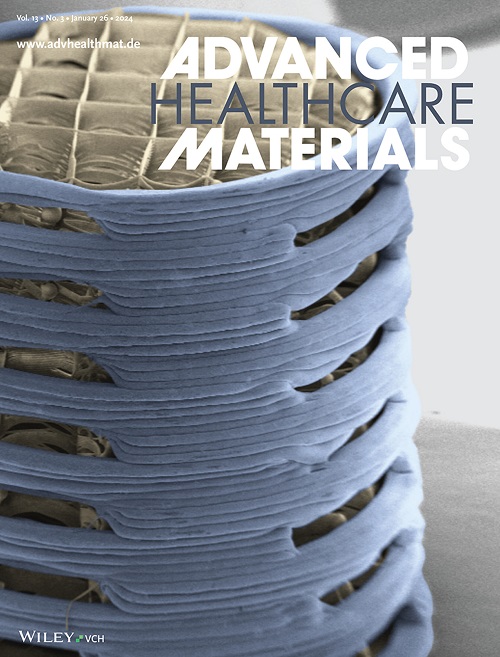
Advanced Healthcare Materials, a distinguished member of the esteemed Advanced portfolio, has been dedicated to disseminating cutting-edge research on materials, devices, and technologies for enhancing human well-being for over ten years. As a comprehensive journal, it encompasses a wide range of disciplines such as biomaterials, biointerfaces, nanomedicine and nanotechnology, tissue engineering, and regenerative medicine.

 求助内容:
 应助结果提醒方式:


 京公网安备 11010802042870号


