Andrea Melissa Páez Iribas, Aruna-Devi Rasu Chettiar, José Antonio Pérez Tavares, Yalpi Karthik, Veronica Campos Ibarra, Laura Susana Acosta-Torres, Pablo Eduardo Cardoso Avila, Manoj-Kumar Arthikala, Ravichandran Manisekaran
{"title":"Comparative Antifungal Performance of Pristine 2D Graphene Oxide and Titanium Carbide Nanosheets on Fusarium oxysporum","authors":"Andrea Melissa Páez Iribas, Aruna-Devi Rasu Chettiar, José Antonio Pérez Tavares, Yalpi Karthik, Veronica Campos Ibarra, Laura Susana Acosta-Torres, Pablo Eduardo Cardoso Avila, Manoj-Kumar Arthikala, Ravichandran Manisekaran","doi":"10.1002/slct.74820","DOIUrl":null,"url":null,"abstract":"<p><i>Fusarium oxysporum</i> is a phytopathogenic fungus that is detrimental to the agricultural sector. With increasing restrictions on the use of chemical fungicides, there has been growing interest in finding alternatives to control fungi and provide sustainable practices. This study focused on two-dimensional (2D) nanomaterials, graphene oxide (GO), and titanium carbide (TiC) nanosheets (NSs) as potential antifungal agents. 2D NSs were synthesized, characterized, and evaluated for their impact on <i>Fusarium</i> by determining radial growth, mycelium biomass, fungal hyphal morphology, and nucleic acid release. The radial growth tests indicated moderate inhibition of colony growth for GO (500 ppm) and TiC (125 ppm), with an 8.57% inhibition; however, biomass testing demonstrated a higher antifungal effect with both NSs, by reducing 93%–96%. Microscopic evaluation of the hyphae indicated deformation and fragmentation when treated with NSs. Additionally, the nucleic acid release assay indicated extreme damage to the cell membrane. These data indicate that GO disrupts the membrane and inhibits development through NS–hyphae interactions. Conversely, TiC generates reactive oxygen species, resulting in oxidative stress. Therefore, 2D NSs have the potential to function as green antifungal agents and can be employed to manage agricultural diseases in a sustainable manner.</p>","PeriodicalId":146,"journal":{"name":"ChemistrySelect","volume":"11 39","pages":""},"PeriodicalIF":2.3000,"publicationDate":"2026-10-15","publicationTypes":"Journal Article","fieldsOfStudy":null,"isOpenAccess":false,"openAccessPdf":"https://onlinelibrary.wiley.com/doi/epdf/10.1002/slct.74820","citationCount":"0","resultStr":null,"platform":"Semanticscholar","paperid":null,"PeriodicalName":"ChemistrySelect","FirstCategoryId":"92","ListUrlMain":"https://onlinelibrary.wiley.com/doi/10.1002/slct.74820","RegionNum":4,"RegionCategory":"化学","ArticlePicture":[],"TitleCN":null,"AbstractTextCN":null,"PMCID":null,"EPubDate":"","PubModel":"","JCR":"Q3","JCRName":"CHEMISTRY, MULTIDISCIPLINARY","Score":null,"Total":0}
引用次数: 0
Abstract
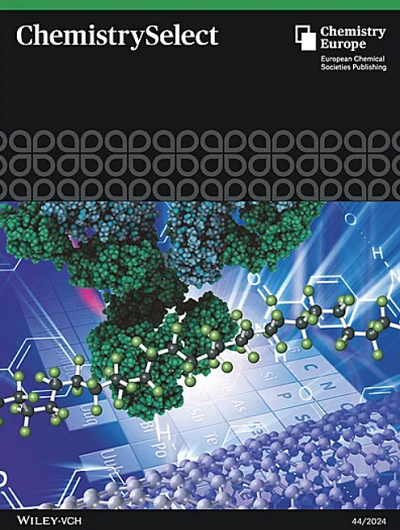
Fusarium oxysporum is a phytopathogenic fungus that is detrimental to the agricultural sector. With increasing restrictions on the use of chemical fungicides, there has been growing interest in finding alternatives to control fungi and provide sustainable practices. This study focused on two-dimensional (2D) nanomaterials, graphene oxide (GO), and titanium carbide (TiC) nanosheets (NSs) as potential antifungal agents. 2D NSs were synthesized, characterized, and evaluated for their impact on Fusarium by determining radial growth, mycelium biomass, fungal hyphal morphology, and nucleic acid release. The radial growth tests indicated moderate inhibition of colony growth for GO (500 ppm) and TiC (125 ppm), with an 8.57% inhibition; however, biomass testing demonstrated a higher antifungal effect with both NSs, by reducing 93%–96%. Microscopic evaluation of the hyphae indicated deformation and fragmentation when treated with NSs. Additionally, the nucleic acid release assay indicated extreme damage to the cell membrane. These data indicate that GO disrupts the membrane and inhibits development through NS–hyphae interactions. Conversely, TiC generates reactive oxygen species, resulting in oxidative stress. Therefore, 2D NSs have the potential to function as green antifungal agents and can be employed to manage agricultural diseases in a sustainable manner.
期刊介绍:
ChemistrySelect is the latest journal from ChemPubSoc Europe and Wiley-VCH. It offers researchers a quality society-owned journal in which to publish their work in all areas of chemistry. Manuscripts are evaluated by active researchers to ensure they add meaningfully to the scientific literature, and those accepted are processed quickly to ensure rapid online publication.

 求助内容:
 应助结果提醒方式:


 京公网安备 11010802042870号


