Vishnumaya K. J., Aadesh R. Shrotri, Sachin U. Nandanwar, R. Nandini Devi
{"title":"Scalable coating of zeolite on alumina hollow fiber membranes for selective water removal from ethanol via pervaporation","authors":"Vishnumaya K. J., Aadesh R. Shrotri, Sachin U. Nandanwar, R. Nandini Devi","doi":"10.1007/s10934-026-01951-w","DOIUrl":null,"url":null,"abstract":"<div><p>The separation of ethanol from water in an azeotropic mixture remains a major industrial challenge. To address this problem, the membrane-based pervaporation has emerged as a viable option due to its molecular selectivity and low temperature requirement. In this study, LTA type zeolite particles were coated on outer surface of alumina hollow fiber (AHF) to make defect free zeolite membrane by dip coating method. Coating method was optimized to enhance scalability as well as to reduce the wastage of synthesis gel. The phase, growth, and morphology of LTA on AHF was confirmed by XRD, FE-SEM, and HRTEM. The thickness of zeolite coating was ranged from 4 μm to 7 μm. Pervaporation tests of ethanol/water (90/10 vol%) mixture with various temperatures revealed strong water selectivity, a steady permeation flux and capacity to break the azeotrope. Permeate flux was increased with increase in temperature from 3.4 to 13 kg.m<sup>−2</sup>h<sup>− 1</sup>, and separation factor varies from 6926.1 to 25754.5 for a feed flow of 2 mL min<sup>− 1</sup>. The activation energy was estimated using the Arrhenius model to describe the temperature dependence of permeation. The activation energy for the CH<sub>3</sub>CH<sub>2</sub>OH and H<sub>2</sub>O was ~ 86.83 and ~ 40 kJ mol<sup>− 1</sup>, respectively; higher activation energy alludes to stronger sensitivity of water permeance to temperature, indicating its potential in water separation through pervaporation.</p></div>","PeriodicalId":660,"journal":{"name":"Journal of Porous Materials","volume":"33 5","pages":"1471 - 1485"},"PeriodicalIF":3.0000,"publicationDate":"2026-07-29","publicationTypes":"Journal Article","fieldsOfStudy":null,"isOpenAccess":false,"openAccessPdf":"","citationCount":"0","resultStr":null,"platform":"Semanticscholar","paperid":null,"PeriodicalName":"Journal of Porous Materials","FirstCategoryId":"88","ListUrlMain":"https://link.springer.com/article/10.1007/s10934-026-01951-w","RegionNum":4,"RegionCategory":"材料科学","ArticlePicture":[],"TitleCN":null,"AbstractTextCN":null,"PMCID":null,"EPubDate":"","PubModel":"","JCR":"Q2","JCRName":"CHEMISTRY, APPLIED","Score":null,"Total":0}
引用次数: 0
Abstract
The separation of ethanol from water in an azeotropic mixture remains a major industrial challenge. To address this problem, the membrane-based pervaporation has emerged as a viable option due to its molecular selectivity and low temperature requirement. In this study, LTA type zeolite particles were coated on outer surface of alumina hollow fiber (AHF) to make defect free zeolite membrane by dip coating method. Coating method was optimized to enhance scalability as well as to reduce the wastage of synthesis gel. The phase, growth, and morphology of LTA on AHF was confirmed by XRD, FE-SEM, and HRTEM. The thickness of zeolite coating was ranged from 4 μm to 7 μm. Pervaporation tests of ethanol/water (90/10 vol%) mixture with various temperatures revealed strong water selectivity, a steady permeation flux and capacity to break the azeotrope. Permeate flux was increased with increase in temperature from 3.4 to 13 kg.m−2h− 1, and separation factor varies from 6926.1 to 25754.5 for a feed flow of 2 mL min− 1. The activation energy was estimated using the Arrhenius model to describe the temperature dependence of permeation. The activation energy for the CH3CH2OH and H2O was ~ 86.83 and ~ 40 kJ mol− 1, respectively; higher activation energy alludes to stronger sensitivity of water permeance to temperature, indicating its potential in water separation through pervaporation.
期刊介绍:
The Journal of Porous Materials is an interdisciplinary and international periodical devoted to all types of porous materials. Its aim is the rapid publication
of high quality, peer-reviewed papers focused on the synthesis, processing, characterization and property evaluation of all porous materials. The objective is to
establish a unique journal that will serve as a principal means of communication for the growing interdisciplinary field of porous materials.
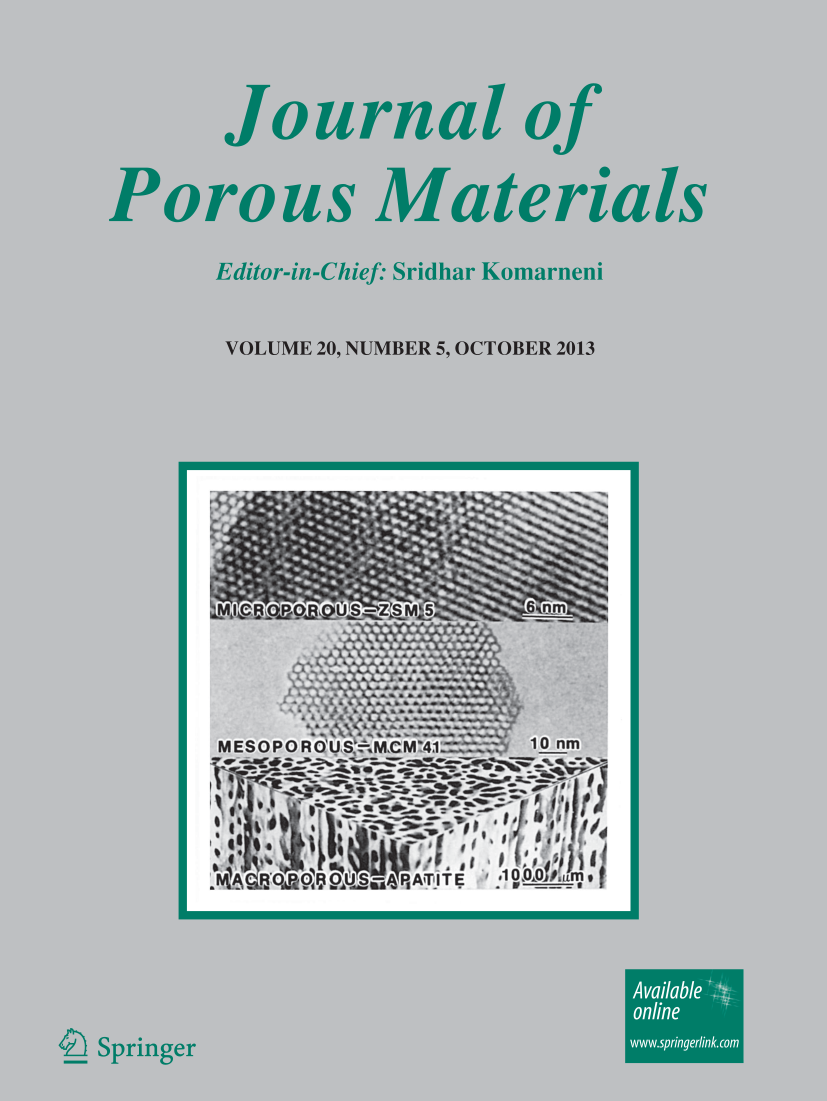
Porous materials include microporous materials with 50 nm pores.
Examples of microporous materials are natural and synthetic molecular sieves, cationic and anionic clays, pillared clays, tobermorites, pillared Zr and Ti
phosphates, spherosilicates, carbons, porous polymers, xerogels, etc. Mesoporous materials include synthetic molecular sieves, xerogels, aerogels, glasses, glass
ceramics, porous polymers, etc.; while macroporous materials include ceramics, glass ceramics, porous polymers, aerogels, cement, etc. The porous materials
can be crystalline, semicrystalline or noncrystalline, or combinations thereof. They can also be either organic, inorganic, or their composites. The overall
objective of the journal is the establishment of one main forum covering the basic and applied aspects of all porous materials.

 求助内容:
 应助结果提醒方式:


 京公网安备 11010802042870号


