Zepan Sun, Tao Hu, Yajing Pan, Zhiqing Liu, Chonggang Wu
{"title":"Preparation and performance of platinum catalysts for hydrosilylation supported by polyphenols modified SBA-15","authors":"Zepan Sun, Tao Hu, Yajing Pan, Zhiqing Liu, Chonggang Wu","doi":"10.1007/s10934-026-01944-9","DOIUrl":null,"url":null,"abstract":"<div><p>Surface modification of porous particles with functional groups is a common way to anchor noble metal catalysts. Herein, surface modification of mesoporous silica (SBA-15) was performed using polyphenols (PNs) through oxidative copolymerization of tea polyphenols and theophylline. The PNs modification ratios on subsequent both Pt loading and chemical states of supported Pt are thoroughly investigated. Catalytic activity of the resulting catalysts was evaluated through various hydrosilylation reactions, while its recyclability was also examined. Results show that modification with PNs can not only facilitates the loading of Pt, but also favors the formation of more active Pt<sup>0</sup> species, thereby increase the catalytic activity of the catalyst. Among them, the SBA-15-PNs-Pt-2 catalyst with the highest PNs ratios exhibits both high activity, good selectivity of anti-Markovnikov addition products and excellent recycling performance. Meanwhile, whether it is under low catalyst loadings or toward the hydrosilylation reactions between a series of substrates, the SBA-15-PNs-Pt-2 catalyst all exhibit undeclined activity, which again signifies the substantial role of PNs in both loading and anchoring Pt species.</p></div>","PeriodicalId":660,"journal":{"name":"Journal of Porous Materials","volume":"33 5","pages":"1457 - 1470"},"PeriodicalIF":3.0000,"publicationDate":"2026-07-24","publicationTypes":"Journal Article","fieldsOfStudy":null,"isOpenAccess":false,"openAccessPdf":"","citationCount":"0","resultStr":null,"platform":"Semanticscholar","paperid":null,"PeriodicalName":"Journal of Porous Materials","FirstCategoryId":"88","ListUrlMain":"https://link.springer.com/article/10.1007/s10934-026-01944-9","RegionNum":4,"RegionCategory":"材料科学","ArticlePicture":[],"TitleCN":null,"AbstractTextCN":null,"PMCID":null,"EPubDate":"","PubModel":"","JCR":"Q2","JCRName":"CHEMISTRY, APPLIED","Score":null,"Total":0}
引用次数: 0
Abstract
Surface modification of porous particles with functional groups is a common way to anchor noble metal catalysts. Herein, surface modification of mesoporous silica (SBA-15) was performed using polyphenols (PNs) through oxidative copolymerization of tea polyphenols and theophylline. The PNs modification ratios on subsequent both Pt loading and chemical states of supported Pt are thoroughly investigated. Catalytic activity of the resulting catalysts was evaluated through various hydrosilylation reactions, while its recyclability was also examined. Results show that modification with PNs can not only facilitates the loading of Pt, but also favors the formation of more active Pt0 species, thereby increase the catalytic activity of the catalyst. Among them, the SBA-15-PNs-Pt-2 catalyst with the highest PNs ratios exhibits both high activity, good selectivity of anti-Markovnikov addition products and excellent recycling performance. Meanwhile, whether it is under low catalyst loadings or toward the hydrosilylation reactions between a series of substrates, the SBA-15-PNs-Pt-2 catalyst all exhibit undeclined activity, which again signifies the substantial role of PNs in both loading and anchoring Pt species.
期刊介绍:
The Journal of Porous Materials is an interdisciplinary and international periodical devoted to all types of porous materials. Its aim is the rapid publication
of high quality, peer-reviewed papers focused on the synthesis, processing, characterization and property evaluation of all porous materials. The objective is to
establish a unique journal that will serve as a principal means of communication for the growing interdisciplinary field of porous materials.
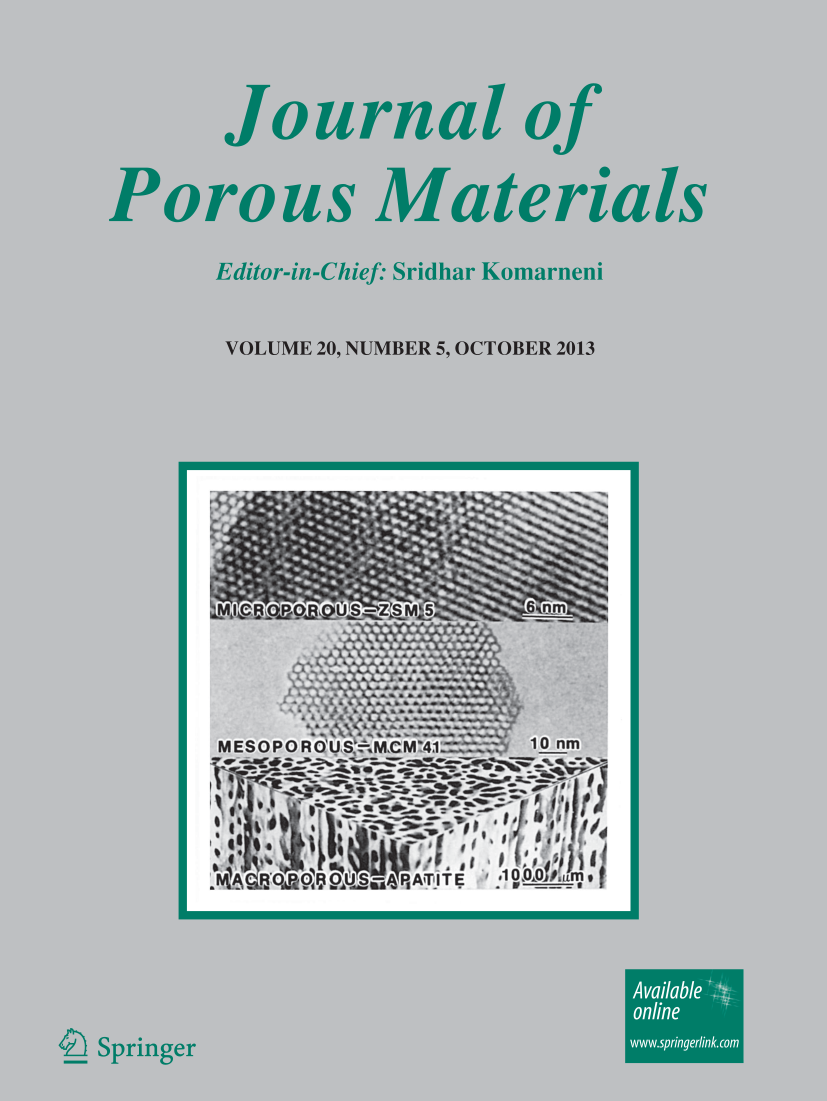
Porous materials include microporous materials with 50 nm pores.
Examples of microporous materials are natural and synthetic molecular sieves, cationic and anionic clays, pillared clays, tobermorites, pillared Zr and Ti
phosphates, spherosilicates, carbons, porous polymers, xerogels, etc. Mesoporous materials include synthetic molecular sieves, xerogels, aerogels, glasses, glass
ceramics, porous polymers, etc.; while macroporous materials include ceramics, glass ceramics, porous polymers, aerogels, cement, etc. The porous materials
can be crystalline, semicrystalline or noncrystalline, or combinations thereof. They can also be either organic, inorganic, or their composites. The overall
objective of the journal is the establishment of one main forum covering the basic and applied aspects of all porous materials.

 求助内容:
 应助结果提醒方式:


 京公网安备 11010802042870号


