M. A. Orduño-Izaguirre, J. E. Leal-Perez, A. Borquez-Mendivil, A. Hurtado-Macias, F. G. Cabrera-Covarrubias, F. Espejel-Ayala, J. C. Leal-Zayas, M. Cortez-Valadez, J. Flores-Valenzuela
{"title":"Surface-associated Cu2S nanodomains on FAU NaX zeolite for sulfidation-dependent sunlight-assisted methylene blue decolorization","authors":"M. A. Orduño-Izaguirre, J. E. Leal-Perez, A. Borquez-Mendivil, A. Hurtado-Macias, F. G. Cabrera-Covarrubias, F. Espejel-Ayala, J. C. Leal-Zayas, M. Cortez-Valadez, J. Flores-Valenzuela","doi":"10.1007/s10934-026-01955-6","DOIUrl":null,"url":null,"abstract":"<div><p>Cu<sub>2</sub>S nanoparticles supported on commercial F9 NaX zeolite (FAU) were prepared and evaluated for sunlight-assisted decolorization of methylene blue in water. Cu<sup>2+</sup> was introduced by aqueous ion exchange (0.025-0.10 M CuSO<sub>4</sub>, 50 °C, 25 min; natural pH) and converted to sulfide by in situ sulfidation with Na<sub>2</sub>S under matched conditions. XRD and FTIR support retention of the FAU framework after both steps. Diffuse reflectance shows broad visible absorption (350–500 nm) with a maximum near 438 nm that increases with nominal sulfidation concentration. HRTEM analysis of ZF9 + Cu<sub>2</sub>S-0.1 reveals dispersed crystalline nanodomains (18 ± 2 nm, <i>n</i> = 100) associated with the host; lattice fringes (d = 1.99 Å) are consistent with Cu<sub>2</sub>S (110). Decolorization tests were performed under sunlight using methylene blue (15 ppm, 25 mL) and 0.10 g solid after 20 min dark equilibration; A0 was defined after the dark step and absorbance was monitored at 664 nm. Dark adsorption and photolysis blanks were included, and outcomes are reported as methylene blue decolorization from the 664 nm absorbance response. ZF9 + Cu<sub>2</sub>S-0.1 reached ~ 95% overall decolorization at 100 min, whereas lower nominal sulfidation concentrations were largely adsorption-driven. Overall, the sustained decrease in the MB band during sunlight exposure occurs only for ZF9 + Cu<sub>2</sub>S-0.1, which exhibits the strongest Cu-S-related optical response, with NaX acting as a growth and stabilization matrix rather than a strict micropore-confinement medium.</p></div>","PeriodicalId":660,"journal":{"name":"Journal of Porous Materials","volume":"33 5","pages":"1487 - 1498"},"PeriodicalIF":3.0000,"publicationDate":"2026-08-11","publicationTypes":"Journal Article","fieldsOfStudy":null,"isOpenAccess":false,"openAccessPdf":"","citationCount":"0","resultStr":null,"platform":"Semanticscholar","paperid":null,"PeriodicalName":"Journal of Porous Materials","FirstCategoryId":"88","ListUrlMain":"https://link.springer.com/article/10.1007/s10934-026-01955-6","RegionNum":4,"RegionCategory":"材料科学","ArticlePicture":[],"TitleCN":null,"AbstractTextCN":null,"PMCID":null,"EPubDate":"","PubModel":"","JCR":"Q2","JCRName":"CHEMISTRY, APPLIED","Score":null,"Total":0}
引用次数: 0
Abstract
Cu2S nanoparticles supported on commercial F9 NaX zeolite (FAU) were prepared and evaluated for sunlight-assisted decolorization of methylene blue in water. Cu2+ was introduced by aqueous ion exchange (0.025-0.10 M CuSO4, 50 °C, 25 min; natural pH) and converted to sulfide by in situ sulfidation with Na2S under matched conditions. XRD and FTIR support retention of the FAU framework after both steps. Diffuse reflectance shows broad visible absorption (350–500 nm) with a maximum near 438 nm that increases with nominal sulfidation concentration. HRTEM analysis of ZF9 + Cu2S-0.1 reveals dispersed crystalline nanodomains (18 ± 2 nm, n = 100) associated with the host; lattice fringes (d = 1.99 Å) are consistent with Cu2S (110). Decolorization tests were performed under sunlight using methylene blue (15 ppm, 25 mL) and 0.10 g solid after 20 min dark equilibration; A0 was defined after the dark step and absorbance was monitored at 664 nm. Dark adsorption and photolysis blanks were included, and outcomes are reported as methylene blue decolorization from the 664 nm absorbance response. ZF9 + Cu2S-0.1 reached ~ 95% overall decolorization at 100 min, whereas lower nominal sulfidation concentrations were largely adsorption-driven. Overall, the sustained decrease in the MB band during sunlight exposure occurs only for ZF9 + Cu2S-0.1, which exhibits the strongest Cu-S-related optical response, with NaX acting as a growth and stabilization matrix rather than a strict micropore-confinement medium.
期刊介绍:
The Journal of Porous Materials is an interdisciplinary and international periodical devoted to all types of porous materials. Its aim is the rapid publication
of high quality, peer-reviewed papers focused on the synthesis, processing, characterization and property evaluation of all porous materials. The objective is to
establish a unique journal that will serve as a principal means of communication for the growing interdisciplinary field of porous materials.
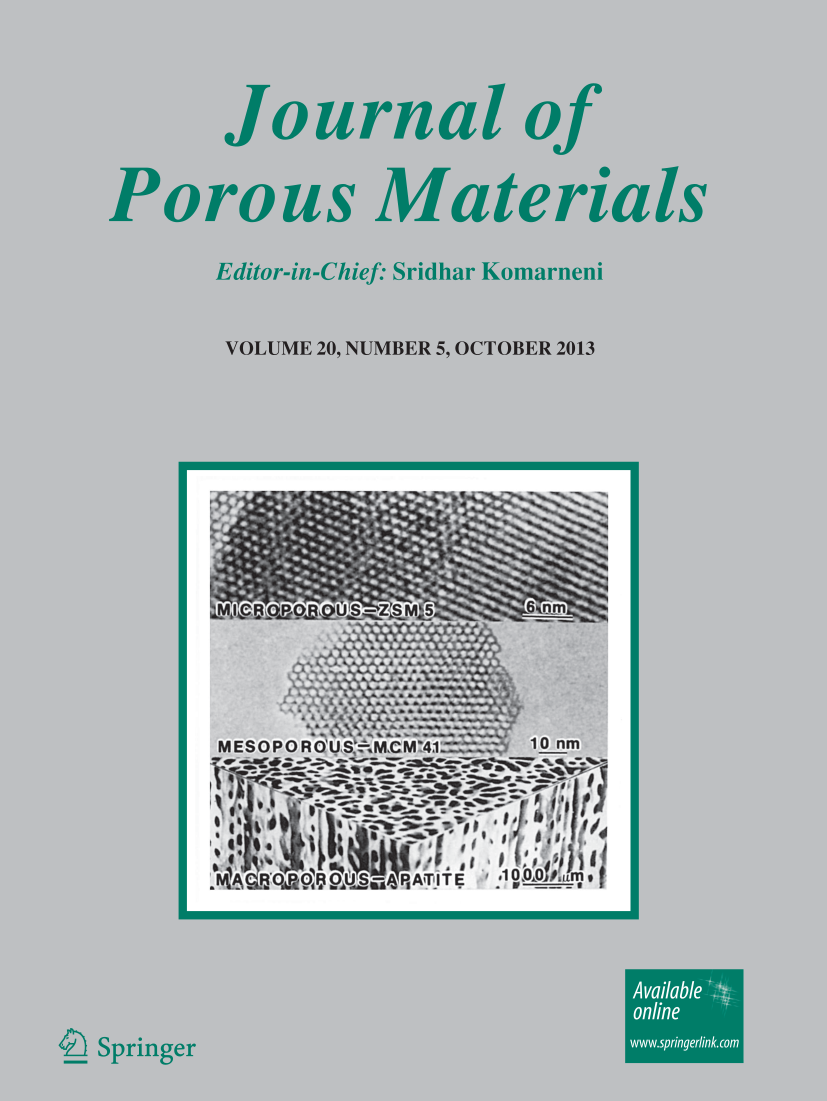
Porous materials include microporous materials with 50 nm pores.
Examples of microporous materials are natural and synthetic molecular sieves, cationic and anionic clays, pillared clays, tobermorites, pillared Zr and Ti
phosphates, spherosilicates, carbons, porous polymers, xerogels, etc. Mesoporous materials include synthetic molecular sieves, xerogels, aerogels, glasses, glass
ceramics, porous polymers, etc.; while macroporous materials include ceramics, glass ceramics, porous polymers, aerogels, cement, etc. The porous materials
can be crystalline, semicrystalline or noncrystalline, or combinations thereof. They can also be either organic, inorganic, or their composites. The overall
objective of the journal is the establishment of one main forum covering the basic and applied aspects of all porous materials.

 求助内容:
 应助结果提醒方式:


 京公网安备 11010802042870号


