{"title":"Preparation of cerium-modified tobermorite and its application for Cr³⁺ and Cu²⁺ ions removal","authors":"Qisheng Wu, Xinyu Miao, Zheyu Zhu","doi":"10.1007/s10934-026-01949-4","DOIUrl":null,"url":null,"abstract":"<div><p>With the rapid development of industrial activities such as electroplating, metallurgy and printing and dyeing, a large volume of wastewater containing typical heavy metals including Cr³⁺ and Cu²⁺ is discharged into the environment. Therefore, the development of efficient and stable heavy metal adsorbent materials is critical for environmental management. This study investigates the preparation method, influencing factors and adsorption mechanism of cerium-modified tobermorite. Through batch static adsorption experiments, model fitting and comprehensive characterization using XRD, FTIR and SEM-EDS, it is determined that the sample modified with 0.05 mol/L Ce exhibits the optimal performance. The modified material can well retain the three-dimensional network structure of tobermorite, and Ce elements are uniformly distributed on the material surface. Under the conditions of a heavy metal solution pH of 6, an initial concentration of 100 mg/L, a material dosage of 1.0 g/L, and a reaction time of 60 min, the removal rates of Cr³⁺ and Cu²⁺ reach as high as 99.08% and 99.76%, respectively. The maximum adsorption capacity of the modified tobermorite for heavy metals exceeds 99 mg/g. After Ce modification, active sites can be introduced, and the silicon-oxygen framework participates in interfacial complexation, which further enhances the adsorption and immobilization effect for heavy metals, with heavy metal ions uniformly and dispersedly distributed on the material surface.</p></div>","PeriodicalId":660,"journal":{"name":"Journal of Porous Materials","volume":"33 5","pages":"1499 - 1511"},"PeriodicalIF":3.0000,"publicationDate":"2026-08-11","publicationTypes":"Journal Article","fieldsOfStudy":null,"isOpenAccess":false,"openAccessPdf":"","citationCount":"0","resultStr":null,"platform":"Semanticscholar","paperid":null,"PeriodicalName":"Journal of Porous Materials","FirstCategoryId":"88","ListUrlMain":"https://link.springer.com/article/10.1007/s10934-026-01949-4","RegionNum":4,"RegionCategory":"材料科学","ArticlePicture":[],"TitleCN":null,"AbstractTextCN":null,"PMCID":null,"EPubDate":"","PubModel":"","JCR":"Q2","JCRName":"CHEMISTRY, APPLIED","Score":null,"Total":0}
引用次数: 0
Abstract
With the rapid development of industrial activities such as electroplating, metallurgy and printing and dyeing, a large volume of wastewater containing typical heavy metals including Cr³⁺ and Cu²⁺ is discharged into the environment. Therefore, the development of efficient and stable heavy metal adsorbent materials is critical for environmental management. This study investigates the preparation method, influencing factors and adsorption mechanism of cerium-modified tobermorite. Through batch static adsorption experiments, model fitting and comprehensive characterization using XRD, FTIR and SEM-EDS, it is determined that the sample modified with 0.05 mol/L Ce exhibits the optimal performance. The modified material can well retain the three-dimensional network structure of tobermorite, and Ce elements are uniformly distributed on the material surface. Under the conditions of a heavy metal solution pH of 6, an initial concentration of 100 mg/L, a material dosage of 1.0 g/L, and a reaction time of 60 min, the removal rates of Cr³⁺ and Cu²⁺ reach as high as 99.08% and 99.76%, respectively. The maximum adsorption capacity of the modified tobermorite for heavy metals exceeds 99 mg/g. After Ce modification, active sites can be introduced, and the silicon-oxygen framework participates in interfacial complexation, which further enhances the adsorption and immobilization effect for heavy metals, with heavy metal ions uniformly and dispersedly distributed on the material surface.
期刊介绍:
The Journal of Porous Materials is an interdisciplinary and international periodical devoted to all types of porous materials. Its aim is the rapid publication
of high quality, peer-reviewed papers focused on the synthesis, processing, characterization and property evaluation of all porous materials. The objective is to
establish a unique journal that will serve as a principal means of communication for the growing interdisciplinary field of porous materials.
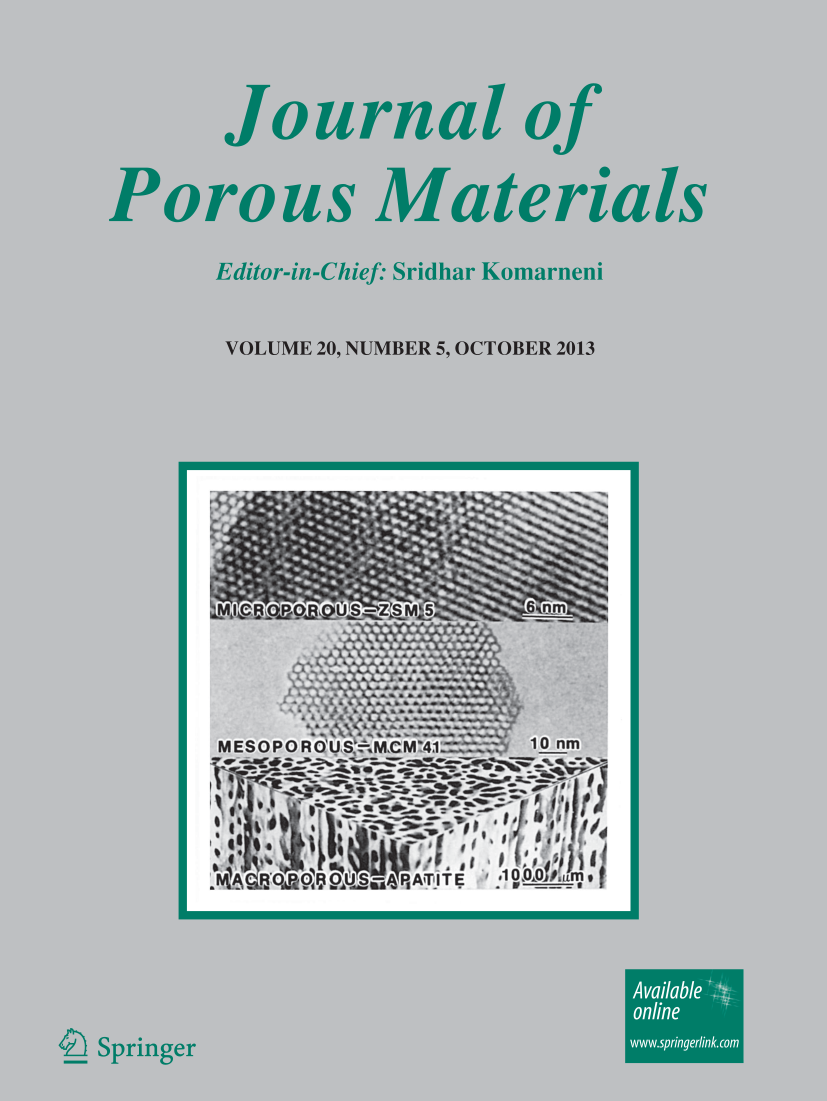
Porous materials include microporous materials with 50 nm pores.
Examples of microporous materials are natural and synthetic molecular sieves, cationic and anionic clays, pillared clays, tobermorites, pillared Zr and Ti
phosphates, spherosilicates, carbons, porous polymers, xerogels, etc. Mesoporous materials include synthetic molecular sieves, xerogels, aerogels, glasses, glass
ceramics, porous polymers, etc.; while macroporous materials include ceramics, glass ceramics, porous polymers, aerogels, cement, etc. The porous materials
can be crystalline, semicrystalline or noncrystalline, or combinations thereof. They can also be either organic, inorganic, or their composites. The overall
objective of the journal is the establishment of one main forum covering the basic and applied aspects of all porous materials.

 求助内容:
 应助结果提醒方式:


 京公网安备 11010802042870号


