Evolution of structure and texture of the Beta zeolite recrystallization-derived materials: Impact of alkaline concentration and exploratory application towards LDPE catalytic pyrolysis
Julio Colmenares-Zerpa, Analio Dugarte-Dugarte, José Miguel Delgado, Ricardo J. Chimentão, M. F. Melendrez, Eliane Soares da Silva, Ernesto A. Urquieta-Gonzalez, J. B.O. Santos, Kevin Jhon Fernández-Andrade, Serguei Alejandro-Martín, Pedro Rodríguez-Sulbarán
{"title":"Evolution of structure and texture of the Beta zeolite recrystallization-derived materials: Impact of alkaline concentration and exploratory application towards LDPE catalytic pyrolysis","authors":"Julio Colmenares-Zerpa, Analio Dugarte-Dugarte, José Miguel Delgado, Ricardo J. Chimentão, M. F. Melendrez, Eliane Soares da Silva, Ernesto A. Urquieta-Gonzalez, J. B.O. Santos, Kevin Jhon Fernández-Andrade, Serguei Alejandro-Martín, Pedro Rodríguez-Sulbarán","doi":"10.1007/s10934-026-01956-5","DOIUrl":null,"url":null,"abstract":"<div><p>The design and preparation of structures involving hierarchical porous systems have attracted interest due to their potential applications in heterogeneous catalysis. In this work, a series of micro/mesoporous composite materials was prepared from Beta zeolite (H-BEA), via a two-step recrystallization method, varying the initial alkaline concentration of the reaction medium (i.e., 0.2, 0.6, 1.2, and 1.8 M aqueous NaOH) generating the MM-02, MM-06, MM-12, and MM-18 samples, respectively. Several techniques, such as FT-IR, XRPD, <sup>27</sup>Al MAS NMR, FESEM-EDX, TEM, and N<sub>2</sub> physisorption, were used to study the structure, acidity, and texture of the resulting materials. The alkaline treatment at the lowest concentration led to a material practically preserving the total concentration of acid sites of the H-BEA precursor and resulting in a hierarchical porous structure having intracrystalline mesopores and the intrinsic microporosity of Beta zeolites (MM-02). Meanwhile, a Beta/MCM-41 composite possessing an interesting hierarchical pore system with a non-conventional N<sub>2</sub> isotherm was synthesized using 0.6 M NaOH (MM-06). Besides, the use of stronger alkalinity induced the formation of materials characterized by a poor contribution of microporosity caused by zeolite degradation, but showing a significant mesoporous presence from MCM-41 (MM-12 and MM-18). Finally, exploration assays of Low-Density Polyethylene (LDPE) catalytic pyrolysis were performed on the rich-zeolite hierarchical materials with a sample-to-catalyst mass ratio of 1/7 at 550 °C. The MM-02 catalyst showed the best performance, yielding selectivity values of 51 and 37% to BTEX (Benzene, Toluene, Ethylbenzene, and Xylenes) and alkanes, respectively, with suppression of polycyclic aromatic hydrocarbons (PAH) production.</p></div>","PeriodicalId":660,"journal":{"name":"Journal of Porous Materials","volume":"33 5","pages":"1565 - 1588"},"PeriodicalIF":3.0000,"publicationDate":"2026-08-20","publicationTypes":"Journal Article","fieldsOfStudy":null,"isOpenAccess":false,"openAccessPdf":"","citationCount":"0","resultStr":null,"platform":"Semanticscholar","paperid":null,"PeriodicalName":"Journal of Porous Materials","FirstCategoryId":"88","ListUrlMain":"https://link.springer.com/article/10.1007/s10934-026-01956-5","RegionNum":4,"RegionCategory":"材料科学","ArticlePicture":[],"TitleCN":null,"AbstractTextCN":null,"PMCID":null,"EPubDate":"","PubModel":"","JCR":"Q2","JCRName":"CHEMISTRY, APPLIED","Score":null,"Total":0}
引用次数: 0
Abstract
The design and preparation of structures involving hierarchical porous systems have attracted interest due to their potential applications in heterogeneous catalysis. In this work, a series of micro/mesoporous composite materials was prepared from Beta zeolite (H-BEA), via a two-step recrystallization method, varying the initial alkaline concentration of the reaction medium (i.e., 0.2, 0.6, 1.2, and 1.8 M aqueous NaOH) generating the MM-02, MM-06, MM-12, and MM-18 samples, respectively. Several techniques, such as FT-IR, XRPD, 27Al MAS NMR, FESEM-EDX, TEM, and N2 physisorption, were used to study the structure, acidity, and texture of the resulting materials. The alkaline treatment at the lowest concentration led to a material practically preserving the total concentration of acid sites of the H-BEA precursor and resulting in a hierarchical porous structure having intracrystalline mesopores and the intrinsic microporosity of Beta zeolites (MM-02). Meanwhile, a Beta/MCM-41 composite possessing an interesting hierarchical pore system with a non-conventional N2 isotherm was synthesized using 0.6 M NaOH (MM-06). Besides, the use of stronger alkalinity induced the formation of materials characterized by a poor contribution of microporosity caused by zeolite degradation, but showing a significant mesoporous presence from MCM-41 (MM-12 and MM-18). Finally, exploration assays of Low-Density Polyethylene (LDPE) catalytic pyrolysis were performed on the rich-zeolite hierarchical materials with a sample-to-catalyst mass ratio of 1/7 at 550 °C. The MM-02 catalyst showed the best performance, yielding selectivity values of 51 and 37% to BTEX (Benzene, Toluene, Ethylbenzene, and Xylenes) and alkanes, respectively, with suppression of polycyclic aromatic hydrocarbons (PAH) production.
分层多孔结构的设计和制备由于其在多相催化中的潜在应用而引起了人们的兴趣。本研究以β沸石(H-BEA)为原料,通过两步重结晶法制备了一系列微孔/介孔复合材料,改变反应介质的初始碱浓度(即0.2、0.6、1.2和1.8 M的NaOH水溶液),分别制备了MM-02、MM-06、MM-12和MM-18样品。利用FT-IR、XRPD、27Al MAS NMR、FESEM-EDX、TEM和N2物理吸附等技术研究了所得材料的结构、酸度和织构。在最低浓度的碱性处理下,材料实际上保留了H-BEA前驱体酸位的总浓度,并产生了具有晶内介孔和β沸石固有微孔的分层多孔结构(MM-02)。同时,用0.6 M NaOH (MM-06)合成了具有不同寻常的N2等温线的Beta/MCM-41复合材料。此外,使用较强的碱度诱导形成的材料,其特征是沸石降解引起的微孔贡献较小,但从MCM-41 (MM-12和MM-18)中表现出明显的介孔存在。最后,在550°C条件下,以1/7的样品-催化剂质量比对低密度聚乙烯(LDPE)进行了富沸石分级材料的催化热解探索实验。MM-02催化剂性能最好,对BTEX(苯、甲苯、乙苯和二甲苯)和烷烃的选择性分别为51%和37%,抑制了多环芳烃(PAH)的生成。
期刊介绍:
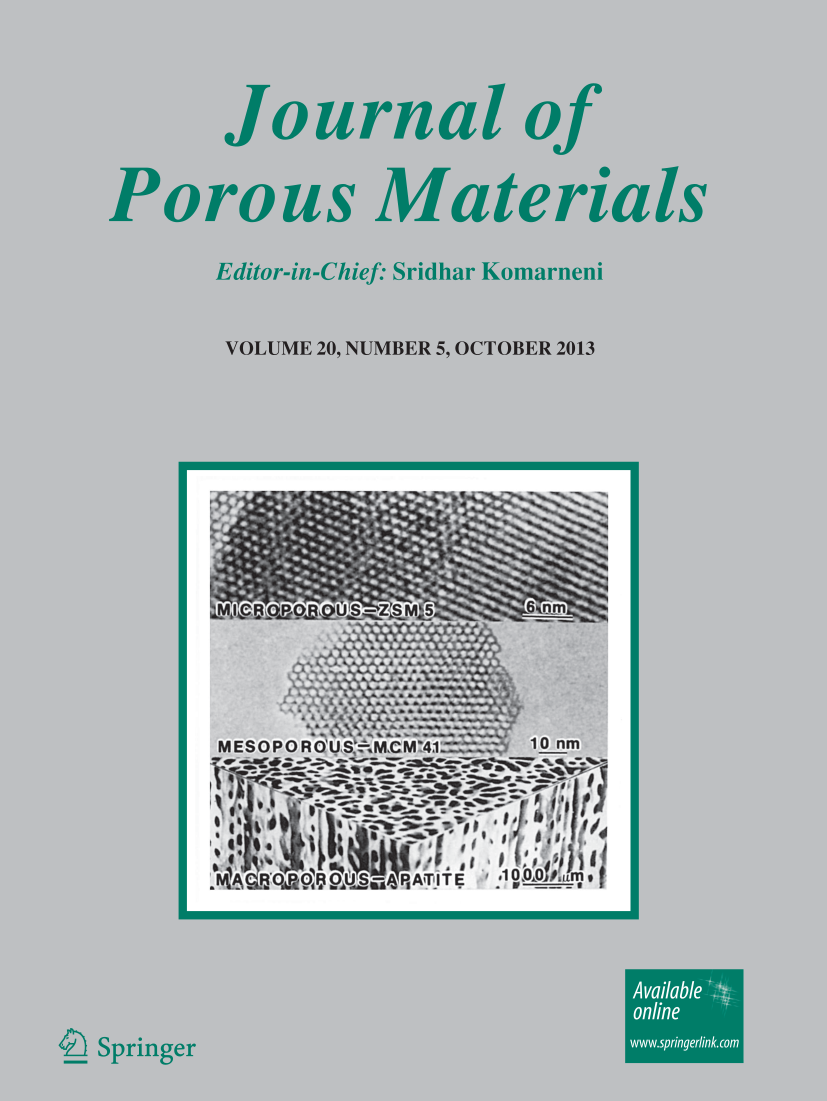
The Journal of Porous Materials is an interdisciplinary and international periodical devoted to all types of porous materials. Its aim is the rapid publication
of high quality, peer-reviewed papers focused on the synthesis, processing, characterization and property evaluation of all porous materials. The objective is to
establish a unique journal that will serve as a principal means of communication for the growing interdisciplinary field of porous materials.
Porous materials include microporous materials with 50 nm pores.
Examples of microporous materials are natural and synthetic molecular sieves, cationic and anionic clays, pillared clays, tobermorites, pillared Zr and Ti
phosphates, spherosilicates, carbons, porous polymers, xerogels, etc. Mesoporous materials include synthetic molecular sieves, xerogels, aerogels, glasses, glass
ceramics, porous polymers, etc.; while macroporous materials include ceramics, glass ceramics, porous polymers, aerogels, cement, etc. The porous materials
can be crystalline, semicrystalline or noncrystalline, or combinations thereof. They can also be either organic, inorganic, or their composites. The overall
objective of the journal is the establishment of one main forum covering the basic and applied aspects of all porous materials.

 求助内容:
 应助结果提醒方式:


 京公网安备 11010802042870号


