{"title":"Structural evolution and photocatalytic behaviour of CaO-Modified Ti-MCM-41 mesoporous materials","authors":"Fasna K., Jhelai Sahadevan, Muthuvel Inbasekaran, Vinoth G., Pramod K.M., Thirunarayanan G., Najeera P.C., Anila P.V., Sreenivasan Koliyat Parayil","doi":"10.1007/s10934-026-01954-7","DOIUrl":null,"url":null,"abstract":"<div><p>This work investigates the influence of CaO incorporation on the structural, textural, optical, surface chemical, and photocatalytic properties of mesoporous Ti-MCM-41. CaO derived from waste eggshells was incorporated into the Ti-MCM-41 framework through a sol-gel method. X-ray diffraction and Raman analyses reveal that increasing CaO loading induces a gradual phase transformation of TiO<sub>2</sub> from anatase to rutile, accompanied by the formation of crystalline CaO domains. Low-angle XRD and nitrogen adsorption–desorption analyses confirm that the ordered mesoporous structure is retained after modification, although the specific surface area decreases from 208.8 to 26.7 m<sup>2</sup> g<sup>− 1</sup> owing to partial pore filling and blockage by CaO species. HRTEM further confirms the preservation of the mesoporous framework together with the coexistence of crystalline CaO and TiO₂ phases. UV-Vis diffuse reflectance spectroscopy shows a gradual increase in the optical band gap from 3.04 to 3.39 eV, while photoluminescence analysis demonstrates progressive suppression of charge carrier recombination with increasing CaO loading. X-ray photoelectron spectroscopy confirms the successful incorporation of CaO and reveals modifications in the surface chemical states and electronic environment of the Ti-MCM-41 framework. Zeta potential measurements show that CaO modification shifts the surface charge towards more negative values, indicating enhanced colloidal stability and favourable electrostatic interactions with cationic dye molecules. The CaO-modified materials exhibit enhanced photocatalytic degradation of organic dyes under UV irradiation following pseudo-first-order kinetics. The improved photocatalytic performance is attributed to the synergistic effects of structural evolution, interfacial charge transport, increased surface basicity, and enhanced charge separation within the mesoporous framework.</p><h3>Graphical Abstract</h3><div><figure><div><div><picture><source><img></source></picture></div></div></figure></div></div>","PeriodicalId":660,"journal":{"name":"Journal of Porous Materials","volume":"33 5","pages":"1533 - 1563"},"PeriodicalIF":3.0000,"publicationDate":"2026-08-17","publicationTypes":"Journal Article","fieldsOfStudy":null,"isOpenAccess":false,"openAccessPdf":"","citationCount":"0","resultStr":null,"platform":"Semanticscholar","paperid":null,"PeriodicalName":"Journal of Porous Materials","FirstCategoryId":"88","ListUrlMain":"https://link.springer.com/article/10.1007/s10934-026-01954-7","RegionNum":4,"RegionCategory":"材料科学","ArticlePicture":[],"TitleCN":null,"AbstractTextCN":null,"PMCID":null,"EPubDate":"","PubModel":"","JCR":"Q2","JCRName":"CHEMISTRY, APPLIED","Score":null,"Total":0}
引用次数: 0
Abstract
This work investigates the influence of CaO incorporation on the structural, textural, optical, surface chemical, and photocatalytic properties of mesoporous Ti-MCM-41. CaO derived from waste eggshells was incorporated into the Ti-MCM-41 framework through a sol-gel method. X-ray diffraction and Raman analyses reveal that increasing CaO loading induces a gradual phase transformation of TiO2 from anatase to rutile, accompanied by the formation of crystalline CaO domains. Low-angle XRD and nitrogen adsorption–desorption analyses confirm that the ordered mesoporous structure is retained after modification, although the specific surface area decreases from 208.8 to 26.7 m2 g− 1 owing to partial pore filling and blockage by CaO species. HRTEM further confirms the preservation of the mesoporous framework together with the coexistence of crystalline CaO and TiO₂ phases. UV-Vis diffuse reflectance spectroscopy shows a gradual increase in the optical band gap from 3.04 to 3.39 eV, while photoluminescence analysis demonstrates progressive suppression of charge carrier recombination with increasing CaO loading. X-ray photoelectron spectroscopy confirms the successful incorporation of CaO and reveals modifications in the surface chemical states and electronic environment of the Ti-MCM-41 framework. Zeta potential measurements show that CaO modification shifts the surface charge towards more negative values, indicating enhanced colloidal stability and favourable electrostatic interactions with cationic dye molecules. The CaO-modified materials exhibit enhanced photocatalytic degradation of organic dyes under UV irradiation following pseudo-first-order kinetics. The improved photocatalytic performance is attributed to the synergistic effects of structural evolution, interfacial charge transport, increased surface basicity, and enhanced charge separation within the mesoporous framework.
期刊介绍:
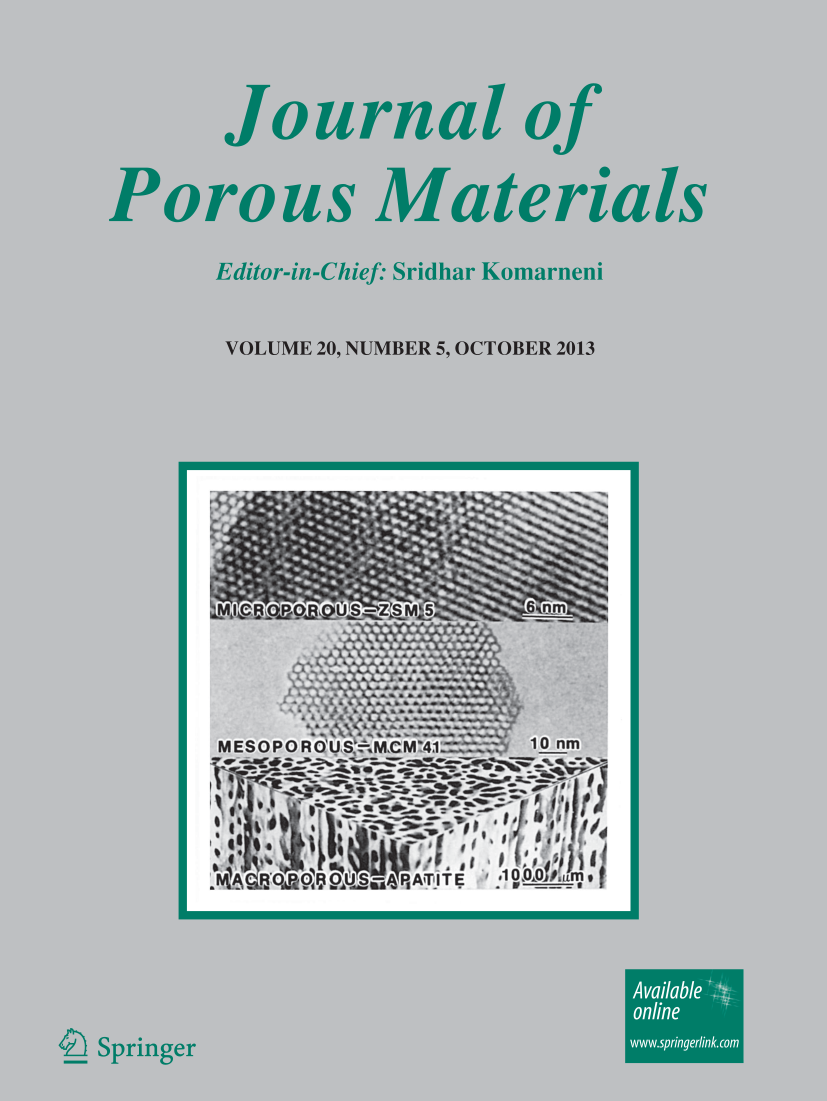
The Journal of Porous Materials is an interdisciplinary and international periodical devoted to all types of porous materials. Its aim is the rapid publication
of high quality, peer-reviewed papers focused on the synthesis, processing, characterization and property evaluation of all porous materials. The objective is to
establish a unique journal that will serve as a principal means of communication for the growing interdisciplinary field of porous materials.
Porous materials include microporous materials with 50 nm pores.
Examples of microporous materials are natural and synthetic molecular sieves, cationic and anionic clays, pillared clays, tobermorites, pillared Zr and Ti
phosphates, spherosilicates, carbons, porous polymers, xerogels, etc. Mesoporous materials include synthetic molecular sieves, xerogels, aerogels, glasses, glass
ceramics, porous polymers, etc.; while macroporous materials include ceramics, glass ceramics, porous polymers, aerogels, cement, etc. The porous materials
can be crystalline, semicrystalline or noncrystalline, or combinations thereof. They can also be either organic, inorganic, or their composites. The overall
objective of the journal is the establishment of one main forum covering the basic and applied aspects of all porous materials.

 求助内容:
 应助结果提醒方式:


 京公网安备 11010802042870号


