Ming Wen, Juan Yao, Lanmeng Wei, Caixia Fan, Shuaiyang Gao, Xiangfu Gu, Pihui Yang, Anzhong Peng, Haifeng Li
{"title":"High-performance MnFe2O4@ZIF-8 magnetic composite and its effectiveness in doxycycline removal","authors":"Ming Wen, Juan Yao, Lanmeng Wei, Caixia Fan, Shuaiyang Gao, Xiangfu Gu, Pihui Yang, Anzhong Peng, Haifeng Li","doi":"10.1007/s10934-026-01959-2","DOIUrl":null,"url":null,"abstract":"<div><p>A high-performance MnFe<sub>2</sub>O<sub>4</sub>@ZIF-8 magnetic composite was successfully designed and synthesized, and its adsorption behavior toward doxycycline (DOX) was systematically investigated. Structural characterization by X-ray diffraction (XRD) and Fourier-transform infrared spectroscopy (FT-IR) confirmed the effective incorporation of MnFe<sub>2</sub>O<sub>4</sub> nanoparticles into the ZIF-8 framework, while magnetic hysteresis measurements demonstrated favorable magnetic responsiveness, enabling rapid separation under an external magnetic field. Adsorption equilibrium data were well described by the Langmuir isotherm model, which yielded a model-derived maximum monolayer adsorption capacity (q<sub>m</sub>) of 3235.5 mg/g at 25 °C. Kinetic, thermodynamic, and adsorption behavior analyses indicated that the adsorption process was spontaneous and endothermic. Based on the combined results of FT-IR spectroscopy, zeta potential analysis, pH-dependent adsorption experiments, and adsorption studies, the adsorption of DOX onto MnFe<sub>2</sub>O<sub>4</sub>@ZIF-8 is proposed to involve multiple cooperative interactions, including electrostatic attraction, hydrogen bonding, π–π interactions, possible metal–DOX coordination, and pore-filling/spatial confinement effects. In addition, the composite maintained good adsorption performance after four consecutive adsorption–desorption cycles, demonstrating promising recyclability. The results suggest that MnFe<sub>2</sub>O<sub>4</sub>@ZIF-8 is a promising magnetic adsorbent for the removal of antibiotic contaminants from aqueous environments and provide useful insights for the design of multifunctional MOF-based adsorbents for water treatment applications.</p></div>","PeriodicalId":660,"journal":{"name":"Journal of Porous Materials","volume":"33 5","pages":"1589 - 1602"},"PeriodicalIF":3.0000,"publicationDate":"2026-08-29","publicationTypes":"Journal Article","fieldsOfStudy":null,"isOpenAccess":false,"openAccessPdf":"","citationCount":"0","resultStr":null,"platform":"Semanticscholar","paperid":null,"PeriodicalName":"Journal of Porous Materials","FirstCategoryId":"88","ListUrlMain":"https://link.springer.com/article/10.1007/s10934-026-01959-2","RegionNum":4,"RegionCategory":"材料科学","ArticlePicture":[],"TitleCN":null,"AbstractTextCN":null,"PMCID":null,"EPubDate":"","PubModel":"","JCR":"Q2","JCRName":"CHEMISTRY, APPLIED","Score":null,"Total":0}
引用次数: 0
Abstract
A high-performance MnFe2O4@ZIF-8 magnetic composite was successfully designed and synthesized, and its adsorption behavior toward doxycycline (DOX) was systematically investigated. Structural characterization by X-ray diffraction (XRD) and Fourier-transform infrared spectroscopy (FT-IR) confirmed the effective incorporation of MnFe2O4 nanoparticles into the ZIF-8 framework, while magnetic hysteresis measurements demonstrated favorable magnetic responsiveness, enabling rapid separation under an external magnetic field. Adsorption equilibrium data were well described by the Langmuir isotherm model, which yielded a model-derived maximum monolayer adsorption capacity (qm) of 3235.5 mg/g at 25 °C. Kinetic, thermodynamic, and adsorption behavior analyses indicated that the adsorption process was spontaneous and endothermic. Based on the combined results of FT-IR spectroscopy, zeta potential analysis, pH-dependent adsorption experiments, and adsorption studies, the adsorption of DOX onto MnFe2O4@ZIF-8 is proposed to involve multiple cooperative interactions, including electrostatic attraction, hydrogen bonding, π–π interactions, possible metal–DOX coordination, and pore-filling/spatial confinement effects. In addition, the composite maintained good adsorption performance after four consecutive adsorption–desorption cycles, demonstrating promising recyclability. The results suggest that MnFe2O4@ZIF-8 is a promising magnetic adsorbent for the removal of antibiotic contaminants from aqueous environments and provide useful insights for the design of multifunctional MOF-based adsorbents for water treatment applications.
期刊介绍:
The Journal of Porous Materials is an interdisciplinary and international periodical devoted to all types of porous materials. Its aim is the rapid publication
of high quality, peer-reviewed papers focused on the synthesis, processing, characterization and property evaluation of all porous materials. The objective is to
establish a unique journal that will serve as a principal means of communication for the growing interdisciplinary field of porous materials.
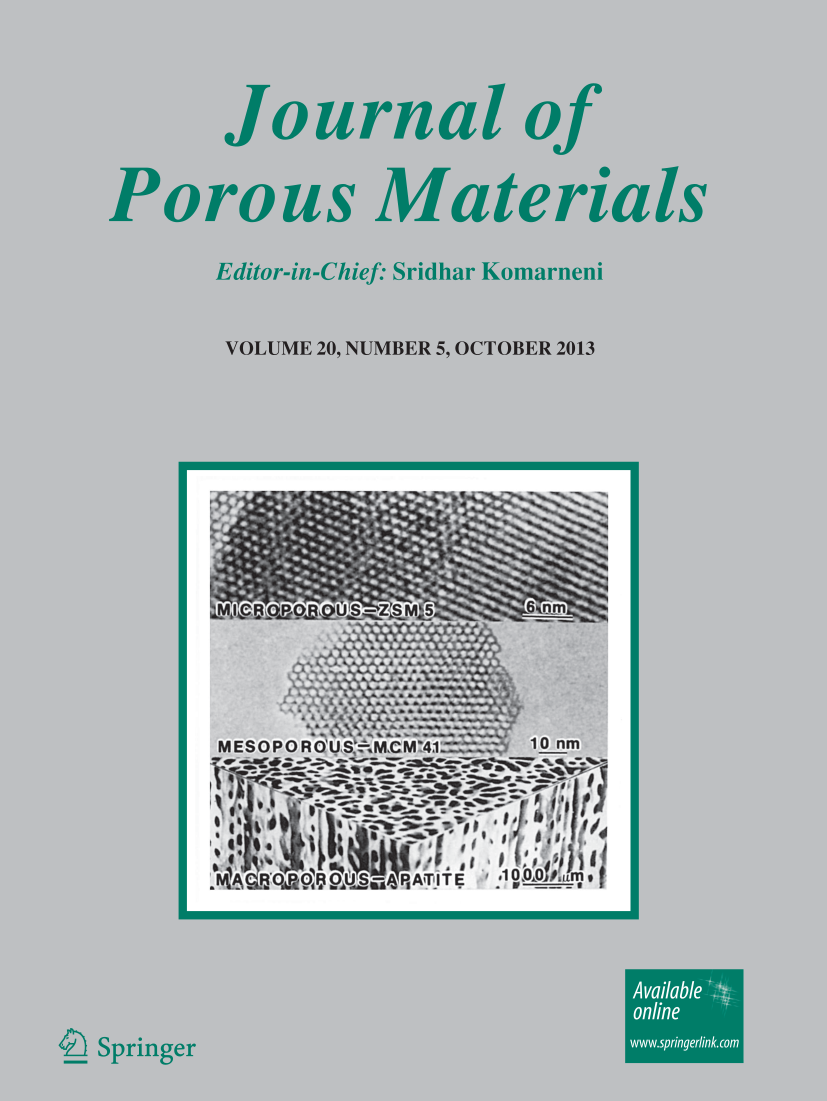
Porous materials include microporous materials with 50 nm pores.
Examples of microporous materials are natural and synthetic molecular sieves, cationic and anionic clays, pillared clays, tobermorites, pillared Zr and Ti
phosphates, spherosilicates, carbons, porous polymers, xerogels, etc. Mesoporous materials include synthetic molecular sieves, xerogels, aerogels, glasses, glass
ceramics, porous polymers, etc.; while macroporous materials include ceramics, glass ceramics, porous polymers, aerogels, cement, etc. The porous materials
can be crystalline, semicrystalline or noncrystalline, or combinations thereof. They can also be either organic, inorganic, or their composites. The overall
objective of the journal is the establishment of one main forum covering the basic and applied aspects of all porous materials.

 求助内容:
 应助结果提醒方式:


 京公网安备 11010802042870号


