
Non-interfering dual-mode luminescence with persistent emission under UV excitation and upconversion thermometry under NIR excitation in Ca3Ga4O9: Pr3+, Er3+, Zn2+
IF 5.2
3区 材料科学
Q1 CHEMISTRY, MULTIDISCIPLINARY
引用次数: 0
Abstract
The excitation-dependent trapping/detrapping kinetics inherent to persistent luminescence (PersL) materials give rise to non‑unique thermometric spectral responses, rendering PersL and fluorescence thermometry intrinsically incompatible and thereby impeding the development of multifunctional luminescent materials. To overcome this challenge, a multifunctional phosphor, Ca3Ga4O9:Pr3+,Er3+,Zn2+, was developed based on a function-decoupling strategy enabled by distinct excitation modes, successfully integrating PersL with upconversion fluorescence thermometry. Under 254 nm UV excitation, the phosphor exhibits blue-green PersL arising from the combined emission of Pr3+ and Er3+, and Zn2+ co-doping increases the total relative trap density by approximately 13 times, resulting in a pronounced enhancement of the PersL intensity. While under 980 nm excitation, the Er3+ upconversion luminescence enables temperature sensing via the fluorescence intensity ratio (FIR) of the thermally coupled 2H11/2/4S3/2 levels, with a maximum relative sensitivity Sr of 1.64% K-1 at 253 K. The independent excitation pathways for PersL and temperature sensing avoid the signal interference under the designated operating conditions. The phosphor integrates UV excitation wavelength-dependent color tunability, PersL, and NIR-excited temperature-sensitive optical thermometry. This multifunctional feature offers a novel strategy for combining multiple optical functionalities within a single luminescent system and may provide a basis for future exploration in optical identification and temperature sensingCa3Ga4O9: Pr3+, Er3+, Zn2+在紫外激发下具有持续发射的无干扰双模发光和近红外激发下的上转换测温
持续发光(PersL)材料固有的依赖于激发的捕获/去捕获动力学会产生非唯一的测温光谱响应,使PersL和荧光测温本质上不相容,从而阻碍了多功能发光材料的发展。为了克服这一挑战,基于不同激发模式的功能解耦策略,开发了一种多功能荧光粉Ca3Ga4O9:Pr3+,Er3+,Zn2+,成功地将PersL与上转换荧光测温相结合。在254 nm紫外光激发下,由于Pr3+和Er3+的联合发射,荧光粉呈现蓝绿色的PersL, Zn2+共掺杂使总相对阱密度增加了约13倍,导致PersL强度显著增强。而在980 nm激发下,Er3+上转换发光通过热耦合2H11/2/4S3/2能级的荧光强度比(FIR)实现温度传感,在253 K时的最大相对灵敏度Sr为1.64% K-1。PersL和温度传感的独立激励路径避免了在指定工作条件下的信号干扰。该荧光粉集成了UV激发波长依赖的颜色可调性,PersL和nir激发的温度敏感光学测温。这种多功能特性为在单一发光系统中结合多种光学功能提供了一种新的策略,为未来在光学识别和温度传感方面的探索提供了基础
本文章由计算机程序翻译,如有差异,请以英文原文为准。
求助全文
约1分钟内获得全文
求助全文
来源期刊
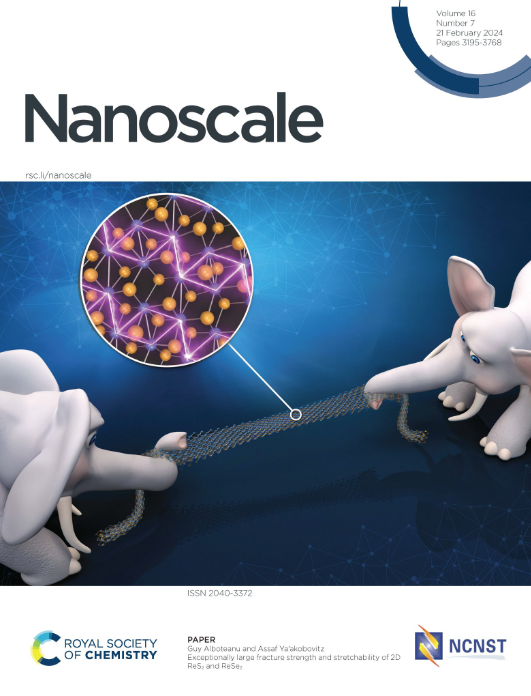
Nanoscale
CHEMISTRY, MULTIDISCIPLINARY-NANOSCIENCE & NANOTECHNOLOGY
CiteScore
12.10
自引率
3.00%
发文量
1628
审稿时长
1.6 months
期刊介绍:
Nanoscale is a high-impact international journal, publishing high-quality research across nanoscience and nanotechnology. Nanoscale publishes a full mix of research articles on experimental and theoretical work, including reviews, communications, and full papers.Highly interdisciplinary, this journal appeals to scientists, researchers and professionals interested in nanoscience and nanotechnology, quantum materials and quantum technology, including the areas of physics, chemistry, biology, medicine, materials, energy/environment, information technology, detection science, healthcare and drug discovery, and electronics.
 求助内容:
 应助结果提醒方式:


 京公网安备 11010802042870号


