
On the Nature of the Mn-O Bond in Trigonal Bipyramidal High-Valent Manganese Complexes

IF 3.3 3区 化学 Q2 CHEMISTRY, INORGANIC & NUCLEAR
Tânia Patrícia Almeida Sousa,Satadal Paul,Frank Neese,Dimitrios Pantazis
{"title":"On the Nature of the Mn-O Bond in Trigonal Bipyramidal High-Valent Manganese Complexes","authors":"Tânia Patrícia Almeida Sousa,Satadal Paul,Frank Neese,Dimitrios Pantazis","doi":"10.1039/d6dt01708h","DOIUrl":null,"url":null,"abstract":"Water oxidation in natural photosynthesis is performed by the oxygen-evolving complex (OEC), an oxo-bridged Mn 4 CaO 5 cluster embedded in the photosystem II protein complex. The precise chemical identity of its catalytically active forms, and thus the mechanistic details of water oxidation, remain under investigation. A key question concerns the nature of the active species that initiates O-O bond formation, specifically its metal-oxo or oxyl character, which would in turn dictate the type of reactivity. This depends on the electronic structure and local coordination characteristics of the implicated Mn ions. Synthetic models are crucial for shedding light into such correlations. Here we focus on a series of five-coordinate Mn compounds with a terminal Mn-O group. They exist in a sequence of oxidation states, allowing us to probe changes in the nature of the terminal Mn-O group upon increasing the total oxidation level. Multireference calculations are used to distinguish between oxo and oxyl formulations and to describe the latter by analyzing specific electronic configurations. The results demonstrate that Mn sites of this type are unlikely to participate in radical-based chemistry. If five-coordinate Mn centers with terminal oxo groups are involved in O-O bond formation, they would instead be implicated in a nucleophilic attack (or acid-base) mechanism. By contrast, oxyl states are readily accessible in the case of six-coordinate high-valent Mn sites, in line with previously proposed oxo-oxyl coupling models for the OEC.","PeriodicalId":71,"journal":{"name":"Dalton Transactions","volume":"32 5 1","pages":""},"PeriodicalIF":3.3000,"publicationDate":"2026-10-15","publicationTypes":"Journal Article","fieldsOfStudy":null,"isOpenAccess":false,"openAccessPdf":"","citationCount":"0","resultStr":null,"platform":"Semanticscholar","paperid":null,"PeriodicalName":"Dalton Transactions","FirstCategoryId":"92","ListUrlMain":"https://doi.org/10.1039/d6dt01708h","RegionNum":3,"RegionCategory":"化学","ArticlePicture":[],"TitleCN":null,"AbstractTextCN":null,"PMCID":null,"EPubDate":"","PubModel":"","JCR":"Q2","JCRName":"CHEMISTRY, INORGANIC & NUCLEAR","Score":null,"Total":0}
引用次数: 0

Abstract

Water oxidation in natural photosynthesis is performed by the oxygen-evolving complex (OEC), an oxo-bridged Mn 4 CaO 5 cluster embedded in the photosystem II protein complex. The precise chemical identity of its catalytically active forms, and thus the mechanistic details of water oxidation, remain under investigation. A key question concerns the nature of the active species that initiates O-O bond formation, specifically its metal-oxo or oxyl character, which would in turn dictate the type of reactivity. This depends on the electronic structure and local coordination characteristics of the implicated Mn ions. Synthetic models are crucial for shedding light into such correlations. Here we focus on a series of five-coordinate Mn compounds with a terminal Mn-O group. They exist in a sequence of oxidation states, allowing us to probe changes in the nature of the terminal Mn-O group upon increasing the total oxidation level. Multireference calculations are used to distinguish between oxo and oxyl formulations and to describe the latter by analyzing specific electronic configurations. The results demonstrate that Mn sites of this type are unlikely to participate in radical-based chemistry. If five-coordinate Mn centers with terminal oxo groups are involved in O-O bond formation, they would instead be implicated in a nucleophilic attack (or acid-base) mechanism. By contrast, oxyl states are readily accessible in the case of six-coordinate high-valent Mn sites, in line with previously proposed oxo-oxyl coupling models for the OEC.
三角双锥体高价锰配合物中Mn-O键性质的研究
自然光合作用中的水氧化是由进化氧络合物(OEC)完成的,OEC是一个氧桥接的Mn 4 CaO 5簇嵌入光系统II蛋白络合物中。其催化活性形式的确切化学特性,以及水氧化的机理细节,仍在研究中。一个关键问题涉及到引发O-O键形成的活性物质的性质,特别是它的金属-氧或氧基特征,这反过来又决定了反应性的类型。这取决于所涉及的锰离子的电子结构和局部配位特性。综合模型对于揭示这种相关性至关重要。本文主要研究了一系列末端有Mn- o基团的五坐标Mn化合物。它们以一系列的氧化态存在,使我们能够探测到随着总氧化水平的增加,末端Mn-O基团性质的变化。多参考计算用于区分氧和氧的配方,并通过分析具体的电子构型来描述后者。结果表明,这种类型的Mn位点不太可能参与自由基化学。如果末端带有氧基的五坐标Mn中心参与O-O键的形成,它们将参与亲核攻击(或酸碱)机制。相比之下,在六坐标的高价Mn位点中,氧态很容易获得,这与先前提出的OEC的氧-氧偶联模型一致。
本文章由计算机程序翻译,如有差异,请以英文原文为准。
求助全文
约1分钟内获得全文 求助全文
来源期刊
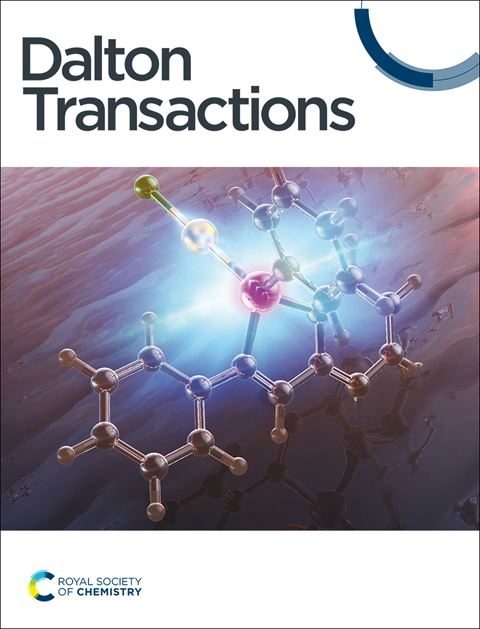
Dalton Transactions
Dalton Transactions 化学-无机化学与核化学
CiteScore
6.60
自引率
7.50%
发文量
1832
审稿时长
1.5 months
期刊介绍: Dalton Transactions is a journal for all areas of inorganic chemistry, which encompasses the organometallic, bioinorganic and materials chemistry of the elements, with applications including synthesis, catalysis, energy conversion/storage, electrical devices and medicine. Dalton Transactions welcomes high-quality, original submissions in all of these areas and more, where the advancement of knowledge in inorganic chemistry is significant.

×
引用
GB/T 7714-2015
复制
MLA
复制
APA
复制
导出至
BibTeX EndNote RefMan NoteFirst NoteExpress
×
提示
您的信息不完整,为了账户安全,请先补充。
现在去补充
×
提示
您因"违规操作"
具体请查看互助需知
我知道了
×
提示
确定
请完成安全验证×
copy
已复制链接
快去分享给好友吧!
我知道了
右上角分享
点击右上角分享
0
联系我们:info@booksci.cn Book学术提供免费学术资源搜索服务,方便国内外学者检索中英文文献。致力于提供最便捷和优质的服务体验。 Copyright © 2023 布克学术 All rights reserved.
京ICP备2023020795号-1
ghs 京公网安备 11010802042870号
Book学术文献互助
Book学术文献互助群
群 号:604180095
Book学术官方微信
小红书


