Ni Zeng, Zhihong Zhang, Fan Yang, Jisheng Song, Bin Shan, Rong Chen
{"title":"Au Nanoparticles Encapsulated in Metal−Organic Framework for Enhanced Carbon Dioxide Reduction","authors":"Ni Zeng, Zhihong Zhang, Fan Yang, Jisheng Song, Bin Shan, Rong Chen","doi":"10.1021/acsanm.6c04147","DOIUrl":null,"url":null,"abstract":"<p>The direct deployment of metal−organic framework (MOF) as an electrocatalyst for CO<sub>2</sub> reduction is often hampered by their intrinsically poor conductivity, the adsorption−desorption trade-off in intermediate binding energetics, and limited formation of multi-carbon products. To address these challenges, gold nanoparticles (Au NPs) were encapsulated within reconstructed nanowire-like structures derived from a copper-based 1,4-benzenedicarboxylate framework (CuBDC) via an in situ reduction strategy, forming an Au/CuBDC-4 composite. Despite the resulting structural disordering and partial copper loss, the optimized catalyst achieved a notable Faradaic efficiency of 60% for ethylene (C<sub>2</sub>H<sub>4</sub>) and 73% for C<sub>2+</sub> at −0.8 V vs RHE, along with a significantly suppressed hydrogen evolution reaction (HER). Electrochemical analyses reveal increased <em>C</em><sub>dl</sub> and reduced charge-transfer resistance and a lower Tafel slope, indicating improved interfacial accessibility and charge-transfer kinetics. In situ Raman spectroscopy identifies potential-dependent vibrational bands associated with metal−CO-related and CO-derived surface species, suggesting the formation of reaction-induced intermediates under CO<sub>2</sub>RR conditions. When combined with density functional theory (DFT) calculations, the cooperative roles of Au and Cu sites at the Au/CuBDC-<em>n</em> interface are further supported. Au sites may facilitate *CO formation and increase local *CO availability adjacent to Cu sites, while the same Cu sites provide favorable sites for C−C coupling with a lower calculated free-energy requirement. The resulting interfacial cooperation, together with increased catalytic-interface accessibility, facilitated interfacial charge transport and more efficient utilization of Cu sites, thereby promoting C<sub>2</sub>H<sub>4</sub> formation. This work offers insights into the rational design of MOF-based synergistic catalysts with high selectivity and low overpotential for efficient CO<sub>2</sub> valorization.</p>","PeriodicalId":6,"journal":{"name":"ACS Applied Nano Materials","volume":"9 40","pages":"19090–19100"},"PeriodicalIF":5.8000,"publicationDate":"2026-10-09","publicationTypes":"Journal Article","fieldsOfStudy":null,"isOpenAccess":false,"openAccessPdf":"","citationCount":"0","resultStr":null,"platform":"Semanticscholar","paperid":null,"PeriodicalName":"ACS Applied Nano Materials","FirstCategoryId":"88","ListUrlMain":"https://pubs.acs.org/doi/10.1021/acsanm.6c04147","RegionNum":2,"RegionCategory":"材料科学","ArticlePicture":[],"TitleCN":null,"AbstractTextCN":null,"PMCID":null,"EPubDate":"2026/9/30 0:00:00","PubModel":"Epub","JCR":"Q2","JCRName":"MATERIALS SCIENCE, MULTIDISCIPLINARY","Score":null,"Total":0}
引用次数: 0
Abstract
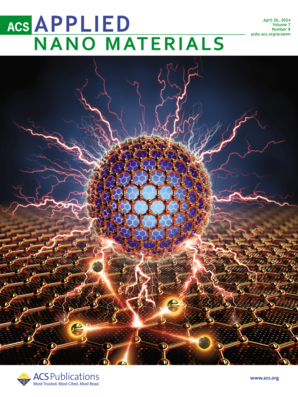
The direct deployment of metal−organic framework (MOF) as an electrocatalyst for CO2 reduction is often hampered by their intrinsically poor conductivity, the adsorption−desorption trade-off in intermediate binding energetics, and limited formation of multi-carbon products. To address these challenges, gold nanoparticles (Au NPs) were encapsulated within reconstructed nanowire-like structures derived from a copper-based 1,4-benzenedicarboxylate framework (CuBDC) via an in situ reduction strategy, forming an Au/CuBDC-4 composite. Despite the resulting structural disordering and partial copper loss, the optimized catalyst achieved a notable Faradaic efficiency of 60% for ethylene (C2H4) and 73% for C2+ at −0.8 V vs RHE, along with a significantly suppressed hydrogen evolution reaction (HER). Electrochemical analyses reveal increased Cdl and reduced charge-transfer resistance and a lower Tafel slope, indicating improved interfacial accessibility and charge-transfer kinetics. In situ Raman spectroscopy identifies potential-dependent vibrational bands associated with metal−CO-related and CO-derived surface species, suggesting the formation of reaction-induced intermediates under CO2RR conditions. When combined with density functional theory (DFT) calculations, the cooperative roles of Au and Cu sites at the Au/CuBDC-n interface are further supported. Au sites may facilitate *CO formation and increase local *CO availability adjacent to Cu sites, while the same Cu sites provide favorable sites for C−C coupling with a lower calculated free-energy requirement. The resulting interfacial cooperation, together with increased catalytic-interface accessibility, facilitated interfacial charge transport and more efficient utilization of Cu sites, thereby promoting C2H4 formation. This work offers insights into the rational design of MOF-based synergistic catalysts with high selectivity and low overpotential for efficient CO2 valorization.
期刊介绍:
ACS Applied Nano Materials is an interdisciplinary journal publishing original research covering all aspects of engineering, chemistry, physics and biology relevant to applications of nanomaterials. The journal is devoted to reports of new and original experimental and theoretical research of an applied nature that integrate knowledge in the areas of materials, engineering, physics, bioscience, and chemistry into important applications of nanomaterials.

 求助内容:
 应助结果提醒方式:


 京公网安备 11010802042870号


