
Population-Balance Modeling of Oligomer Evolution and Reactor-Configuration Effects in Poly(ethylene terephthalate) Glycolysis

IF 3.9 3区 工程技术 Q2 ENGINEERING, CHEMICAL
Shu-Qi Zhang,Xiao-Sa Liu,Fan Ju,Jing-Yi Yang,Zi-Bin Huang,Pei-Qing Yuan
{"title":"Population-Balance Modeling of Oligomer Evolution and Reactor-Configuration Effects in Poly(ethylene terephthalate) Glycolysis","authors":"Shu-Qi Zhang,Xiao-Sa Liu,Fan Ju,Jing-Yi Yang,Zi-Bin Huang,Pei-Qing Yuan","doi":"10.1021/acs.iecr.6c02834","DOIUrl":null,"url":null,"abstract":"In zinc acetate-catalyzed poly(ethylene terephthalate) (PET) glycolysis in ethylene glycol, PET conversion and bis(2-hydroxyethyl) terephthalate (BHET) yield cannot resolve the oligomer distributions governing separation and reactor staging. We develop a repeat-unit-conserving population balance model resolving degree of polymerization (DP) for this reaction. It couples heterogeneous solid scission and interfacial fragment release with liquid-phase internal scission, terminal BHET formation, and reverse condensation in a shrinking-core accessibility framework. Calibrated at 140–180 °C, it reproduces conversion and BHET yield with RMSEs of 0.066 and 0.061, and semiquantitative chromatographic trends at 180 °C support the predicted shift toward dimers. At 220 °C and equal volume, replacing one stirred tank with plug flow raises BHET yield from 74.5% to 82.2% while reducing DP > 4 residues by 99.81%; two tanks capture 65.7% of this gain and a two-tank–plug-flow hybrid 96.6%. The framework links chain-length evolution to reactor screening against yield and residue specifications.","PeriodicalId":39,"journal":{"name":"Industrial & Engineering Chemistry Research","volume":"29 1","pages":""},"PeriodicalIF":3.9000,"publicationDate":"2026-10-11","publicationTypes":"Journal Article","fieldsOfStudy":null,"isOpenAccess":false,"openAccessPdf":"","citationCount":"0","resultStr":null,"platform":"Semanticscholar","paperid":null,"PeriodicalName":"Industrial & Engineering Chemistry Research","FirstCategoryId":"5","ListUrlMain":"https://doi.org/10.1021/acs.iecr.6c02834","RegionNum":3,"RegionCategory":"工程技术","ArticlePicture":[],"TitleCN":null,"AbstractTextCN":null,"PMCID":null,"EPubDate":"","PubModel":"","JCR":"Q2","JCRName":"ENGINEERING, CHEMICAL","Score":null,"Total":0}
引用次数: 0

Abstract

In zinc acetate-catalyzed poly(ethylene terephthalate) (PET) glycolysis in ethylene glycol, PET conversion and bis(2-hydroxyethyl) terephthalate (BHET) yield cannot resolve the oligomer distributions governing separation and reactor staging. We develop a repeat-unit-conserving population balance model resolving degree of polymerization (DP) for this reaction. It couples heterogeneous solid scission and interfacial fragment release with liquid-phase internal scission, terminal BHET formation, and reverse condensation in a shrinking-core accessibility framework. Calibrated at 140–180 °C, it reproduces conversion and BHET yield with RMSEs of 0.066 and 0.061, and semiquantitative chromatographic trends at 180 °C support the predicted shift toward dimers. At 220 °C and equal volume, replacing one stirred tank with plug flow raises BHET yield from 74.5% to 82.2% while reducing DP > 4 residues by 99.81%; two tanks capture 65.7% of this gain and a two-tank–plug-flow hybrid 96.6%. The framework links chain-length evolution to reactor screening against yield and residue specifications.

Abstract Image

聚对苯二甲酸乙酯糖酵解中低聚物进化和反应器构型效应的种群平衡模型
在醋酸锌催化的聚对苯二甲酸乙酯(PET)在乙二醇中的糖酵解过程中,PET的转化和双(2-羟乙基)对苯二甲酸乙酯(BHET)的产率不能解决控制分离和反应器分级的低聚物分布。我们开发了一个重复保存单元的种群平衡模型来解决该反应的聚合度(DP)。在收缩岩心可及性框架中,将非均相固体分裂和界面碎片释放与液相内部分裂、末端BHET形成和反冷凝耦合在一起。在140-180°C校准时,它再现了转化率和BHET产率,rmse分别为0.066和0.061,180°C的半定量色谱趋势支持预测的向二聚体的转变。在220℃、等体积条件下,用塞流代替一个搅拌槽,将BHET产率从74.5%提高到82.2%,DP bbb40残留量减少99.81%;两个储罐获得了65.7%的增益,两个储罐- plug-flow混合式获得了96.6%的增益。该框架将链长演变与反应器筛选与产率和残留物规范联系起来。
本文章由计算机程序翻译,如有差异,请以英文原文为准。
求助全文
约1分钟内获得全文 求助全文
来源期刊
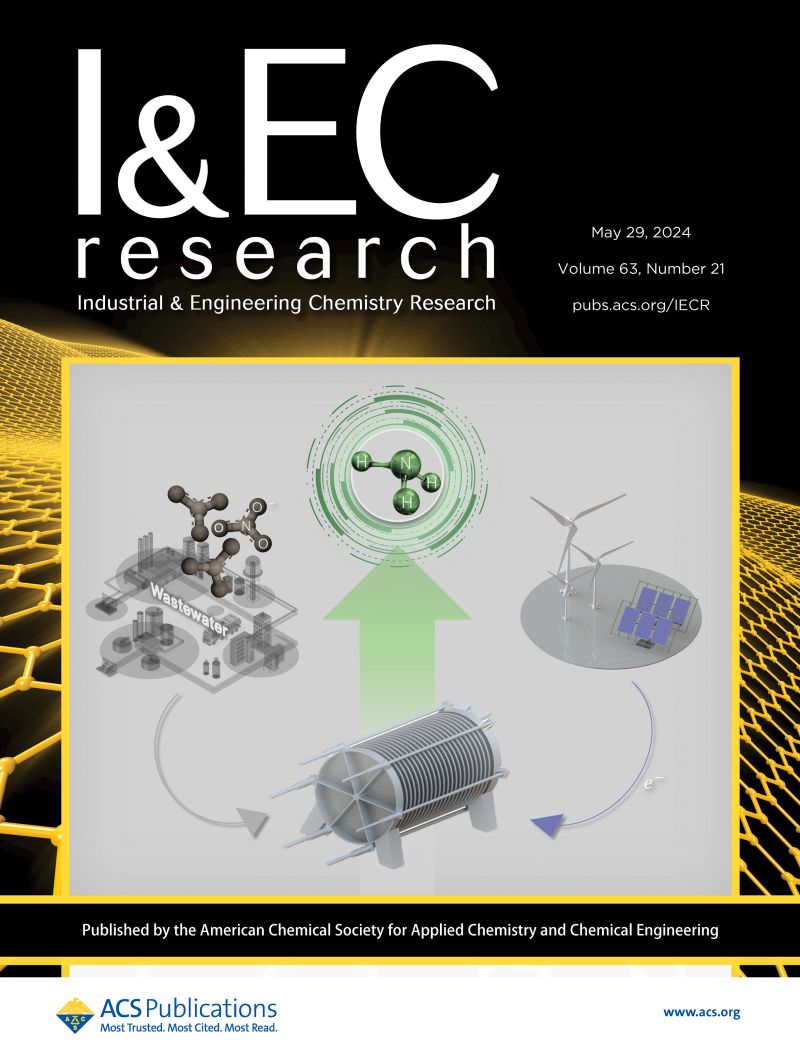
Industrial & Engineering Chemistry Research
Industrial & Engineering Chemistry Research 工程技术-工程:化工
CiteScore
7.40
自引率
7.10%
发文量
1467
审稿时长
2.8 months
期刊介绍: ndustrial & Engineering Chemistry, with variations in title and format, has been published since 1909 by the American Chemical Society. Industrial & Engineering Chemistry Research is a weekly publication that reports industrial and academic research in the broad fields of applied chemistry and chemical engineering with special focus on fundamentals, processes, and products.

×
引用
GB/T 7714-2015
复制
MLA
复制
APA
复制
导出至
BibTeX EndNote RefMan NoteFirst NoteExpress
×
提示
您的信息不完整,为了账户安全,请先补充。
现在去补充
×
提示
您因"违规操作"
具体请查看互助需知
我知道了
×
提示
确定
请完成安全验证×
copy
已复制链接
快去分享给好友吧!
我知道了
右上角分享
点击右上角分享
0
联系我们:info@booksci.cn Book学术提供免费学术资源搜索服务,方便国内外学者检索中英文文献。致力于提供最便捷和优质的服务体验。 Copyright © 2023 布克学术 All rights reserved.
京ICP备2023020795号-1
ghs 京公网安备 11010802042870号
Book学术文献互助
Book学术文献互助群
群 号:604180095
Book学术官方微信
小红书


