Dong Cheng, Yuansen Tan, Junjie Shu, Si Chen, Fan Wu, Jiaqing Luo, Hengli Ni, Liwei Yang, Bo Chen, Feng He
{"title":"Unveiling the Role of the Soil Matrix in Trichloroethylene Degradation by Ball-Milled Sulfidated Microscale Zero-Valent Iron","authors":"Dong Cheng, Yuansen Tan, Junjie Shu, Si Chen, Fan Wu, Jiaqing Luo, Hengli Ni, Liwei Yang, Bo Chen, Feng He","doi":"10.1021/acs.est.6c13776","DOIUrl":null,"url":null,"abstract":"<p>Ball-milled sulfidated microscale\r\nzerovalent iron (S-mZVI<sup>bm</sup>) is highly effective in degrading\r\ntrichloroethylene (TCE) in anoxic\r\nwater. This study investigated its performance and soil-mediated regulation\r\nin a soil-water mixed system (SWMS) using two natural soils. The results\r\nshow that soil addition markedly enhanced the reactivity of S-mZVI<sup>bm</sup>. Compared with the aqueous system, the degradation rate\r\nconstant of TCE (<em>k</em><sub>TCE</sub>) exhibited a 6.0–8.4-fold\r\nincrease at a soil-to-water ratio (S/W) of 0.5 to 2.0, while H<sub>2</sub> production concurrently increased 210%–450%. This\r\nactivation was accompanied by a decrease in apparent electron efficiency\r\nfrom 74.3% in water to 15.9%–27.6% in SWMS. S-mZVI<sup>bm</sup> retained higher reactivity in SWMS than in water across pH 6–10,\r\nwith a maximum <em>k</em><sub>TCE</sub> of 0.26 h<sup>–1</sup> at pH 8.0. SEM, XPS, and component-specific experiments indicated\r\nthat soil-mediated surface restructuring and Fe(II) redistribution-induced\r\ndepassivation increased the accessibility of Fe<sup>0</sup>-rich domains,\r\nwhereas organic matter and Ca/Mg-bearing phases imposed inhibitory\r\neffects. Sulfidation suppressed H<sub>2</sub> evolution and reduced\r\nsoil-specific variability under multicontaminant conditions involving\r\nTCE, carbon tetrachloride, nitrobenzene, and perchloroethylene. These\r\nresults identify soil as an active regulator of Fe<sup>0</sup> accessibility\r\nand electron allocation rather than a passive reaction medium, providing\r\na mechanistic basis for site-specific S-mZVI<sup>bm</sup> remediation.</p>","PeriodicalId":36,"journal":{"name":"环境科学与技术","volume":"60 41","pages":"29689–29699"},"PeriodicalIF":12.2000,"publicationDate":"2026-10-20","publicationTypes":"Journal Article","fieldsOfStudy":null,"isOpenAccess":false,"openAccessPdf":"","citationCount":"0","resultStr":null,"platform":"Semanticscholar","paperid":null,"PeriodicalName":"环境科学与技术","FirstCategoryId":"1","ListUrlMain":"https://pubs.acs.org/doi/10.1021/acs.est.6c13776","RegionNum":1,"RegionCategory":"环境科学与生态学","ArticlePicture":[],"TitleCN":null,"AbstractTextCN":null,"PMCID":null,"EPubDate":"2026/10/8 0:00:00","PubModel":"Epub","JCR":"Q1","JCRName":"ENGINEERING, ENVIRONMENTAL","Score":null,"Total":0}
引用次数: 0
Abstract
Ball-milled sulfidated microscale
zerovalent iron (S-mZVIbm) is highly effective in degrading
trichloroethylene (TCE) in anoxic
water. This study investigated its performance and soil-mediated regulation
in a soil-water mixed system (SWMS) using two natural soils. The results
show that soil addition markedly enhanced the reactivity of S-mZVIbm. Compared with the aqueous system, the degradation rate
constant of TCE (kTCE) exhibited a 6.0–8.4-fold
increase at a soil-to-water ratio (S/W) of 0.5 to 2.0, while H2 production concurrently increased 210%–450%. This
activation was accompanied by a decrease in apparent electron efficiency
from 74.3% in water to 15.9%–27.6% in SWMS. S-mZVIbm retained higher reactivity in SWMS than in water across pH 6–10,
with a maximum kTCE of 0.26 h–1 at pH 8.0. SEM, XPS, and component-specific experiments indicated
that soil-mediated surface restructuring and Fe(II) redistribution-induced
depassivation increased the accessibility of Fe0-rich domains,
whereas organic matter and Ca/Mg-bearing phases imposed inhibitory
effects. Sulfidation suppressed H2 evolution and reduced
soil-specific variability under multicontaminant conditions involving
TCE, carbon tetrachloride, nitrobenzene, and perchloroethylene. These
results identify soil as an active regulator of Fe0 accessibility
and electron allocation rather than a passive reaction medium, providing
a mechanistic basis for site-specific S-mZVIbm remediation.
期刊介绍:
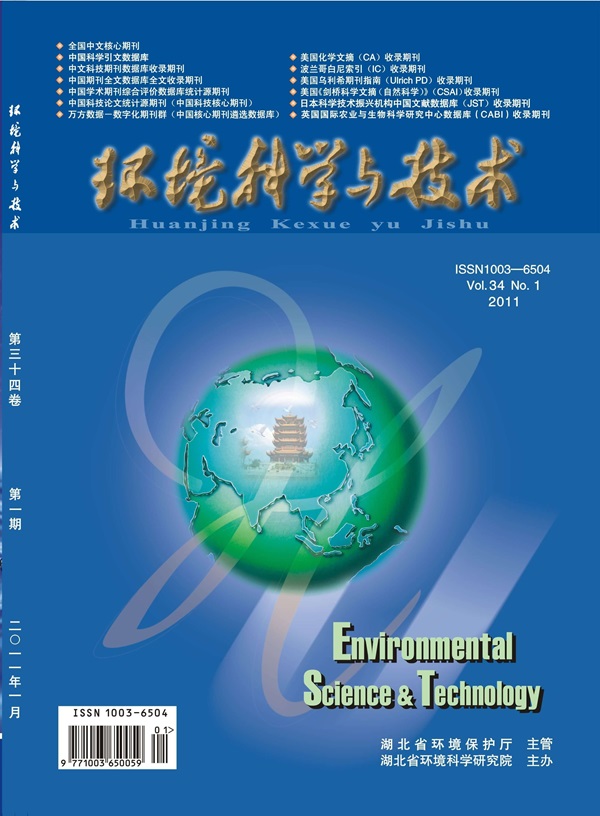
Environmental Science & Technology (ES&T) is a co-sponsored academic and technical magazine by the Hubei Provincial Environmental Protection Bureau and the Hubei Provincial Academy of Environmental Sciences.
Environmental Science & Technology (ES&T) holds the status of Chinese core journals, scientific papers source journals of China, Chinese Science Citation Database source journals, and Chinese Academic Journal Comprehensive Evaluation Database source journals. This publication focuses on the academic field of environmental protection, featuring articles related to environmental protection and technical advancements.

 求助内容:
 应助结果提醒方式:


 京公网安备 11010802042870号


