
Ultrafast Dynamics of Competing Dimethyl Disulfide Photodissociation Pathways

IF 4.5 2区 化学 Q2 CHEMISTRY, PHYSICAL
Neil C. Cole-Filipiak,Varun Rishi,Jack Dalton,Jan Troß,Christopher J. Kliewer,Andrew R. Attar,Matthias C. Hoffmann,Fuhao Ji,Ming-Fu Lin,Yusong Liu,Duan Luo,Joao Pedro Figueira Nunes,Alexander H. Reid,Xiaozhe Shen,Xijie Wang,Thomas Wolf,Jie Yang,Susana Herrera,Vasilios G. Stavros,Laura M. McCaslin,Krupa Ramasesha
{"title":"Ultrafast Dynamics\nof Competing Dimethyl Disulfide\nPhotodissociation Pathways","authors":"Neil C. Cole-Filipiak,Varun Rishi,Jack Dalton,Jan Troß,Christopher J. Kliewer,Andrew R. Attar,Matthias C. Hoffmann,Fuhao Ji,Ming-Fu Lin,Yusong Liu,Duan Luo,Joao Pedro Figueira Nunes,Alexander H. Reid,Xiaozhe Shen,Xijie Wang,Thomas Wolf,Jie Yang,Susana Herrera,Vasilios G. Stavros,Laura M. McCaslin,Krupa Ramasesha","doi":"10.1021/acs.jpclett.6c02772","DOIUrl":null,"url":null,"abstract":"Abstract Disulfide photochemistry impacts a wide range of chemical processes from biological UV photodamage to polymer self-healing and green photocatalysis. Despite this, the response of disulfide bonds to deep-UV light remains poorly understood. Dimethyl disulfide serves as a model system for understanding the fundamental properties of this chemical motif, including its UV photodynamics. While 267-nm excitation exclusively cleaves the S–S bond on a subpicosecond time scale, 200 nm excites electronic states of Rydberg and antibonding character, resulting in competing C–S and S–S dissociation on an unknown time scale. Using mega-electron-volt ultrafast electron diffraction and time-resolved velocity-mapped ion imaging, we find subpicosecond as well as unexpectedly long, picosecond lifetimes. Nonadiabatic mixed quantum-classical dynamics reveal mechanisms and observables. We attribute the subpicosecond dynamics to bond dissociation on singlet states and the picosecond dynamics to dissociation after intersystem crossing. Our study reveals that deep-UV excitation in disulfide-containing molecules can induce complex, multi-time scale dynamics.","PeriodicalId":62,"journal":{"name":"The Journal of Physical Chemistry Letters","volume":"82 1 1","pages":""},"PeriodicalIF":4.5000,"publicationDate":"2026-10-09","publicationTypes":"Journal Article","fieldsOfStudy":null,"isOpenAccess":false,"openAccessPdf":"","citationCount":"0","resultStr":null,"platform":"Semanticscholar","paperid":null,"PeriodicalName":"The Journal of Physical Chemistry Letters","FirstCategoryId":"1","ListUrlMain":"https://doi.org/10.1021/acs.jpclett.6c02772","RegionNum":2,"RegionCategory":"化学","ArticlePicture":[],"TitleCN":null,"AbstractTextCN":null,"PMCID":null,"EPubDate":"","PubModel":"","JCR":"Q2","JCRName":"CHEMISTRY, PHYSICAL","Score":null,"Total":0}
引用次数: 0

Abstract

Abstract Disulfide photochemistry impacts a wide range of chemical processes from biological UV photodamage to polymer self-healing and green photocatalysis. Despite this, the response of disulfide bonds to deep-UV light remains poorly understood. Dimethyl disulfide serves as a model system for understanding the fundamental properties of this chemical motif, including its UV photodynamics. While 267-nm excitation exclusively cleaves the S–S bond on a subpicosecond time scale, 200 nm excites electronic states of Rydberg and antibonding character, resulting in competing C–S and S–S dissociation on an unknown time scale. Using mega-electron-volt ultrafast electron diffraction and time-resolved velocity-mapped ion imaging, we find subpicosecond as well as unexpectedly long, picosecond lifetimes. Nonadiabatic mixed quantum-classical dynamics reveal mechanisms and observables. We attribute the subpicosecond dynamics to bond dissociation on singlet states and the picosecond dynamics to dissociation after intersystem crossing. Our study reveals that deep-UV excitation in disulfide-containing molecules can induce complex, multi-time scale dynamics.
竞争二甲基二硫化物光解途径的超快动力学
摘要:二硫化物光化学影响着从生物紫外光损伤到聚合物自愈和绿色光催化等广泛的化学过程。尽管如此,二硫键对深紫外光的反应仍然知之甚少。二甲基二硫化物作为一个模型系统来理解这种化学基序的基本性质,包括它的紫外光动力学。267nm激发仅在亚皮秒时间尺度上裂解S-S键,而200nm激发了Rydberg电子态和反键特征,导致在未知时间尺度上竞争C-S和S-S解离。利用兆电子伏特超快电子衍射和时间分辨速度映射离子成像,我们发现亚皮秒以及意想不到的长皮秒寿命。非绝热混合量子经典动力学揭示机制和观测。我们将亚皮秒动力学归因于单重态上的键解离,皮秒动力学归因于系统间交叉后的解离。我们的研究表明,在含二硫化物的分子中,深紫外激发可以诱导复杂的、多时间尺度的动力学。
本文章由计算机程序翻译,如有差异,请以英文原文为准。
求助全文
约1分钟内获得全文 求助全文
来源期刊
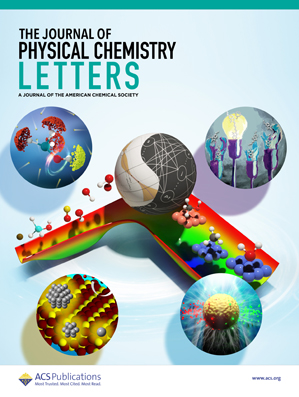
The Journal of Physical Chemistry Letters
The Journal of Physical Chemistry Letters CHEMISTRY, PHYSICAL-NANOSCIENCE & NANOTECHNOLOGY
CiteScore
9.60
自引率
7.00%
发文量
1519
审稿时长
1.6 months
期刊介绍: The Journal of Physical Chemistry (JPC) Letters is devoted to reporting new and original experimental and theoretical basic research of interest to physical chemists, biophysical chemists, chemical physicists, physicists, material scientists, and engineers. An important criterion for acceptance is that the paper reports a significant scientific advance and/or physical insight such that rapid publication is essential. Two issues of JPC Letters are published each month.

×
引用
GB/T 7714-2015
复制
MLA
复制
APA
复制
导出至
BibTeX EndNote RefMan NoteFirst NoteExpress
×
提示
您的信息不完整,为了账户安全,请先补充。
现在去补充
×
提示
您因"违规操作"
具体请查看互助需知
我知道了
×
提示
确定
请完成安全验证×
copy
已复制链接
快去分享给好友吧!
我知道了
右上角分享
点击右上角分享
0
联系我们:info@booksci.cn Book学术提供免费学术资源搜索服务,方便国内外学者检索中英文文献。致力于提供最便捷和优质的服务体验。 Copyright © 2023 布克学术 All rights reserved.
京ICP备2023020795号-1
ghs 京公网安备 11010802042870号
Book学术文献互助
Book学术文献互助群
群 号:604180095
Book学术官方微信
小红书


