Alejandro Guzman-Landero, Ulrike Zanzen, Alexander Prange, Ramiro Marroquin-Garcia, Hanne Diliën, Bart van Grinsven, Rocio Arreguin-Campos
{"title":"Molecularly Imprinted Polymers as an Indirect Sensing Approach for Bacillus cereus Detection.","authors":"Alejandro Guzman-Landero, Ulrike Zanzen, Alexander Prange, Ramiro Marroquin-Garcia, Hanne Diliën, Bart van Grinsven, Rocio Arreguin-Campos","doi":"10.1021/acssensors.6c02873","DOIUrl":null,"url":null,"abstract":"<p><p>Bacterial endospores are a major challenge in food safety due to their high resistance and potential to cause spoilage and foodborne illness. Current detection methods can be labor-intensive and require specialized instrumentation. A low-cost, label-free thermal sensing platform for indirect detection of Bacillus cereus endospores using molecularly imprinted polymers (MIPs) targeting dipicolinic acid (DPA), a spore biomarker, was developed. The MIPs were synthesized by free-radical bulk polymerization, characterized by rebinding assays, and evaluated using the Heat Transfer Method (HTM). At 100 μM DPA, the MIPs exhibited an imprinting factor (IF) of 2.62 ± 0.18 (n = 3), demonstrating preferential DPA binding. Sensor performance was evaluated using aqueous DPA, structural analogues, and a complex food matrix. HTM measurements produced concentration-dependent responses, with limits of detection of 0.20 ± 0.15 μM in aqueous DPA solutions and 0.060 ± 0.0098 μM in unpretreated, spiked ultrahigh-temperature (UHT) milk. Terbium(III) fluorescence independently supported DPA retention by the MIPs. Real-time assays with germinated B. cereus suspensions at 105 colony-forming units (CFU) mL-1 enabled proof-of-concept monitoring of biologically released DPA under laboratory conditions. These findings highlight the potential of combining DPA-imprinted polymers with HTM for real-time and label-free indirect endospore detection.</p>","PeriodicalId":24,"journal":{"name":"ACS Sensors","volume":" ","pages":""},"PeriodicalIF":10.9000,"publicationDate":"2026-10-09","publicationTypes":"Journal Article","fieldsOfStudy":null,"isOpenAccess":false,"openAccessPdf":"","citationCount":"0","resultStr":null,"platform":"Semanticscholar","paperid":null,"PeriodicalName":"ACS Sensors","FirstCategoryId":"92","ListUrlMain":"https://doi.org/10.1021/acssensors.6c02873","RegionNum":1,"RegionCategory":"化学","ArticlePicture":[],"TitleCN":null,"AbstractTextCN":null,"PMCID":null,"EPubDate":"","PubModel":"","JCR":"Q1","JCRName":"CHEMISTRY, ANALYTICAL","Score":null,"Total":0}
引用次数: 0
Abstract
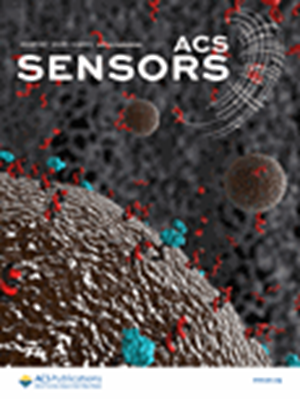
Bacterial endospores are a major challenge in food safety due to their high resistance and potential to cause spoilage and foodborne illness. Current detection methods can be labor-intensive and require specialized instrumentation. A low-cost, label-free thermal sensing platform for indirect detection of Bacillus cereus endospores using molecularly imprinted polymers (MIPs) targeting dipicolinic acid (DPA), a spore biomarker, was developed. The MIPs were synthesized by free-radical bulk polymerization, characterized by rebinding assays, and evaluated using the Heat Transfer Method (HTM). At 100 μM DPA, the MIPs exhibited an imprinting factor (IF) of 2.62 ± 0.18 (n = 3), demonstrating preferential DPA binding. Sensor performance was evaluated using aqueous DPA, structural analogues, and a complex food matrix. HTM measurements produced concentration-dependent responses, with limits of detection of 0.20 ± 0.15 μM in aqueous DPA solutions and 0.060 ± 0.0098 μM in unpretreated, spiked ultrahigh-temperature (UHT) milk. Terbium(III) fluorescence independently supported DPA retention by the MIPs. Real-time assays with germinated B. cereus suspensions at 105 colony-forming units (CFU) mL-1 enabled proof-of-concept monitoring of biologically released DPA under laboratory conditions. These findings highlight the potential of combining DPA-imprinted polymers with HTM for real-time and label-free indirect endospore detection.
期刊介绍:
ACS Sensors is a peer-reviewed research journal that focuses on the dissemination of new and original knowledge in the field of sensor science, particularly those that selectively sense chemical or biological species or processes. The journal covers a broad range of topics, including but not limited to biosensors, chemical sensors, gas sensors, intracellular sensors, single molecule sensors, cell chips, and microfluidic devices. It aims to publish articles that address conceptual advances in sensing technology applicable to various types of analytes or application papers that report on the use of existing sensing concepts in new ways or for new analytes.

 求助内容:
 应助结果提醒方式:


 京公网安备 11010802042870号


