An intelligent AQI prediction method using transfer learning and an IASO-optimized DCM-DESN under multi-source data: A case study of four Chinese cities
Yuanhao Du, Xiuli Geng, Sheng Cheng, Hongliu Zhang
{"title":"An intelligent AQI prediction method using transfer learning and an IASO-optimized DCM-DESN under multi-source data: A case study of four Chinese cities","authors":"Yuanhao Du, Xiuli Geng, Sheng Cheng, Hongliu Zhang","doi":"10.1007/s11869-026-02109-y","DOIUrl":null,"url":null,"abstract":"<div><p>Accurately understanding the real-time evolution of the Air Quality Index (AQI) is essential for atmospheric pollution prevention and urban public health management. Although scholars have proposed numerous AQI prediction models, most have not fully considered AQI data's noise characteristics. Moreover, previous models mainly focus on a single region and do not effectively address cross-regional prediction issues. To tackle these challenges, this paper proposes an intelligent AQI monitoring framework: using transfer learning and an improved atomic search optimization (ASO) algorithm optimized deep echo state network with a dynamic activation mechanism (DCM-DESN) under multi-source data. Firstly, a data processing method combining complementary ensemble empirical mode decomposition with adaptive noise (CEEMDAN) and phase space reconstruction (PSR) is designed for the collected multi-source AQI data. CEEMDAN is applied to adaptively decompose the data, significantly reducing noise effects, followed by PSR on the denoised data to identify the dynamic characteristics of the AQI time series data. Secondly, we design a deep learning model of DCM-DESN for AQI prediction. By adjusting the nonlinear connection mode of DESN through a dynamic activation mechanism, it reduces the model's dependence on the number of reservoir neurons. Meanwhile, an improved ASO (IASO) is proposed to optimize the network weights of DCM-DESN. Finally, daily data from Xi’an, Wuhan, Changsha, and Shenzhen covering the period from January 1, 2021 to March 24, 2024 were collected to construct multiple cross-city transfer-learning tasks. Historical pollutant concentrations and related environmental variables available up to the current day were used to directly predict the AQI one day ahead. For each task, the IASO-DCM-DESN is first pretrained on the source-city data. The pretrained reservoir-based model is then transferred to the target city and frozen, while the output weights are fine-tuned using a limited target-domain adaptation set. The proposed model’s performance across various tasks is validated using MAE, RMSE, and R<sup>2</sup> metrics, demonstrating excellent performance.</p></div>","PeriodicalId":49109,"journal":{"name":"Air Quality Atmosphere and Health","volume":"19 10","pages":""},"PeriodicalIF":3.1000,"publicationDate":"2026-09-29","publicationTypes":"Journal Article","fieldsOfStudy":null,"isOpenAccess":false,"openAccessPdf":"","citationCount":"0","resultStr":null,"platform":"Semanticscholar","paperid":null,"PeriodicalName":"Air Quality Atmosphere and Health","FirstCategoryId":"93","ListUrlMain":"https://link.springer.com/article/10.1007/s11869-026-02109-y","RegionNum":4,"RegionCategory":"环境科学与生态学","ArticlePicture":[],"TitleCN":null,"AbstractTextCN":null,"PMCID":null,"EPubDate":"","PubModel":"","JCR":"Q3","JCRName":"ENVIRONMENTAL SCIENCES","Score":null,"Total":0}
引用次数: 0
Abstract
Accurately understanding the real-time evolution of the Air Quality Index (AQI) is essential for atmospheric pollution prevention and urban public health management. Although scholars have proposed numerous AQI prediction models, most have not fully considered AQI data's noise characteristics. Moreover, previous models mainly focus on a single region and do not effectively address cross-regional prediction issues. To tackle these challenges, this paper proposes an intelligent AQI monitoring framework: using transfer learning and an improved atomic search optimization (ASO) algorithm optimized deep echo state network with a dynamic activation mechanism (DCM-DESN) under multi-source data. Firstly, a data processing method combining complementary ensemble empirical mode decomposition with adaptive noise (CEEMDAN) and phase space reconstruction (PSR) is designed for the collected multi-source AQI data. CEEMDAN is applied to adaptively decompose the data, significantly reducing noise effects, followed by PSR on the denoised data to identify the dynamic characteristics of the AQI time series data. Secondly, we design a deep learning model of DCM-DESN for AQI prediction. By adjusting the nonlinear connection mode of DESN through a dynamic activation mechanism, it reduces the model's dependence on the number of reservoir neurons. Meanwhile, an improved ASO (IASO) is proposed to optimize the network weights of DCM-DESN. Finally, daily data from Xi’an, Wuhan, Changsha, and Shenzhen covering the period from January 1, 2021 to March 24, 2024 were collected to construct multiple cross-city transfer-learning tasks. Historical pollutant concentrations and related environmental variables available up to the current day were used to directly predict the AQI one day ahead. For each task, the IASO-DCM-DESN is first pretrained on the source-city data. The pretrained reservoir-based model is then transferred to the target city and frozen, while the output weights are fine-tuned using a limited target-domain adaptation set. The proposed model’s performance across various tasks is validated using MAE, RMSE, and R2 metrics, demonstrating excellent performance.
期刊介绍:
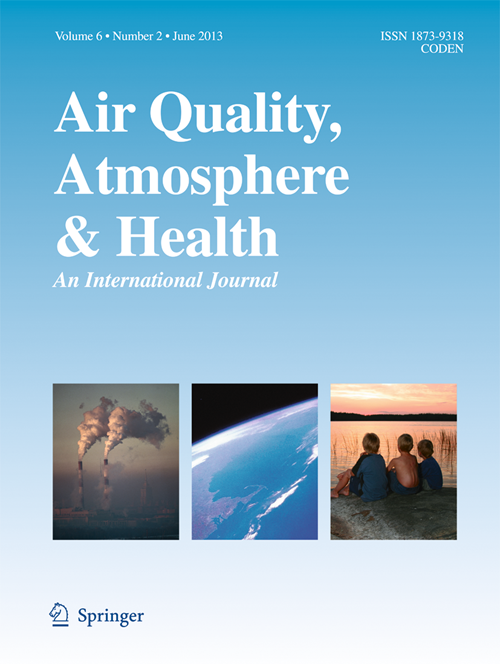
Air Quality, Atmosphere, and Health is a multidisciplinary journal which, by its very name, illustrates the broad range of work it publishes and which focuses on atmospheric consequences of human activities and their implications for human and ecological health.
It offers research papers, critical literature reviews and commentaries, as well as special issues devoted to topical subjects or themes.
International in scope, the journal presents papers that inform and stimulate a global readership, as the topic addressed are global in their import. Consequently, we do not encourage submission of papers involving local data that relate to local problems. Unless they demonstrate wide applicability, these are better submitted to national or regional journals.
Air Quality, Atmosphere & Health addresses such topics as acid precipitation; airborne particulate matter; air quality monitoring and management; exposure assessment; risk assessment; indoor air quality; atmospheric chemistry; atmospheric modeling and prediction; air pollution climatology; climate change and air quality; air pollution measurement; atmospheric impact assessment; forest-fire emissions; atmospheric science; greenhouse gases; health and ecological effects; clean air technology; regional and global change and satellite measurements.
This journal benefits a diverse audience of researchers, public health officials and policy makers addressing problems that call for solutions based in evidence from atmospheric and exposure assessment scientists, epidemiologists, and risk assessors. Publication in the journal affords the opportunity to reach beyond defined disciplinary niches to this broader readership.

 求助内容:
 应助结果提醒方式:


 京公网安备 11010802042870号


