John O. Bamikole, Caitlin Stapelberg, Caleb Narasigadu
{"title":"Experimental Measurement and Modeling of Liquid–Liquid Equilibria for the Ternary System Water + Propan-1-ol + Ethyl Acetate","authors":"John O. Bamikole, Caitlin Stapelberg, Caleb Narasigadu","doi":"10.1021/acs.jced.6c00298","DOIUrl":null,"url":null,"abstract":"<p>The world’s\r\ngrowing energy needs and the depletion of fossil\r\nfuels have driven demand for renewable alternatives, such as biofuels.\r\nPropan-1-ol is a valuable biofuel component; however, the presence\r\nof water during its production remains a significant challenge. A\r\nviable solution is liquid–liquid extraction to selectively\r\nrecover propan-1-ol from a water mixture. Ethyl acetate is considered\r\na promising solvent due to its chemical stability, eco-friendly nature,\r\nmoderate water immiscibility, and favorable density difference for\r\nphase separation in a water-propan-1-ol mixture. In this study, ternary\r\nLLE measurements for water (1), propan-1-ol (2), and ethyl acetate\r\n(3) were conducted at 298.15, 313.15, and 328.15 K to evaluate ethyl\r\nacetate as a solvent for extracting propan-1-ol. The selectivity and\r\ncapacity of the solvent were calculated. The experimental data were\r\nmodeled using the NRTL and UNIQUAC activity models, both of which\r\nadequately describe the phase behavior, with NRTL slightly better\r\nthan UNIQUAC. The group method of data handling (GMDH) neural network\r\nwas also employed to complement the thermodynamic model, accurately\r\npredicting phase composition. The findings of this study show that\r\nethyl acetate has excellent potential for selectively extracting propan-1-ol\r\nfrom water, with the extraction efficiency increasing with temperature.</p>","PeriodicalId":42,"journal":{"name":"Journal of Chemical & Engineering Data","volume":"71 10","pages":"4303–4314"},"PeriodicalIF":2.4000,"publicationDate":"2026-10-08","publicationTypes":"Journal Article","fieldsOfStudy":null,"isOpenAccess":false,"openAccessPdf":"","citationCount":"0","resultStr":null,"platform":"Semanticscholar","paperid":null,"PeriodicalName":"Journal of Chemical & Engineering Data","FirstCategoryId":"1","ListUrlMain":"https://pubs.acs.org/doi/10.1021/acs.jced.6c00298","RegionNum":3,"RegionCategory":"工程技术","ArticlePicture":[],"TitleCN":null,"AbstractTextCN":null,"PMCID":null,"EPubDate":"2026/9/9 0:00:00","PubModel":"Epub","JCR":"Q3","JCRName":"CHEMISTRY, MULTIDISCIPLINARY","Score":null,"Total":0}
引用次数: 0
Abstract
The world’s
growing energy needs and the depletion of fossil
fuels have driven demand for renewable alternatives, such as biofuels.
Propan-1-ol is a valuable biofuel component; however, the presence
of water during its production remains a significant challenge. A
viable solution is liquid–liquid extraction to selectively
recover propan-1-ol from a water mixture. Ethyl acetate is considered
a promising solvent due to its chemical stability, eco-friendly nature,
moderate water immiscibility, and favorable density difference for
phase separation in a water-propan-1-ol mixture. In this study, ternary
LLE measurements for water (1), propan-1-ol (2), and ethyl acetate
(3) were conducted at 298.15, 313.15, and 328.15 K to evaluate ethyl
acetate as a solvent for extracting propan-1-ol. The selectivity and
capacity of the solvent were calculated. The experimental data were
modeled using the NRTL and UNIQUAC activity models, both of which
adequately describe the phase behavior, with NRTL slightly better
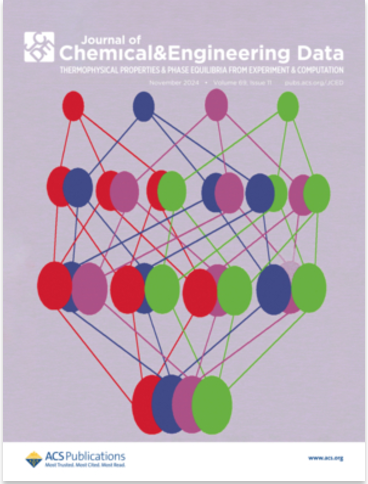
than UNIQUAC. The group method of data handling (GMDH) neural network
was also employed to complement the thermodynamic model, accurately
predicting phase composition. The findings of this study show that
ethyl acetate has excellent potential for selectively extracting propan-1-ol
from water, with the extraction efficiency increasing with temperature.
期刊介绍:
The Journal of Chemical & Engineering Data is a monthly journal devoted to the publication of data obtained from both experiment and computation, which are viewed as complementary. It is the only American Chemical Society journal primarily concerned with articles containing data on the phase behavior and the physical, thermodynamic, and transport properties of well-defined materials, including complex mixtures of known compositions. While environmental and biological samples are of interest, their compositions must be known and reproducible. As a result, adsorption on natural product materials does not generally fit within the scope of Journal of Chemical & Engineering Data.

 求助内容:
 应助结果提醒方式:


 京公网安备 11010802042870号


