Rafael Aponte Alburquerque, Josue I Hernandez, Aasritha Nallapu, Marick Starick, Jungheun Hyun, John Michael Sanchez, Neelou Etesami, Sandip K Mukherjee, Ayse Naz Ozanturk, Jose Vazquez, Allison Chang, Ashley Zheng, Lorena Garnica, Alberto E Lopez, Andrew E Gelman, John A Belperio, Jae Woo Lee, Devesha H Kulkarni, Alexander Hoffmann, Hrishikesh S Kulkarni
{"title":"Kinetics of local C3 production orchestrates neutrophil recruitment in lung injury.","authors":"Rafael Aponte Alburquerque, Josue I Hernandez, Aasritha Nallapu, Marick Starick, Jungheun Hyun, John Michael Sanchez, Neelou Etesami, Sandip K Mukherjee, Ayse Naz Ozanturk, Jose Vazquez, Allison Chang, Ashley Zheng, Lorena Garnica, Alberto E Lopez, Andrew E Gelman, John A Belperio, Jae Woo Lee, Devesha H Kulkarni, Alexander Hoffmann, Hrishikesh S Kulkarni","doi":"10.1016/j.mucimm.2026.100412","DOIUrl":null,"url":null,"abstract":"<p><p>Complement component 3 (C3) is crucial for host defense against bacteria. While the liver is the primary source of circulating C3, local C3 production at barrier surfaces such as the lung is key in early responses. Yet, how local complement-mediated responses are initiated at mucosal barriers-and how locally-derived C3 functions distinctly from its established cytoprotective role-is unknown. This study investigates the kinetics and necessity of lung-derived C3 during the initial hours of an infection. Leveraging models of bacterial pneumonia in ex vivo-perfused human lungs and mice deficient in liver-derived C3, we demonstrate that intrapulmonary C3 production and activation precedes the accumulation of circulating C3 into the bronchoalveolar space. Utilizing conditional knockout mice, we demonstrate that lung epithelial cell-derived C3 is required for early neutrophil recruitment in pneumonia. C3-mediated early neutrophil recruitment depends on a local C3a-C3aR axis that increases epithelial CXCL1 and CXCL2 production and occurs without any difference in epithelial injury, revealing that this activity is mechanistically different from its cytoprotective function. Collectively, our study demonstrates that an initial, entirely local phase of complement-mediated mucosal protection is critical for host defense during lung injury, before alveolar-capillary barrier disruption results in a subsequent, systemic response.</p>","PeriodicalId":18877,"journal":{"name":"Mucosal Immunology","volume":" ","pages":"100412"},"PeriodicalIF":5.5000,"publicationDate":"2026-10-05","publicationTypes":"Journal Article","fieldsOfStudy":null,"isOpenAccess":false,"openAccessPdf":"","citationCount":"0","resultStr":null,"platform":"Semanticscholar","paperid":null,"PeriodicalName":"Mucosal Immunology","FirstCategoryId":"3","ListUrlMain":"https://doi.org/10.1016/j.mucimm.2026.100412","RegionNum":2,"RegionCategory":"医学","ArticlePicture":[],"TitleCN":null,"AbstractTextCN":null,"PMCID":null,"EPubDate":"","PubModel":"","JCR":"Q1","JCRName":"IMMUNOLOGY","Score":null,"Total":0}
引用次数: 0
Abstract
Complement component 3 (C3) is crucial for host defense against bacteria. While the liver is the primary source of circulating C3, local C3 production at barrier surfaces such as the lung is key in early responses. Yet, how local complement-mediated responses are initiated at mucosal barriers-and how locally-derived C3 functions distinctly from its established cytoprotective role-is unknown. This study investigates the kinetics and necessity of lung-derived C3 during the initial hours of an infection. Leveraging models of bacterial pneumonia in ex vivo-perfused human lungs and mice deficient in liver-derived C3, we demonstrate that intrapulmonary C3 production and activation precedes the accumulation of circulating C3 into the bronchoalveolar space. Utilizing conditional knockout mice, we demonstrate that lung epithelial cell-derived C3 is required for early neutrophil recruitment in pneumonia. C3-mediated early neutrophil recruitment depends on a local C3a-C3aR axis that increases epithelial CXCL1 and CXCL2 production and occurs without any difference in epithelial injury, revealing that this activity is mechanistically different from its cytoprotective function. Collectively, our study demonstrates that an initial, entirely local phase of complement-mediated mucosal protection is critical for host defense during lung injury, before alveolar-capillary barrier disruption results in a subsequent, systemic response.
期刊介绍:
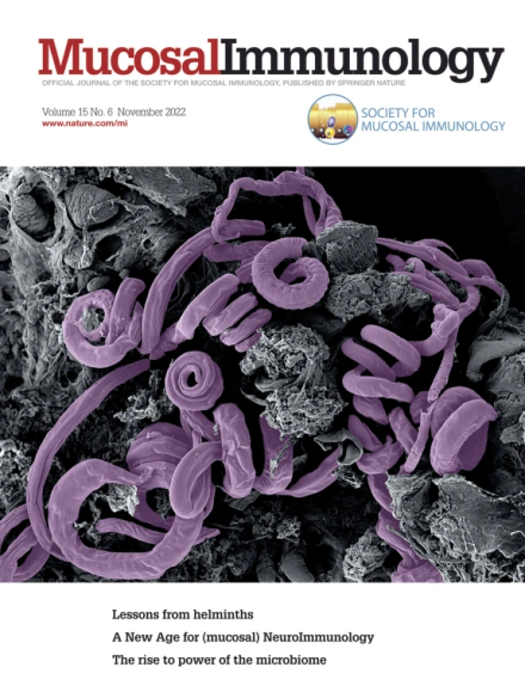
Mucosal Immunology, the official publication of the Society of Mucosal Immunology (SMI), serves as a forum for both basic and clinical scientists to discuss immunity and inflammation involving mucosal tissues. It covers gastrointestinal, pulmonary, nasopharyngeal, oral, ocular, and genitourinary immunology through original research articles, scholarly reviews, commentaries, editorials, and letters. The journal gives equal consideration to basic, translational, and clinical studies and also serves as a primary communication channel for the SMI governing board and its members, featuring society news, meeting announcements, policy discussions, and job/training opportunities advertisements.

 求助内容:
 应助结果提醒方式:


 京公网安备 11010802042870号


