Estimation of the relative effectiveness and waning of the monovalent third dose of COVID-19 vaccine against hospital admission in France: a novel self-controlled case series analysis.
IF 4.1 2区 医学Q1 PUBLIC, ENVIRONMENTAL & OCCUPATIONAL HEALTH
{"title":"Estimation of the relative effectiveness and waning of the monovalent third dose of COVID-19 vaccine against hospital admission in France: a novel self-controlled case series analysis.","authors":"Jérémie Botton, Yonas Ghebremichael-Weldeselassie, Mounia Nacima Hocine, Paddy Farrington","doi":"10.1093/aje/kwag250","DOIUrl":null,"url":null,"abstract":"<p><p>We present a novel application of the SCCS method for estimating the effectiveness and waning of the third dose of COVID-19 monovalent vaccine in France. We used data on individuals hospitalised for COVID-19 between September 2021 and February 2022 from the Système National des Données de Santé. Only cases having received a 3rd dose of COVID-19 vaccine prior to or on the day of hospitalisation were included in the analysis. We developed a new SCCS model including only time post-dose 3 vaccination, with reference period 24-65 days post-vaccination to capture maximum vaccine protection. Time was split into short-term and long-term post-vaccination risk periods, including days 4-9 corresponding to minimum protection, and successive 7-day windows from day 66 post vaccination. The model included two exposure variables, representing short-term and long-term effects of vaccination. The analysis confirms the relative effectiveness of the third-dose COVID-19 vaccination, the waning of vaccine immunity though of limited extent, and possible effect modification related to virus strain, vaccine, vaccination history, age, and sex. The strengths and weaknesses of this approach are discussed. Suitably applied, the SCCS method may provide a useful method of analysis of vaccine effectiveness which automatically controls for time-invariant confounders.</p>","PeriodicalId":7472,"journal":{"name":"American journal of epidemiology","volume":" ","pages":""},"PeriodicalIF":4.1000,"publicationDate":"2026-10-05","publicationTypes":"Journal Article","fieldsOfStudy":null,"isOpenAccess":false,"openAccessPdf":"","citationCount":"0","resultStr":null,"platform":"Semanticscholar","paperid":null,"PeriodicalName":"American journal of epidemiology","FirstCategoryId":"3","ListUrlMain":"https://doi.org/10.1093/aje/kwag250","RegionNum":2,"RegionCategory":"医学","ArticlePicture":[],"TitleCN":null,"AbstractTextCN":null,"PMCID":null,"EPubDate":"","PubModel":"","JCR":"Q1","JCRName":"PUBLIC, ENVIRONMENTAL & OCCUPATIONAL HEALTH","Score":null,"Total":0}
引用次数: 0
Abstract
We present a novel application of the SCCS method for estimating the effectiveness and waning of the third dose of COVID-19 monovalent vaccine in France. We used data on individuals hospitalised for COVID-19 between September 2021 and February 2022 from the Système National des Données de Santé. Only cases having received a 3rd dose of COVID-19 vaccine prior to or on the day of hospitalisation were included in the analysis. We developed a new SCCS model including only time post-dose 3 vaccination, with reference period 24-65 days post-vaccination to capture maximum vaccine protection. Time was split into short-term and long-term post-vaccination risk periods, including days 4-9 corresponding to minimum protection, and successive 7-day windows from day 66 post vaccination. The model included two exposure variables, representing short-term and long-term effects of vaccination. The analysis confirms the relative effectiveness of the third-dose COVID-19 vaccination, the waning of vaccine immunity though of limited extent, and possible effect modification related to virus strain, vaccine, vaccination history, age, and sex. The strengths and weaknesses of this approach are discussed. Suitably applied, the SCCS method may provide a useful method of analysis of vaccine effectiveness which automatically controls for time-invariant confounders.
期刊介绍:
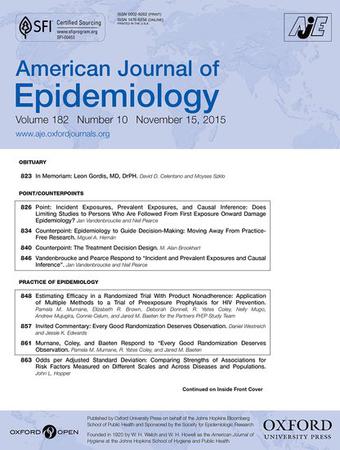
The American Journal of Epidemiology is the oldest and one of the premier epidemiologic journals devoted to the publication of empirical research findings, opinion pieces, and methodological developments in the field of epidemiologic research.
It is a peer-reviewed journal aimed at both fellow epidemiologists and those who use epidemiologic data, including public health workers and clinicians.

 求助内容:
 应助结果提醒方式:


 京公网安备 11010802042870号


