Hayden R Montgomery, Tong Zhang, Grace E Kunkel, Magdalena F Polite, Jeonghun Lee, Marco S Messina, Alexander M Spokoyny, Heather D Maynard
{"title":"Biomolecule-polymer conjugates synthesized by a combination of organometallic bioconjugation and atom transfer radical polymerization.","authors":"Hayden R Montgomery, Tong Zhang, Grace E Kunkel, Magdalena F Polite, Jeonghun Lee, Marco S Messina, Alexander M Spokoyny, Heather D Maynard","doi":"10.1039/d6py00714g","DOIUrl":null,"url":null,"abstract":"<p><p>Organometallic Au(iii) cysteine arylation strategies have recently been employed for efficient and selective conjugation to proteins and peptides. In this work, atom transfer radical polymerization (ATRP) was utilized to synthesize iodophenyl end-functionalized poly(polyethylene glycol methacrylate) (pPEGMA), poly(hydroxyethyl methacrylate) (pHEMA) and poly(2-(dimethylamino)ethyl methacrylate) (pDMAEMA), which were subjected to MeDalPhos-Au(i)Cl to form Au(iii) polymer reagents. The Au(iii)-pPEGMA was reacted with T4-lysozyme (T4L) containing a free thiol to form a T4L-pPEGMA conjugate. In a complementary approach, an Au(iii) ATRP initiator was synthesized for subsequent conjugation to a peptide and T4L to form biomacroinitators. These peptide and protein macroinitiators were then subjected to polymerization conditions to form pDMAEMA conjugates <i>in situ</i>. This work demonstrates that Au(iii) organometallic reagents in conjunction with ATRP offers an efficient strategy for the preparation of protein-polymer conjugates by either grafting to or grafting from approaches.</p>","PeriodicalId":100,"journal":{"name":"Polymer Chemistry","volume":" ","pages":""},"PeriodicalIF":3.9000,"publicationDate":"2026-10-05","publicationTypes":"Journal Article","fieldsOfStudy":null,"isOpenAccess":false,"openAccessPdf":"https://www.ncbi.nlm.nih.gov/pmc/articles/PMC13637460/pdf/","citationCount":"0","resultStr":null,"platform":"Semanticscholar","paperid":null,"PeriodicalName":"Polymer Chemistry","FirstCategoryId":"92","ListUrlMain":"https://doi.org/10.1039/d6py00714g","RegionNum":2,"RegionCategory":"化学","ArticlePicture":[],"TitleCN":null,"AbstractTextCN":null,"PMCID":null,"EPubDate":"","PubModel":"","JCR":"Q2","JCRName":"POLYMER SCIENCE","Score":null,"Total":0}
引用次数: 0
Abstract
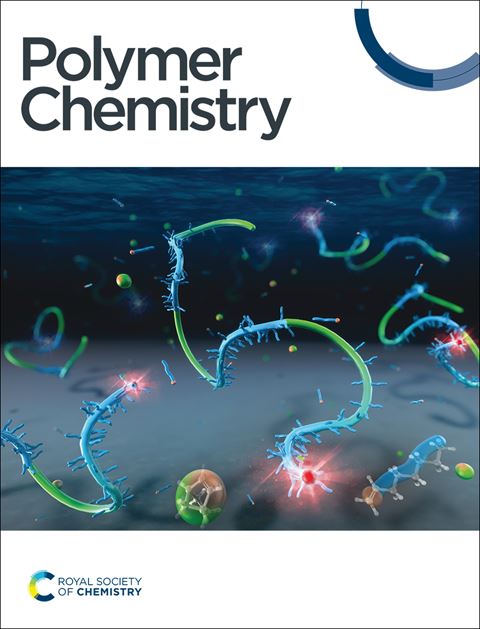
Organometallic Au(iii) cysteine arylation strategies have recently been employed for efficient and selective conjugation to proteins and peptides. In this work, atom transfer radical polymerization (ATRP) was utilized to synthesize iodophenyl end-functionalized poly(polyethylene glycol methacrylate) (pPEGMA), poly(hydroxyethyl methacrylate) (pHEMA) and poly(2-(dimethylamino)ethyl methacrylate) (pDMAEMA), which were subjected to MeDalPhos-Au(i)Cl to form Au(iii) polymer reagents. The Au(iii)-pPEGMA was reacted with T4-lysozyme (T4L) containing a free thiol to form a T4L-pPEGMA conjugate. In a complementary approach, an Au(iii) ATRP initiator was synthesized for subsequent conjugation to a peptide and T4L to form biomacroinitators. These peptide and protein macroinitiators were then subjected to polymerization conditions to form pDMAEMA conjugates in situ. This work demonstrates that Au(iii) organometallic reagents in conjunction with ATRP offers an efficient strategy for the preparation of protein-polymer conjugates by either grafting to or grafting from approaches.
期刊介绍:
Polymer Chemistry welcomes submissions in all areas of polymer science that have a strong focus on macromolecular chemistry. Manuscripts may cover a broad range of fields, yet no direct application focus is required.

 求助内容:
 应助结果提醒方式:


 京公网安备 11010802042870号


