{"title":"Fluorescent Molecular Scaffold-Building Mononuclear Iron(II) Complexes Display Synergistic Spin Crossover and Fluorescence Behaviors","authors":"Xin-Xin Wang, Peng Chen, Shu-Man Gao, Xu Wang, Xue-Ru Wu, Zhi-Kun Liu, Feng Shao","doi":"10.1021/acs.cgd.6c00990","DOIUrl":null,"url":null,"abstract":"<p>Magnetic fluorescent bifunctional spin crossover (SCO) materials show switchable magnetic and optical properties and have attracted continuous research interest due to their potential application in magneto-optical switches and multi-sensors. Herein, we report two octahedral Fe(II) SCO complexes, namely, [Fe<sub>2</sub>(1-isoTQA)<sub>2</sub>(NCS)<sub>4</sub>]·CH<sub>2</sub>Cl<sub>2</sub> (<strong>1</strong>·CH<sub>2</sub>Cl<sub>2</sub>) and its desolvated sample, Fe<sub>2</sub>(1-isoTQA)<sub>2</sub>(NCS)<sub>4</sub> (<strong>1d</strong>), based on the fluorescent molecular scaffold ligand of <em>tris</em>(1-isoquinolylmethyl)amine (1-isoTQA). Magnetic studies revealed that <strong>1</strong>·CH<sub>2</sub>Cl<sub>2</sub> exhibits two-step SCO behavior, while <strong>1d</strong> displays one-step, incomplete SCO behavior. Temperature-dependent fluorescence measurements indicated that the emission intensity of <strong>1d</strong> can be observed to increase synchronously with the spin transition. Moreover, the temperature-dependent structural analyses and theoretical calculations confirmed that the emission intensity can be modulated by the spin state through the energy-transfer mechanism.</p>","PeriodicalId":34,"journal":{"name":"Crystal Growth & Design","volume":"26 19","pages":"7830–7838"},"PeriodicalIF":3.6000,"publicationDate":"2026-10-07","publicationTypes":"Journal Article","fieldsOfStudy":null,"isOpenAccess":false,"openAccessPdf":"","citationCount":"0","resultStr":null,"platform":"Semanticscholar","paperid":null,"PeriodicalName":"Crystal Growth & Design","FirstCategoryId":"92","ListUrlMain":"https://pubs.acs.org/doi/10.1021/acs.cgd.6c00990","RegionNum":2,"RegionCategory":"化学","ArticlePicture":[],"TitleCN":null,"AbstractTextCN":null,"PMCID":null,"EPubDate":"2026/9/25 0:00:00","PubModel":"Epub","JCR":"Q2","JCRName":"CHEMISTRY, MULTIDISCIPLINARY","Score":null,"Total":0}
引用次数: 0
Abstract
Magnetic fluorescent bifunctional spin crossover (SCO) materials show switchable magnetic and optical properties and have attracted continuous research interest due to their potential application in magneto-optical switches and multi-sensors. Herein, we report two octahedral Fe(II) SCO complexes, namely, [Fe2(1-isoTQA)2(NCS)4]·CH2Cl2 (1·CH2Cl2) and its desolvated sample, Fe2(1-isoTQA)2(NCS)4 (1d), based on the fluorescent molecular scaffold ligand of tris(1-isoquinolylmethyl)amine (1-isoTQA). Magnetic studies revealed that 1·CH2Cl2 exhibits two-step SCO behavior, while 1d displays one-step, incomplete SCO behavior. Temperature-dependent fluorescence measurements indicated that the emission intensity of 1d can be observed to increase synchronously with the spin transition. Moreover, the temperature-dependent structural analyses and theoretical calculations confirmed that the emission intensity can be modulated by the spin state through the energy-transfer mechanism.
期刊介绍:
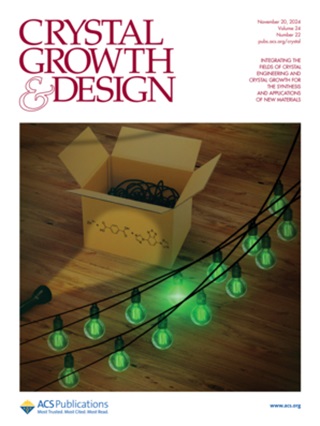
The aim of Crystal Growth & Design is to stimulate crossfertilization of knowledge among scientists and engineers working in the fields of crystal growth, crystal engineering, and the industrial application of crystalline materials.
Crystal Growth & Design publishes theoretical and experimental studies of the physical, chemical, and biological phenomena and processes related to the design, growth, and application of crystalline materials. Synergistic approaches originating from different disciplines and technologies and integrating the fields of crystal growth, crystal engineering, intermolecular interactions, and industrial application are encouraged.

 求助内容:
 应助结果提醒方式:


 京公网安备 11010802042870号


