
Symbolic promotions: Conceptualization and empirical investigation
IF 8.8
1区 管理学
Q1 BUSINESS
引用次数: 0
Abstract
Abstract Symbolic promotions are an increasingly prevalent marketing practice globally, yet little is known about how or when they influence consumer behavior. We conceptualize symbolic promotions as a distinct type of sales promotion that creates value by reinforcing consumers' social identity through shared group membership rather than by providing economic incentives, such as reward-based promotions, or supporting distant others, such as cause-related marketing promotions (CMPs). We investigate the effectiveness of symbolic promotions and their underlying mechanisms using a multimethod approach. A nine-year longitudinal field study of daily sales for 22,084 books demonstrates that an existing symbolic promotion ("On August 12, I buy a Quebec book!") generates a substantial increase in sales, with stronger effects for lesser-known brands than for well-known brands. A follow-up experiment uncovers the unique mechanisms underlying these effects, showing that symbolic promotions stimulate curiosity and community rootedness, which in turn enhance multiple types of behavioral intentions, i.e., the likelihood of participating in the promotion, sharing it on social media, and future brand consideration. Together, these findings position symbolic promotions as a distinct, complementary addition to firms’ promotional portfolios, and demonstrate how firms can leverage shared identities to create value beyond traditional monetary incentives, with implications for various stakeholders.符号化晋升:概念与实证研究
象征性促销是一种日益普遍的全球营销实践,但很少知道如何或何时影响消费者的行为。我们将象征性促销概念化为一种独特类型的销售促销,它通过通过共享的群体成员身份来强化消费者的社会身份,而不是通过提供经济激励(如基于奖励的促销)或支持遥远的其他人(如与事业相关的营销促销(cmp))来创造价值。我们使用多方法研究了象征性促销的有效性及其潜在机制。对22,084本书的日销量进行的一项为期9年的纵向实地研究表明,现有的象征性促销(“8月12日,我买了一本魁北克的书!”)使销售额大幅增长,对知名度较低的品牌的效果强于对知名品牌的效果。一项后续实验揭示了这些效应背后的独特机制,表明象征性促销激发了好奇心和社区根植性,这反过来又增强了多种类型的行为意图,即参与促销、在社交媒体上分享促销的可能性,以及未来对品牌的考虑。总之,这些发现将象征性促销定位为公司促销组合的独特补充,并展示了公司如何利用共享身份来创造超越传统货币激励的价值,并对各种利益相关者产生影响。
本文章由计算机程序翻译,如有差异,请以英文原文为准。
求助全文
约1分钟内获得全文
求助全文
来源期刊
CiteScore
30.00
自引率
7.10%
发文量
82
期刊介绍:
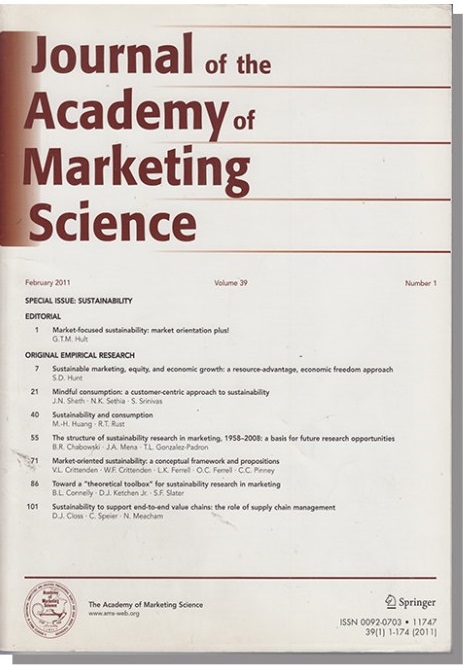
JAMS, also known as The Journal of the Academy of Marketing Science, plays a crucial role in bridging the gap between scholarly research and practical application in the realm of marketing. Its primary objective is to study and enhance marketing practices by publishing research-driven articles.
When manuscripts are submitted to JAMS for publication, they are evaluated based on their potential to contribute to the advancement of marketing science and practice.
 求助内容:
 应助结果提醒方式:


 京公网安备 11010802042870号


