
Geoeconomic fragmentation and green exceptionalism: Evidence from trade and finance
IF 10.2
1区 经济学
Q1 BUSINESS, FINANCE
International Review of Financial Analysis
Pub Date : 2026-11-01
Epub Date: 2026-10-05
DOI:10.1016/j.irfa.2026.105424
引用次数: 0
Abstract
This study examines how geoeconomic fragmentation reshapes cross-border trade, capital allocation, and renewable energy deployment. It introduces Green Exceptionalism as a perspective on conditional resilience: transition-related resource allocation may be less sensitive to bilateral frictions when demand remains persistent or resources can be redirected across financing and institutional channels, but more vulnerable when delivery depends on specific bilateral relationships. Using bilateral gravity models covering 59,963 trade dyad-years, 44,588 portfolio-investment dyad-years, and 7940 public-finance dyad-years, together with country-level panels from 2008 to 2024, we document substantial variation across transition mechanisms. Political distance is negatively associated with total merchandise trade, whereas renewable-goods trade exhibits no systematic negative association. Negative associations are more evident for commercial portfolio holdings and bilateral public renewable-finance commitments. At the country level, green bond issuance increases with trade-policy interventions, while aggregate international public financial commitments and renewable energy deployment remain broadly resilient. These findings indicate that institutional organization, rather than a generic green classification, shapes whether fragmentation constrains, redirects, or leaves transition-related resource allocation largely intact. Overall, geoeconomic fragmentation appears to reorganize the geography and institutional channels of transition finance without systematically slowing aggregate renewable energy deployment.
地缘经济碎片化与绿色例外论:来自贸易和金融的证据
本研究探讨了地缘经济碎片化如何重塑跨境贸易、资本配置和可再生能源部署。报告介绍了绿色例外论作为条件复原力的视角:当需求持续或资源可以通过融资和机构渠道重新定向时,与转型相关的资源配置可能对双边摩擦不太敏感,但当交付取决于特定的双边关系时,则更容易受到影响。利用涵盖59,963个贸易年、44,588个证券投资年和7940个公共财政年的双边重力模型,以及2008年至2024年的国家级面板,我们记录了转型机制之间的实质性变化。政治距离与商品贸易总量呈负相关,而可再生商品贸易没有系统性的负相关。商业投资组合持有和双边公共可再生金融承诺的负面关联更为明显。在国家层面,绿色债券发行随着贸易政策干预而增加,而国际公共财政承诺和可再生能源部署总体上保持弹性。这些发现表明,制度组织,而不是一般的绿色分类,决定了碎片化是否限制、重定向或使转型相关的资源配置基本保持不变。总体而言,地缘经济碎片化似乎重新组织了转型融资的地理和体制渠道,而没有系统性地减缓可再生能源的总体部署。
本文章由计算机程序翻译,如有差异,请以英文原文为准。
求助全文
约1分钟内获得全文
求助全文
来源期刊
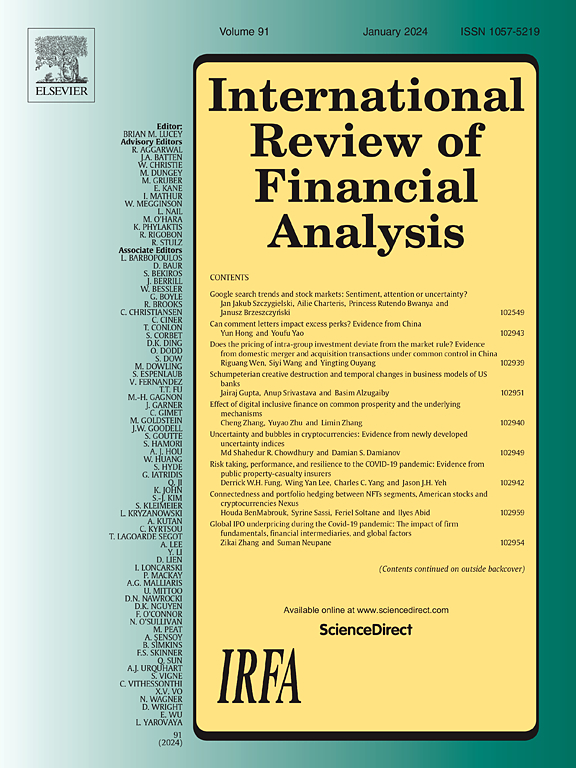
International Review of Financial Analysis
BUSINESS, FINANCE-
CiteScore
10.30
自引率
9.80%
发文量
366
期刊介绍:
The International Review of Financial Analysis (IRFA) is an impartial refereed journal designed to serve as a platform for high-quality financial research. It welcomes a diverse range of financial research topics and maintains an unbiased selection process. While not limited to U.S.-centric subjects, IRFA, as its title suggests, is open to valuable research contributions from around the world.
 求助内容:
 应助结果提醒方式:


 京公网安备 11010802042870号


