
Bidirectional Chiral-Achiral Coupling for Tunable Lateral Optical Forces in Nanoparticle Systems
IF 6
1区 物理与天体物理
Q1 MATERIALS SCIENCE, MULTIDISCIPLINARY
引用次数: 0
Abstract
Abstract Light-induced optical forces provide a powerful route for manipulating nanoparticles, and chiral optical forces are particularly important for enantioselective trapping, separation, and sensing. Existing studies have mainly focused on the force response of chiral nanoparticles themselves, while the mutual photomechanical coupling between chiral and achiral nanoparticles remains insufficiently understood. Here, we reveal a bidirectional optical-force coupling mechanism in chiral-achiral nanoparticle systems. Under linearly polarized plane-wave illumination, an achiral nanoparticle can experience a tunable lateral optical force when coupled to a neighboring chiral nanoparticle. This counterintuitive force originates from chirality-mediated mirror-symmetry breaking in the coupled scattering process, which generates an asymmetric transverse momentum flow in the scattered field. The force direction reverses when the handedness of the chiral particle is inverted, and it can also be switched by rotating the incident polarization. Conversely, adjacent achiral Mie resonators can reshape and enhance the local electromagnetic field around a small chiral particle, leading to a substantially amplified chirality-dependent lateral force. Furthermore, by extending the system from spherical chiral particles to structurally chiral helical nanostructures, we show that chirality transfer remains robust and can further reverse the direction of the lateral force on adjacent achiral particles. These results provide a mechanistic understanding of chirality transfer and near-field-enhanced optical forces in hybrid chiral-achiral nanoparticle systems and suggest new opportunities for enantioselective optical manipulation, force-based chiral sensing, and chiral nanophotonic device design.纳米粒子系统中可调侧光力的双向手性-非手性耦合
光致光力为操纵纳米粒子提供了强有力的途径,而手性光力在对映选择性捕获、分离和传感中尤为重要。现有的研究主要集中在手性纳米粒子本身的力响应上,而对手性纳米粒子和非手性纳米粒子之间的相互光力学耦合还不够了解。在这里,我们揭示了手性-非手性纳米颗粒体系中的双向光-力耦合机制。在线偏振平面波照射下,非手性纳米粒子与相邻的手性纳米粒子耦合时,可以产生可调的侧向光力。这种反直觉力源于耦合散射过程中手性介导的镜像对称性破缺,在散射场中产生不对称的横向动量流。当手性粒子的手性反转时,力方向反转,也可以通过旋转入射偏振来切换。相反,相邻的非手性Mie谐振器可以重塑和增强小手性粒子周围的局部电磁场,从而导致与手性相关的侧向力大大放大。此外,通过将系统从球形手性颗粒扩展到结构上的手性螺旋纳米结构,我们发现手性转移仍然是鲁棒的,并且可以进一步扭转邻近非手性颗粒的侧向力方向。这些结果为手性-非手性混合纳米粒子系统中的手性转移和近场增强光力提供了机制理解,并为对手性选择光学操作、基于力的手性传感和手性纳米光子器件设计提供了新的机会。
本文章由计算机程序翻译,如有差异,请以英文原文为准。
求助全文
约1分钟内获得全文
求助全文
来源期刊
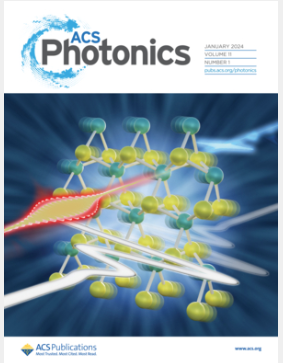
ACS Photonics
NANOSCIENCE & NANOTECHNOLOGY-MATERIALS SCIENCE, MULTIDISCIPLINARY
CiteScore
11.90
自引率
5.70%
发文量
438
审稿时长
2.3 months
期刊介绍:
Published as soon as accepted and summarized in monthly issues, ACS Photonics will publish Research Articles, Letters, Perspectives, and Reviews, to encompass the full scope of published research in this field.
 求助内容:
 应助结果提醒方式:


 京公网安备 11010802042870号


