
Post-Complexation Synthesis of Responsive Polymer Nanoparticles Functionalized with Kinetically Inert Europium(III) Complexes for Bicarbonate Sensing
IF 10.9
1区 化学
Q1 CHEMISTRY, ANALYTICAL
引用次数: 0
Abstract
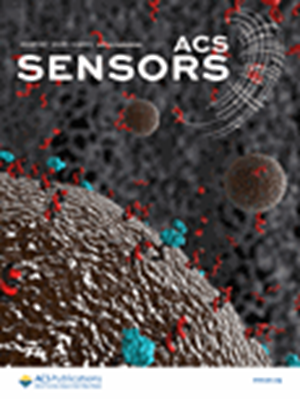
Abstract Engineering nanomaterials to perform a specific function requires control of the complex chemistry involved in the formation of the nanomaterial and thus control of the resulting architecture. Here, we explored the sequence of steps required to make responsive nanoparticles (NPs), nanooptodes, for bicarbonate sensing. The sensor action is based on lanthanide-centered interactions and lanthanide luminescence, which, in addition to providing the sensing action, informs on the NP architecture. Two NP-forming reactions were tested, but only the synthesis pathway where amphiphilic components were used reproducibly provided functional nanooptodes with a responsive lanthanide complex placed at the nanoparticle–solution interface. This protocol creates nanooptodes with a shelf life of years and an explainable response to bicarbonate. The lanthanide luminescence provides real-time feedback on the NP structure, ensuring reliability and reproducibility across sensing applications.以惰性铕(III)配合物功能化的响应性聚合物纳米颗粒的络合后合成及其在碳酸氢盐传感中的应用
要使纳米材料具有特定的功能,就需要控制纳米材料形成过程中的复杂化学反应,从而控制纳米材料的结构。在这里,我们探索了制造响应纳米粒子(NPs)所需的步骤序列,纳米光电器件,用于碳酸氢盐传感。传感器的作用是基于以镧系元素为中心的相互作用和镧系元素发光,这除了提供传感作用外,还通知了NP架构。测试了两种np形成反应,但只有两亲性成分可重复使用的合成途径提供了在纳米粒子-溶液界面上具有响应性镧系复合物的功能纳米光电器件。该方案创造了具有多年保质期和可解释的对碳酸氢盐反应的纳米光电器件。镧系发光提供了对NP结构的实时反馈,确保了传感应用的可靠性和可重复性。
本文章由计算机程序翻译,如有差异,请以英文原文为准。
求助全文
约1分钟内获得全文
求助全文
来源期刊
ACS Sensors
Chemical Engineering-Bioengineering
CiteScore
14.50
自引率
3.40%
发文量
372
期刊介绍:
ACS Sensors is a peer-reviewed research journal that focuses on the dissemination of new and original knowledge in the field of sensor science, particularly those that selectively sense chemical or biological species or processes. The journal covers a broad range of topics, including but not limited to biosensors, chemical sensors, gas sensors, intracellular sensors, single molecule sensors, cell chips, and microfluidic devices. It aims to publish articles that address conceptual advances in sensing technology applicable to various types of analytes or application papers that report on the use of existing sensing concepts in new ways or for new analytes.
 求助内容:
 应助结果提醒方式:


 京公网安备 11010802042870号


