Dongchun Wang, Haibo Ma, Xiaxia Wang, Zixuan Li, Zhaoli Yang, Shuyi Li, Youran Niu, Xiaoxuan Mao, Tao Huang, Yuan Zhao, Hong Gao, Jianmin Ma
{"title":"Kinetic Aerosol Trapping Drives Arctic Enrichment of Organophosphate Flame Retardants","authors":"Dongchun Wang, Haibo Ma, Xiaxia Wang, Zixuan Li, Zhaoli Yang, Shuyi Li, Youran Niu, Xiaoxuan Mao, Tao Huang, Yuan Zhao, Hong Gao, Jianmin Ma","doi":"10.1021/acs.est.6c09739","DOIUrl":null,"url":null,"abstract":"<p>Organophosphate\r\nflame retardants (OPFRs) are emerging contaminants\r\nposing significant risks to the Arctic environment and human health.\r\nConcerns have been raised about the origins of Arctic OPFRs because\r\natmospheric models have failed to reproduce the high Arctic OPFR levels\r\ndue to unresolved phase-partitioning dynamics and atmospheric chemistry.\r\nHere, we implement a kinetic gas-particle accumulation scheme, in\r\nwhich particle-bound OPFRs do not re-equilibrate to the gas phase,\r\ninto the atmospheric chemistry model GEOS-Chem High Performance (GCHP)\r\nv14.5.0. A 2 × 2 factorial design crossing the partitioning mechanism\r\nwith hydroxyl radical (OH) chemistry isolates the importance of each\r\nprocess. In the Arctic, kinetic accumulation reduces the apparent\r\nOH removal efficiency from 79% under equilibrium partitioning to 64%.\r\nThe corresponding atmospheric lifetime of ΣOPFRs is extended\r\nfrom 1.0 day under gas-phase-only conditions to 9.8 days under the\r\nkinetic accumulation framework. Sulfate and hydrophilic organic carbon\r\ntogether carry over 90% of the Arctic particulate OPFR burden. This\r\nkinetic scheme increases the simulated Arctic annual mean ΣOPFR\r\nconcentration from 82 pg m<sup>–3</sup> under gas-phase-only\r\nconditions and 145 pg m<sup>–3</sup> under instantaneous equilibrium\r\nto 353 pg m<sup>–3</sup>, representing 4.3-fold and 2.4-fold\r\nincreases, respectively, consistent with field measurements across\r\nthe Arctic.</p>","PeriodicalId":36,"journal":{"name":"环境科学与技术","volume":"60 41","pages":"29492–29501"},"PeriodicalIF":12.2000,"publicationDate":"2026-10-20","publicationTypes":"Journal Article","fieldsOfStudy":null,"isOpenAccess":false,"openAccessPdf":"","citationCount":"0","resultStr":null,"platform":"Semanticscholar","paperid":null,"PeriodicalName":"环境科学与技术","FirstCategoryId":"1","ListUrlMain":"https://pubs.acs.org/doi/10.1021/acs.est.6c09739","RegionNum":1,"RegionCategory":"环境科学与生态学","ArticlePicture":[],"TitleCN":null,"AbstractTextCN":null,"PMCID":null,"EPubDate":"2026/10/6 0:00:00","PubModel":"Epub","JCR":"Q1","JCRName":"ENGINEERING, ENVIRONMENTAL","Score":null,"Total":0}
引用次数: 0
Abstract
Organophosphate
flame retardants (OPFRs) are emerging contaminants
posing significant risks to the Arctic environment and human health.
Concerns have been raised about the origins of Arctic OPFRs because
atmospheric models have failed to reproduce the high Arctic OPFR levels
due to unresolved phase-partitioning dynamics and atmospheric chemistry.
Here, we implement a kinetic gas-particle accumulation scheme, in
which particle-bound OPFRs do not re-equilibrate to the gas phase,
into the atmospheric chemistry model GEOS-Chem High Performance (GCHP)
v14.5.0. A 2 × 2 factorial design crossing the partitioning mechanism
with hydroxyl radical (OH) chemistry isolates the importance of each
process. In the Arctic, kinetic accumulation reduces the apparent
OH removal efficiency from 79% under equilibrium partitioning to 64%.
The corresponding atmospheric lifetime of ΣOPFRs is extended
from 1.0 day under gas-phase-only conditions to 9.8 days under the
kinetic accumulation framework. Sulfate and hydrophilic organic carbon
together carry over 90% of the Arctic particulate OPFR burden. This
kinetic scheme increases the simulated Arctic annual mean ΣOPFR
concentration from 82 pg m–3 under gas-phase-only
conditions and 145 pg m–3 under instantaneous equilibrium
to 353 pg m–3, representing 4.3-fold and 2.4-fold
increases, respectively, consistent with field measurements across
the Arctic.
期刊介绍:
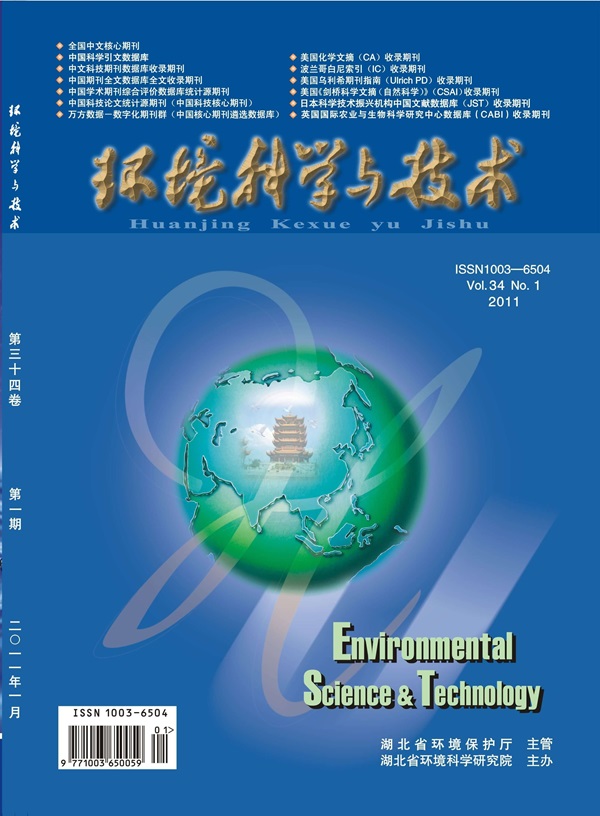
Environmental Science & Technology (ES&T) is a co-sponsored academic and technical magazine by the Hubei Provincial Environmental Protection Bureau and the Hubei Provincial Academy of Environmental Sciences.
Environmental Science & Technology (ES&T) holds the status of Chinese core journals, scientific papers source journals of China, Chinese Science Citation Database source journals, and Chinese Academic Journal Comprehensive Evaluation Database source journals. This publication focuses on the academic field of environmental protection, featuring articles related to environmental protection and technical advancements.

 求助内容:
 应助结果提醒方式:


 京公网安备 11010802042870号


