
Deep Reinforcement Learning Inverse Design of Dielectric Metasurfaces Supporting Dual Quasi‐BIC Resonances
IF 6.8
2区 物理与天体物理
Q1 MATERIALS SCIENCE, MULTIDISCIPLINARY
引用次数: 0
Abstract
ABSTRACT Optimizing resonance characteristics in dielectric metasurfaces, including the resonance wavelength, quality factor, and near‐field enhancement, is fundamental to nanophotonic applications such as sensing, nonlinear optics, and enhanced light–matter interactions. This task is especially challenging in dual quasi‐bound states in the continuum (quasi‐BIC) metasurfaces, where narrow‐linewidth resonances, strong modal coupling, and sensitivity to geometric perturbations create a highly nonconvex and constrained design landscape. Existing optimization methods, including heuristic algorithms and deep learning, are useful in simpler settings, but they often become inefficient, rely on large training datasets, or struggle to coordinate tightly coupled objectives in quasi‐BIC systems. To address these limitations, we introduce a deep reinforcement‐learning framework for the inverse design of a dielectric metasurface supporting dual quasi‐BIC resonances. A dueling double deep Q‐network with rollout is used to mitigate myopic search under coupled objectives and unstable reward responses. The resulting framework coordinates two resonance wavelengths, achieves Q factors of approximately 1219 and 1104 for the two quasi‐BIC modes, reaches an electric‐field amplitude enhancement of approximately 81, reduces the design time from 1 month to 82 h, and achieves 5 × higher sample efficiency than other mainstream high‐performance algorithms. These results demonstrate the potential of reinforcement learning for strongly coupled multi‐objective photonic optimization.支持双准BIC共振的介电元表面的深度强化学习反设计
优化介电超表面的共振特性,包括共振波长、质量因子和近场增强,是纳米光子应用的基础,如传感、非线性光学和增强光-物质相互作用。这一任务在连续体(准BIC)超表面的双准束缚态中尤其具有挑战性,其中窄线宽共振,强模态耦合以及对几何扰动的敏感性创造了高度非凸和约束的设计景观。现有的优化方法,包括启发式算法和深度学习,在更简单的环境中是有用的,但它们往往效率低下,依赖于大型训练数据集,或者在准BIC系统中难以协调紧密耦合的目标。为了解决这些限制,我们引入了一个深度强化学习框架,用于支持双准BIC共振的介电超表面的反设计。在目标耦合和奖励响应不稳定的情况下,采用了一种带滚动的双深度Q网络来缓解近视搜索。所得到的框架协调了两个共振波长,两种准BIC模式的Q因子约为1219和1104,电场振幅增强约为81,设计时间从1个月减少到82小时,样品效率比其他主流高性能算法高5倍。这些结果证明了强化学习在强耦合多目标光子优化中的潜力。
本文章由计算机程序翻译,如有差异,请以英文原文为准。
求助全文
约1分钟内获得全文
求助全文
来源期刊
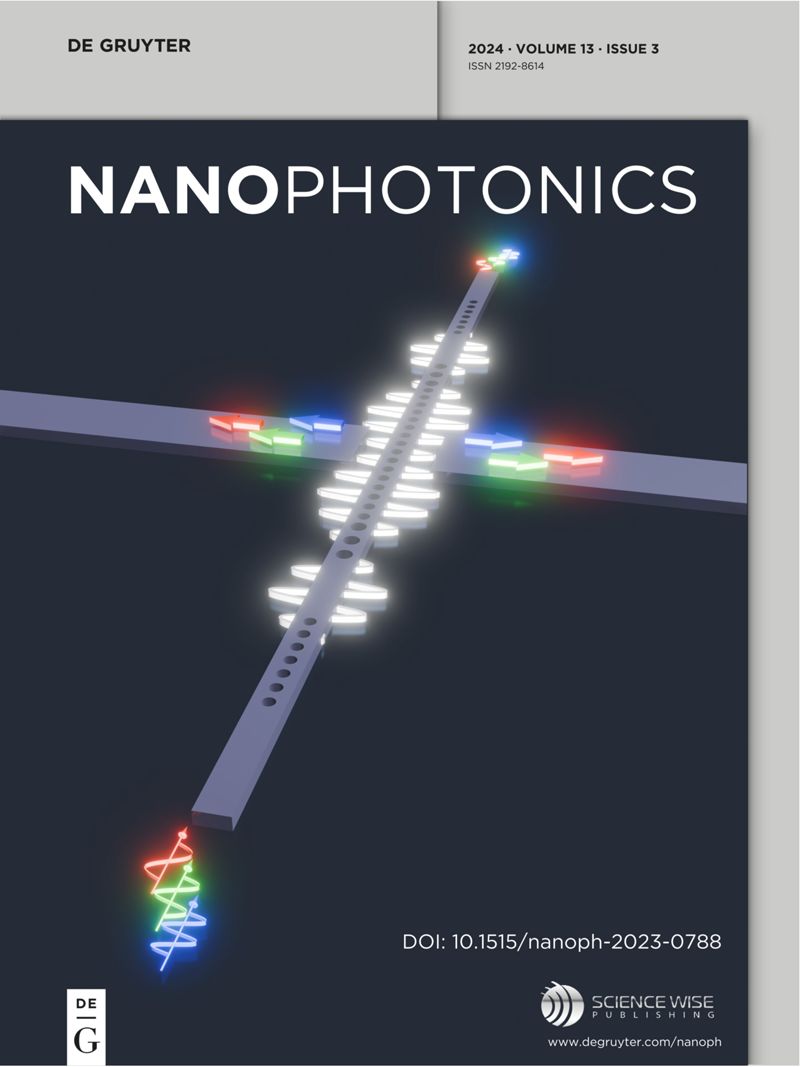
Nanophotonics
NANOSCIENCE & NANOTECHNOLOGY-MATERIALS SCIENCE, MULTIDISCIPLINARY
CiteScore
13.50
自引率
6.70%
发文量
358
审稿时长
7 weeks
期刊介绍:
Nanophotonics, published in collaboration with Sciencewise, is a prestigious journal that showcases recent international research results, notable advancements in the field, and innovative applications. It is regarded as one of the leading publications in the realm of nanophotonics and encompasses a range of article types including research articles, selectively invited reviews, letters, and perspectives.
The journal specifically delves into the study of photon interaction with nano-structures, such as carbon nano-tubes, nano metal particles, nano crystals, semiconductor nano dots, photonic crystals, tissue, and DNA. It offers comprehensive coverage of the most up-to-date discoveries, making it an essential resource for physicists, engineers, and material scientists.
 求助内容:
 应助结果提醒方式:


 京公网安备 11010802042870号


