
Impact of Undertreated Antithrombotic Therapy on Adverse Patient Outcomes: A Scientific Statement From the American Heart Association

IF 41.3 1区 医学 Q1 CARDIAC & CARDIOVASCULAR SYSTEMS
Kelly Rudd,Youssef Bessada,Geoffrey D. Barnes,Ulf G. Bronas,Ashley N. Budd,Taylor Goot,Natalie A. Montanez,Toby Trujillo,on behalf of the American Heart Association Council on Peripheral Vascular Disease; Council on Arteriosclerosis, Thrombosis and Vascular Biology; Council on Cardiovascular and Stroke Nursing; Council on Cardiovascular Radiology and Intervention; Council o
{"title":"Impact of Undertreated Antithrombotic Therapy on Adverse Patient Outcomes: A Scientific Statement From the American Heart Association","authors":"Kelly Rudd,Youssef Bessada,Geoffrey D. Barnes,Ulf G. Bronas,Ashley N. Budd,Taylor Goot,Natalie A. Montanez,Toby Trujillo,on behalf of the American Heart Association Council on Peripheral Vascular Disease; Council on Arteriosclerosis, Thrombosis and Vascular Biology; Council on Cardiovascular and Stroke Nursing; Council on Cardiovascular Radiology and Intervention; Council o","doi":"10.1161/cir.0000000000001474","DOIUrl":null,"url":null,"abstract":"Antithrombotic therapy undertreatment includes omission, nonadherence, underdosing, and clinical circumstances that result in subtherapeutic antithrombotic levels. Antithrombotic undertreatment has profound implications for patient safety, public health, and healthcare costs. Due to deviation from evidence-based clinical practice, misperceptions of bleeding versus thrombotic risk, and inequities in healthcare access, many patients with atrial fibrillation, venous thromboembolism, or peripheral artery disease remain untreated or receive suboptimal anticoagulant dosing. Antithrombotic undertreatment has been shown to increase rates of ischemic stroke, systemic embolism, recurrent thrombosis, and mortality. Real-world data continue to highlight substantial gaps in care, which appear to be magnified in patients with inequity in social determinants of health. The emergence of antithrombotic stewardship, in concert with growing bodies of literature on antithrombotic agent underdosing, represents a transformative opportunity to address these gaps through structured, interprofessional, and evidence-based approaches. Through interdisciplinary collaboration, healthcare professionals are well positioned to enhance patient health and safety by recognizing and recommitting to reducing antithrombotic undertreatment.","PeriodicalId":10331,"journal":{"name":"Circulation","volume":"15 1","pages":""},"PeriodicalIF":41.3000,"publicationDate":"2026-10-01","publicationTypes":"Journal Article","fieldsOfStudy":null,"isOpenAccess":false,"openAccessPdf":"","citationCount":"0","resultStr":null,"platform":"Semanticscholar","paperid":null,"PeriodicalName":"Circulation","FirstCategoryId":"3","ListUrlMain":"https://doi.org/10.1161/cir.0000000000001474","RegionNum":1,"RegionCategory":"医学","ArticlePicture":[],"TitleCN":null,"AbstractTextCN":null,"PMCID":null,"EPubDate":"","PubModel":"","JCR":"Q1","JCRName":"CARDIAC & CARDIOVASCULAR SYSTEMS","Score":null,"Total":0}
引用次数: 0

Abstract

Antithrombotic therapy undertreatment includes omission, nonadherence, underdosing, and clinical circumstances that result in subtherapeutic antithrombotic levels. Antithrombotic undertreatment has profound implications for patient safety, public health, and healthcare costs. Due to deviation from evidence-based clinical practice, misperceptions of bleeding versus thrombotic risk, and inequities in healthcare access, many patients with atrial fibrillation, venous thromboembolism, or peripheral artery disease remain untreated or receive suboptimal anticoagulant dosing. Antithrombotic undertreatment has been shown to increase rates of ischemic stroke, systemic embolism, recurrent thrombosis, and mortality. Real-world data continue to highlight substantial gaps in care, which appear to be magnified in patients with inequity in social determinants of health. The emergence of antithrombotic stewardship, in concert with growing bodies of literature on antithrombotic agent underdosing, represents a transformative opportunity to address these gaps through structured, interprofessional, and evidence-based approaches. Through interdisciplinary collaboration, healthcare professionals are well positioned to enhance patient health and safety by recognizing and recommitting to reducing antithrombotic undertreatment.
未充分治疗的抗血栓治疗对患者不良结果的影响:美国心脏协会的科学声明
抗血栓治疗治疗不足包括遗漏、不依从、剂量不足和导致抗血栓治疗水平低于治疗水平的临床情况。抗血栓治疗不足对患者安全、公共卫生和医疗保健费用具有深远的影响。由于偏离循证临床实践,对出血与血栓形成风险的误解,以及医疗保健机会的不公平,许多心房颤动、静脉血栓栓塞或外周动脉疾病患者仍未得到治疗或接受不理想的抗凝剂量。抗血栓治疗不足已被证明会增加缺血性中风、全身性栓塞、复发性血栓和死亡率。现实世界的数据继续突出了护理方面的巨大差距,在健康的社会决定因素不平等的患者中,这种差距似乎被放大了。抗血栓管理的出现,与越来越多的关于抗血栓药物剂量不足的文献相一致,代表了一个变革性的机会,通过结构化的、跨专业的和基于证据的方法来解决这些差距。通过跨学科的合作,医疗保健专业人员可以很好地通过认识和重新承诺减少抗血栓治疗不足来增强患者的健康和安全。
本文章由计算机程序翻译,如有差异,请以英文原文为准。
求助全文
约1分钟内获得全文 求助全文
来源期刊
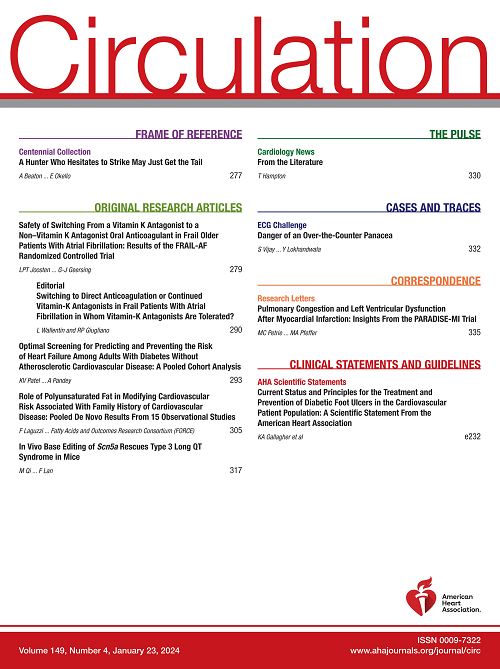
Circulation
Circulation 医学-外周血管病
CiteScore
45.70
自引率
2.10%
发文量
1473
审稿时长
2 months
期刊介绍: Circulation is a platform that publishes a diverse range of content related to cardiovascular health and disease. This includes original research manuscripts, review articles, and other contributions spanning observational studies, clinical trials, epidemiology, health services, outcomes studies, and advancements in basic and translational research. The journal serves as a vital resource for professionals and researchers in the field of cardiovascular health, providing a comprehensive platform for disseminating knowledge and fostering advancements in the understanding and management of cardiovascular issues.

×
引用
GB/T 7714-2015
复制
MLA
复制
APA
复制
导出至
BibTeX EndNote RefMan NoteFirst NoteExpress
×
提示
您的信息不完整,为了账户安全,请先补充。
现在去补充
×
提示
您因"违规操作"
具体请查看互助需知
我知道了
×
提示
确定
请完成安全验证×
copy
已复制链接
快去分享给好友吧!
我知道了
右上角分享
点击右上角分享
0
联系我们:info@booksci.cn Book学术提供免费学术资源搜索服务,方便国内外学者检索中英文文献。致力于提供最便捷和优质的服务体验。 Copyright © 2023 布克学术 All rights reserved.
京ICP备2023020795号-1
ghs 京公网安备 11010802042870号
Book学术文献互助
Book学术文献互助群
群 号:604180095
Book学术官方微信
小红书


