
A-083 Rapid screening for acute chikungunya virus infection using an interpretable machine learning model based on routine complete blood count parameters.
IF 8.3
2区 医学
Q1 MEDICAL LABORATORY TECHNOLOGY
引用次数: 0
Abstract
Background The 2025 Chikungunya virus (CHIKV) outbreak in Foshan, China, highlighted an urgent need for rapid screening tools. Molecular diagnostics are constrained by time, cost, and availability. This study aimed to develop and validate an interpretable machine learning model using routine complete blood count (CBC) parameters to identify patients at high risk of CHIKV infection. Methods A retrospective cohort study was conducted on 1,537 suspected CHIKV patients from two medical centers in Foshan. CBC and cell population data (CPD) were obtained using Mindray BC-7500 analyzers. CHIKV infection was confirmed by reverse transcription polymerase chain reaction (RT-PCR). After rigorous data preprocessing and feature selection using LASSO regression, four models Logistic Regression (LR), Support Vector Machine (SVM), Random Forest (RF), and LightGBM (LGBM) were developed on a training set (n=1,132 from Center A) and evaluated on an internal test set (n=192) and an independent external test set (n=213 from Center B). Model performance was assessed by the area under the receiver operating characteristic curve (AUC), sensitivity, specificity, and net benefit. Results In the external validation set, the LR model demonstrated superior and robust performance (AUC = 0.807, sensitivity = 88.0%, specificity = 65.0%, NPV = 93.0%), significantly outperforming the tree-based models. Decision curve analysis confirmed its clinical utility across a wide range of risk thresholds. SHAP analysis revealed that lower white blood cell count (WBC_N), lower lymphocyte percentage (Lym%), and increased neutrophil morphological heterogeneity (D_Neu_SSC_CV) were the strongest predictors, aligning with the established pathophysiology of CHIKV infection. Conclusion We developed an interpretable LR model based on CBC parameters that can effectively screen for acute CHIKV infection with high sensitivity and NPV. This model serves as a reliable, rapid, and cost-effective tool for patient triage during outbreaks, especially in resource-limited settings awaiting confirmatory PCR testing.A-083使用基于常规全血细胞计数参数的可解释机器学习模型快速筛查急性基孔肯雅病毒感染。
2025年中国佛山基孔肯雅病毒(CHIKV)暴发凸显了对快速筛查工具的迫切需求。分子诊断受到时间、成本和可用性的限制。本研究旨在利用常规全血细胞计数(CBC)参数开发和验证一种可解释的机器学习模型,以识别高危的CHIKV感染患者。方法采用回顾性队列研究方法,对佛山市2个医疗中心的1537例疑似CHIKV患者进行调查。CBC和细胞群数据(CPD)采用迈瑞BC-7500分析仪测定。逆转录聚合酶链反应(RT-PCR)证实感染。在使用LASSO回归进行严格的数据预处理和特征选择后,在训练集(来自中心a的n= 1132)上开发了逻辑回归(LR)、支持向量机(SVM)、随机森林(RF)和LightGBM (LGBM)四个模型,并在内部测试集(n=192)和独立外部测试集(n=213)上进行了评估。通过受试者工作特征曲线下面积(AUC)、敏感性、特异性和净效益来评估模型的性能。结果在外部验证集中,LR模型表现出优越的鲁棒性(AUC = 0.807,灵敏度= 88.0%,特异性= 65.0%,NPV = 93.0%),显著优于基于树的模型。决策曲线分析证实了它在广泛的风险阈值范围内的临床应用。SHAP分析显示,较低的白细胞计数(WBC_N)、较低的淋巴细胞百分比(Lym%)和增加的中性粒细胞形态异质性(D_Neu_SSC_CV)是最强的预测因子,与已建立的CHIKV感染病理生理一致。结论建立了一种基于CBC参数的可解释的LR模型,该模型可有效筛选急性CHIKV感染,具有高敏感性和NPV。该模型可作为疫情期间患者分诊的可靠、快速和具有成本效益的工具,特别是在资源有限的环境中等待验证性PCR检测。
本文章由计算机程序翻译,如有差异,请以英文原文为准。
求助全文
约1分钟内获得全文
求助全文
来源期刊
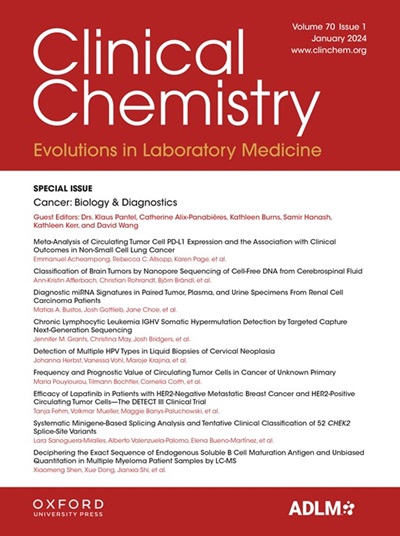
Clinical chemistry
医学-医学实验技术
CiteScore
11.30
自引率
4.30%
发文量
212
审稿时长
1.7 months
期刊介绍:
Clinical Chemistry is a peer-reviewed scientific journal that is the premier publication for the science and practice of clinical laboratory medicine. It was established in 1955 and is associated with the Association for Diagnostics & Laboratory Medicine (ADLM).
The journal focuses on laboratory diagnosis and management of patients, and has expanded to include other clinical laboratory disciplines such as genomics, hematology, microbiology, and toxicology. It also publishes articles relevant to clinical specialties including cardiology, endocrinology, gastroenterology, genetics, immunology, infectious diseases, maternal-fetal medicine, neurology, nutrition, oncology, and pediatrics.
In addition to original research, editorials, and reviews, Clinical Chemistry features recurring sections such as clinical case studies, perspectives, podcasts, and Q&A articles. It has the highest impact factor among journals of clinical chemistry, laboratory medicine, pathology, analytical chemistry, transfusion medicine, and clinical microbiology.
The journal is indexed in databases such as MEDLINE and Web of Science.
 求助内容:
 应助结果提醒方式:


 京公网安备 11010802042870号


