
B-161 Clinical Application of Magnetic Particle Chemiluminescence Method for Detecting HBV PreS1 in Chronic HBV Infection
IF 8.3
2区 医学
Q1 MEDICAL LABORATORY TECHNOLOGY
引用次数: 0
Abstract
Background To detect the role of PreS1 in different stages of chronic HBV infection and to explore its potential as a predictor of HBsAg clearance. Methods Quantitative detection of HBV PreS1 was performed on serum samples from 594 patients with chronic HBV infection, chronic hepatitis B (CHB), liver cirrhosis (LC), and hepatocellular carcinoma (HCC). The cohort of HBeAg-negative patients receiving pegylated interferon (Peg-IFN) treatment was divided into the HBsAg seroclearance group and the HBsAg non-seroclearance group based on whether HBsAg was cleared at 48 weeks. The level of PreS1 was detected using magnetic particle chemiluminescence method. Results The level of PreS1 varied in different natural history periods and was correlated with HBV serum markers. The level of PreS1 had a high diagnostic value in the diagnosis of HBV infection stages. The baseline levels of PreS1 and HBsAg in the HBsAg seroclearance group were significantly lower than those in the HBsAg non-seroclearance group. The combination of baseline PreS1 and HBsAg levels had a better predictive value for HBsAg clearance. In the HBsAg seroclearance group, PreS1 disappeared before HBsAg; in the HBsAg non-seroclearance group, PreS1 partially disappeared. The rate of decline of PreS1 and HBsAg in the HBsAg seroclearance group was faster than that in the HBsAg non-seroclearance group. The level of PreS1 in CHB patients was significantly higher than that in LC and HCC patients. Conclusion The baseline level of PreS1 is not only an important biomarker for differentiating chronic HBV infection from CHB, but also can predict HBsAg clearance in HBeAg-negative patients after Peg-IFN treatment.B-161磁颗粒化学发光法检测HBV PreS1在慢性HBV感染中的临床应用
背景:检测PreS1在慢性HBV感染不同阶段的作用,并探讨其作为HBsAg清除的预测因子的潜力。方法对594例慢性HBV感染、慢性乙型肝炎(CHB)、肝硬化(LC)、肝细胞癌(HCC)患者的血清样本进行HBV PreS1的定量检测。根据48周时HBsAg是否清除,将接受聚乙二醇化干扰素(Peg-IFN)治疗的hbeag阴性患者队列分为HBsAg血清清除组和HBsAg非血清清除组。采用磁颗粒化学发光法检测PreS1水平。结果PreS1水平在不同自然历史时期存在差异,并与HBV血清标志物相关。PreS1水平在HBV感染分期诊断中具有较高的诊断价值。HBsAg血清清除率组PreS1和HBsAg基线水平明显低于非HBsAg血清清除率组。结合基线PreS1和HBsAg水平对HBsAg清除有更好的预测价值。在HBsAg清除率组,PreS1先于HBsAg消失;在HBsAg非血清清除组,PreS1部分消失。HBsAg血清清除率组PreS1和HBsAg下降速度快于非HBsAg血清清除率组。CHB患者PreS1水平明显高于LC和HCC患者。结论PreS1基线水平不仅是区分慢性HBV感染与慢性乙型肝炎的重要生物标志物,而且可以预测Peg-IFN治疗后hbeag阴性患者的HBsAg清除率。
本文章由计算机程序翻译,如有差异,请以英文原文为准。
求助全文
约1分钟内获得全文
求助全文
来源期刊
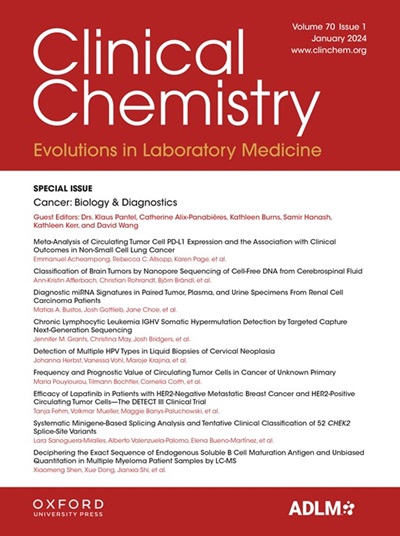
Clinical chemistry
医学-医学实验技术
CiteScore
11.30
自引率
4.30%
发文量
212
审稿时长
1.7 months
期刊介绍:
Clinical Chemistry is a peer-reviewed scientific journal that is the premier publication for the science and practice of clinical laboratory medicine. It was established in 1955 and is associated with the Association for Diagnostics & Laboratory Medicine (ADLM).
The journal focuses on laboratory diagnosis and management of patients, and has expanded to include other clinical laboratory disciplines such as genomics, hematology, microbiology, and toxicology. It also publishes articles relevant to clinical specialties including cardiology, endocrinology, gastroenterology, genetics, immunology, infectious diseases, maternal-fetal medicine, neurology, nutrition, oncology, and pediatrics.
In addition to original research, editorials, and reviews, Clinical Chemistry features recurring sections such as clinical case studies, perspectives, podcasts, and Q&A articles. It has the highest impact factor among journals of clinical chemistry, laboratory medicine, pathology, analytical chemistry, transfusion medicine, and clinical microbiology.
The journal is indexed in databases such as MEDLINE and Web of Science.
 求助内容:
 应助结果提醒方式:


 京公网安备 11010802042870号


