
B-103 Implementation of an Automated Critical Value Module in a Latin American Oncology Institute Laboratory: Process Optimization and Clinical Impact Analysis
IF 8.3
2区 医学
Q1 MEDICAL LABORATORY TECHNOLOGY
引用次数: 0
Abstract
Background In high-complexity oncology, rapid communication of laboratory critical values (CV) is essential to ensure patient safety and enable timely therapeutic interventions. Prior to implementation, the laboratory at Instituto Alexander Fleming (IAF), located in Argentina and recognized as the first private oncology center in Latin America, relied on manual identification of critical values (CV) using Excel spreadsheets. This process was prone to errors, lacked traceability, and caused delays. This study aims to assess the impact of implementing an automated CV alert module within the Laboratory Information System (LIS) on reporting efficiency and downstream clinical intervention. Methods A dual-phase study was conducted. First, a quasi-experimental pre-post implementation analysis compared a manual recording period (Nov 2022–Apr 2023) with an automated period (Nov 2023–Apr 2024). Variables included the number of communicated CV and reporting time, defined as detection-to-notification. Statistical analysis was performed to compare pre- and post-implementation periods. Laboratory analyzers (Abbott Diagnostics) were interfaced with the LIS (Kern LIS, Argentina), enabling automated alerts to be triggered when a critical value result was transmitted from the analyzer to the LIS. Second, a retrospective observational study (Nov 2023–Apr 2024) assessed clinical impact in emergency department patients and outpatients for the three most frequently reported CV analytes: Hemoglobin (HGB), white blood cells (WBC), and potassium (K). Medical response times (notification-to-action), types of clinical interventions, and hospitalization rates were evaluated. Results The implementation of the automated critical value module significantly increased the number of communicated CVs from 336 to 881 (p < 0.0001). The median reporting time was reduced from 26 to 10 minutes (p < 0.0001). Regarding clinical impact, 94.1% of outpatients and 98.8% of emergency department patients received documented medical intervention following CV notification. Specific therapeutic actions were more frequent in the emergency department (94.2%) compared with outpatients (76.5%). Emergency department settings showed faster clinical response times (median 64 minutes) and higher hospitalization rates (75.6%) compared with the outpatient setting, which had a median response time of 88 minutes and a hospitalization rate of 22.4%. Conclusion The implementation of the automated module optimized CV management by drastically reducing reporting times and enhancing data traceability. Beyond technical efficiency, the system proved to be a vital clinical support tool, ensuring high rates of timely medical interventions in more than 94% of cases. In the context of high-complexity oncologic care, where patients are particularly vulnerable to rapid clinical deterioration, these findings confirm that automation effectively supports timely, and potentially life-saving, clinical decision-making.B-103自动化临界值模块在拉丁美洲肿瘤研究所实验室的实施:流程优化和临床影响分析
背景:在高度复杂的肿瘤学中,实验室临界值(CV)的快速沟通对于确保患者安全和及时的治疗干预至关重要。在实施之前,位于阿根廷的亚历山大·弗莱明研究所(IAF)的实验室,被认为是拉丁美洲第一个私人肿瘤中心,依靠使用Excel电子表格手动识别临界值(CV)。这个过程容易出错,缺乏可追溯性,并导致延迟。本研究旨在评估在实验室信息系统(LIS)中实施自动CV警报模块对报告效率和下游临床干预的影响。方法采用两期研究。首先,对人工记录周期(2022年11月至2023年4月)和自动记录周期(2023年11月至2024年4月)进行了准实验前后分析。变量包括传播CV的数量和报告时间,定义为检测到通知。对实施前后的时间进行统计分析比较。实验室分析仪(雅培诊断)与LIS(阿根廷Kern LIS)连接,当一个临界值结果从分析仪传输到LIS时,能够触发自动警报。其次,一项回顾性观察性研究(2023年11月至2024年4月)评估了三种最常报道的CV分析物:血红蛋白(HGB)、白细胞(WBC)和钾(K)对急诊科患者和门诊患者的临床影响。评估了医疗反应时间(通知-行动)、临床干预措施类型和住院率。结果自动化临界值模块的实施使通信cv数从336个显著增加到881个(p < 0.0001)。中位报告时间从26分钟减少到10分钟(p < 0.0001)。关于临床影响,94.1%的门诊患者和98.8%的急诊科患者在CV通知后接受了记录在案的医疗干预。特殊治疗措施在急诊科(94.2%)比门诊(76.5%)更常见。与中位反应时间为88分钟、住院率为22.4%的门诊相比,急诊科的临床反应时间(中位64分钟)更快,住院率(75.6%)更高。结论自动化模块的实施通过大幅减少报告时间和增强数据可追溯性,优化了CV管理。除了技术效率之外,该系统被证明是一个重要的临床支持工具,确保了94%以上病例的高及时性医疗干预率。在高度复杂的肿瘤护理背景下,患者特别容易受到快速临床恶化的影响,这些发现证实了自动化有效地支持及时和可能挽救生命的临床决策。
本文章由计算机程序翻译,如有差异,请以英文原文为准。
求助全文
约1分钟内获得全文
求助全文
来源期刊
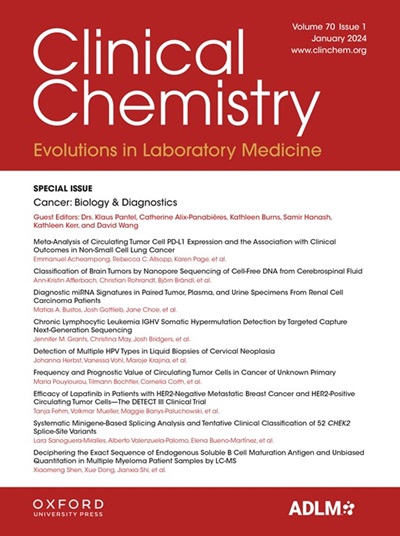
Clinical chemistry
医学-医学实验技术
CiteScore
11.30
自引率
4.30%
发文量
212
审稿时长
1.7 months
期刊介绍:
Clinical Chemistry is a peer-reviewed scientific journal that is the premier publication for the science and practice of clinical laboratory medicine. It was established in 1955 and is associated with the Association for Diagnostics & Laboratory Medicine (ADLM).
The journal focuses on laboratory diagnosis and management of patients, and has expanded to include other clinical laboratory disciplines such as genomics, hematology, microbiology, and toxicology. It also publishes articles relevant to clinical specialties including cardiology, endocrinology, gastroenterology, genetics, immunology, infectious diseases, maternal-fetal medicine, neurology, nutrition, oncology, and pediatrics.
In addition to original research, editorials, and reviews, Clinical Chemistry features recurring sections such as clinical case studies, perspectives, podcasts, and Q&A articles. It has the highest impact factor among journals of clinical chemistry, laboratory medicine, pathology, analytical chemistry, transfusion medicine, and clinical microbiology.
The journal is indexed in databases such as MEDLINE and Web of Science.
 求助内容:
 应助结果提醒方式:


 京公网安备 11010802042870号


