
B-185 Comparison of clinical and paraclinical features among NMOSD, MOGAD, and seronegative patients
IF 8.3
2区 医学
Q1 MEDICAL LABORATORY TECHNOLOGY
引用次数: 0
Abstract
Background Neuromyelitis optica spectrum disorders are autoimmune inflammatory diseases of the central nervous system, most commonly associated with anti-aquaporin-4 antibodies. A subset of patients with similar clinical presentations but negative for anti-aquaporin-4 antibodies has been identified with anti-myelin oligodendrocyte glycoprotein antibodies and classified as myelin oligodendrocyte glycoprotein antibody-associated disease. Additionally, some patients remain negative for both antibodies, creating diagnostic and therapeutic challenges. Methods A retrospective descriptive study was conducted on 75 patients with NMOSD-like clinical presentations diagnosed and treated at the University Medical Center Ho Chi Minh City from January 2022 to July 2024. Patients were stratified into three groups based on serostatus: anti-aquaporin-4 positive NMOSD, anti-myelin oligodendrocyte glycoprotein positive disease, and double-seronegative. Demographic characteristics, clinical manifestations, and paraclinical findings, including cerebrospinal fluid and serum immunological indices, were compared among the groups. Results The cohort had a mean age of 43.6 years with a strong female predominance, showing a female-to-male ratio of 6.5 to 1. Anti-aquaporin-4 antibodies were detected in 72 percent of patients, while 12 percent were classified as myelin oligodendrocyte glycoprotein antibody-associated disease and 16 percent were double-seronegative. The anti-aquaporin-4 positive group demonstrated the highest female predominance and significantly higher serum IgG levels (p < 0.001). Patients with myelin oligodendrocyte glycoprotein antibody-associated disease showed higher cerebrospinal fluid IgG levels (p = 0.019). Seronegative patients exhibited overlapping clinical and paraclinical features. Conclusion Antibody-based stratification revealed distinct clinical and paraclinical profiles among NMOSD, myelin oligodendrocyte glycoprotein antibody-associated disease, and seronegative patients. Anti-aquaporin-4 positivity accounted for the majority of cases in this cohort. In patients negative for anti-aquaporin-4 antibodies, additional anti-myelin oligodendrocyte glycoprotein testing and close clinical follow-up are essential to support accurate diagnosis and appropriate management.B-185 NMOSD、MOGAD和血清阴性患者的临床和临床旁特征比较
视神经脊髓炎谱系障碍是中枢神经系统的自身免疫性炎症性疾病,最常与抗水通道蛋白-4抗体相关。临床表现相似但抗水通道蛋白-4抗体阴性的患者亚群已被鉴定为抗髓鞘少突胶质细胞糖蛋白抗体,并归类为髓鞘少突胶质细胞糖蛋白抗体相关疾病。此外,一些患者两种抗体均呈阴性,这给诊断和治疗带来了挑战。方法对2022年1月至2024年7月在胡志明市大学医学中心诊断和治疗的75例nmosd样临床表现的患者进行回顾性描述性研究。根据血清状态将患者分为抗水通道蛋白-4阳性NMOSD、抗髓鞘少突胶质细胞糖蛋白阳性疾病和双血清阴性三组。比较两组患者的人口学特征、临床表现和临床旁表现,包括脑脊液和血清免疫指标。结果该队列平均年龄为43.6岁,女性优势明显,男女比例为6.5:1。在72%的患者中检测到抗水通道蛋白-4抗体,而12%的患者被归类为髓鞘少突胶质细胞糖蛋白抗体相关疾病,16%的患者双血清阴性。抗水通道蛋白-4阳性组表现出最高的女性优势,血清IgG水平显著升高(p < 0.001)。髓鞘少突胶质细胞糖蛋白抗体相关疾病患者脑脊液IgG水平较高(p = 0.019)。血清阴性患者表现出重叠的临床和临床特征。结论基于抗体的分层揭示了NMOSD、髓鞘少突胶质细胞糖蛋白抗体相关疾病和血清阴性患者的不同临床和临床旁特征。抗水通道蛋白-4阳性占该队列中大多数病例。对于抗水通道蛋白-4抗体阴性的患者,额外的抗髓鞘少突胶质细胞糖蛋白检测和密切的临床随访对于支持准确的诊断和适当的管理至关重要。
本文章由计算机程序翻译,如有差异,请以英文原文为准。
求助全文
约1分钟内获得全文
求助全文
来源期刊
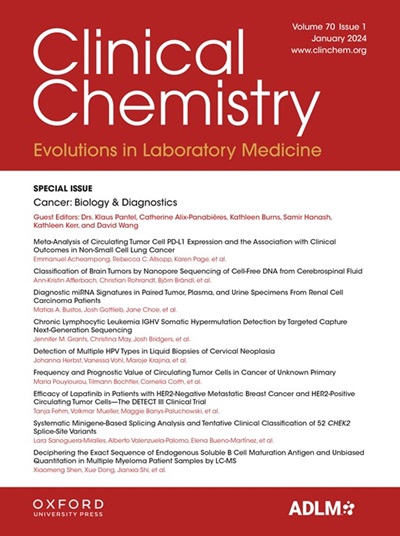
Clinical chemistry
医学-医学实验技术
CiteScore
11.30
自引率
4.30%
发文量
212
审稿时长
1.7 months
期刊介绍:
Clinical Chemistry is a peer-reviewed scientific journal that is the premier publication for the science and practice of clinical laboratory medicine. It was established in 1955 and is associated with the Association for Diagnostics & Laboratory Medicine (ADLM).
The journal focuses on laboratory diagnosis and management of patients, and has expanded to include other clinical laboratory disciplines such as genomics, hematology, microbiology, and toxicology. It also publishes articles relevant to clinical specialties including cardiology, endocrinology, gastroenterology, genetics, immunology, infectious diseases, maternal-fetal medicine, neurology, nutrition, oncology, and pediatrics.
In addition to original research, editorials, and reviews, Clinical Chemistry features recurring sections such as clinical case studies, perspectives, podcasts, and Q&A articles. It has the highest impact factor among journals of clinical chemistry, laboratory medicine, pathology, analytical chemistry, transfusion medicine, and clinical microbiology.
The journal is indexed in databases such as MEDLINE and Web of Science.
 求助内容:
 应助结果提醒方式:


 京公网安备 11010802042870号


