
A Spatially‐Resolved Approach via Quantifying the Dominant Yet Overlooked Orbital‐Weighted Energy Contribution for Breaking Solvent Oxidation Chemistry
IF 25.5
1区 材料科学
Q1 CHEMISTRY, PHYSICAL
引用次数: 0
Abstract
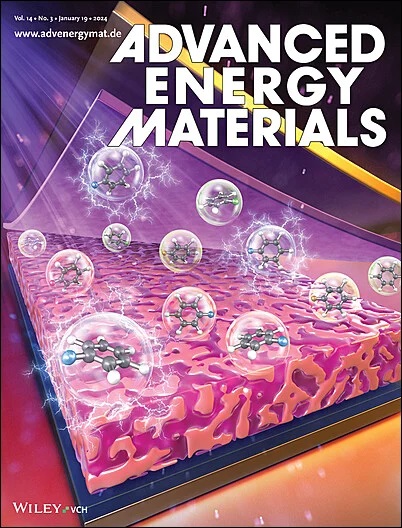
Rational design of solvents with high oxidation chemistry stability represents an essential path toward pursuing high‐energy‐density batteries. Conventional methods assess oxidation stability using orbital energy level/ionization energetics; however, they misjudge the local nature of electron loss by ignoring the influence of collective orbitals on electron energy. Herein, we propose a spatially‐resolved energetics approach called Pseudo‐Eox, where the core average local ionization energy minimum parameter is used to measure the vulnerability of the highest‐energy electron via electron‐density‐weighted orbital energy averaging and to pinpoint its prevalent sub‐HOMO localization. This approach reproduces the oxidation stability trend of HOMO‐dominant solvents (EC/PC with quantified contributions > 60%), while mechanistically revealing why conventional models fail in most cases like DEC with HOMO contribution < 24%. Its robustness is demonstrated on 20 regular solvents with mean absolute error of only 0.38 V. Following this, taking potentially practical fluorinated solvents as a prototype, we retrieve the 2‐fluoroethyl 2,2,2‐trifluoroethyl, which will be overlooked by HOMO‐based rankings, exhibiting the highest theoretical oxidation stability (6.45 V) among candidates obtained by constructing 147 widely adopted carbonate/ether derivatives. This study overturns the single‐orbital‐only cognition of solvent oxidation, offering a spatially informed energetics perspective for investigating organic chemistry where localized electron loss governs stability and functionality.一种空间分解方法,通过量化溶剂氧化化学中占主导地位但被忽视的轨道加权能量贡献
合理设计具有高氧化化学稳定性的溶剂是追求高能量密度电池的重要途径。传统方法使用轨道能级/电离能量学评估氧化稳定性;然而,他们忽略了集体轨道对电子能量的影响,错误地判断了电子损失的局域性质。在此,我们提出了一种称为Pseudo - Eox的空间分辨能量学方法,其中使用核心平均局部电离能最小参数通过电子密度加权轨道能量平均来测量最高能量电子的易损性,并确定其普遍的亚HOMO定位。该方法再现了HOMO -优势溶剂(EC/PC,贡献量化为60%)的氧化稳定性趋势,同时从机制上揭示了为什么传统模型在大多数情况下失败,如DEC,贡献为24%。该方法在20种常规溶剂上的稳健性得到了验证,平均绝对误差仅为0.38 V。接下来,以潜在的实用氟化溶剂为原型,我们检索了2 -氟乙基2,2,2 -三氟乙基,这将被HOMO - based排名所忽略,在构建147个广泛采用的碳酸盐/醚衍生物得到的候选物中,表现出最高的理论氧化稳定性(6.45 V)。这项研究推翻了对溶剂氧化的单轨道认知,为研究局部电子损失控制稳定性和功能的有机化学提供了一个空间信息的能量学视角。
本文章由计算机程序翻译,如有差异,请以英文原文为准。
求助全文
约1分钟内获得全文
求助全文
来源期刊
Advanced Energy Materials
CHEMISTRY, PHYSICAL-ENERGY & FUELS
CiteScore
41.90
自引率
4.00%
发文量
889
审稿时长
1.4 months
期刊介绍:
Established in 2011, Advanced Energy Materials is an international, interdisciplinary, English-language journal that focuses on materials used in energy harvesting, conversion, and storage. It is regarded as a top-quality journal alongside Advanced Materials, Advanced Functional Materials, and Small.
With a 2022 Impact Factor of 27.8, Advanced Energy Materials is considered a prime source for the best energy-related research. The journal covers a wide range of topics in energy-related research, including organic and inorganic photovoltaics, batteries and supercapacitors, fuel cells, hydrogen generation and storage, thermoelectrics, water splitting and photocatalysis, solar fuels and thermosolar power, magnetocalorics, and piezoelectronics.
The readership of Advanced Energy Materials includes materials scientists, chemists, physicists, and engineers in both academia and industry. The journal is indexed in various databases and collections, such as Advanced Technologies & Aerospace Database, FIZ Karlsruhe, INSPEC (IET), Science Citation Index Expanded, Technology Collection, and Web of Science, among others.
 求助内容:
 应助结果提醒方式:


 京公网安备 11010802042870号


