Siloxane-Based Additives via Electronic Structure Tailoring: A Key Strategy for High-Efficiency and Stable Organic Solar Cells Compatible with Air and Green Solvent Processing†
{"title":"Siloxane-Based Additives via Electronic Structure Tailoring: A Key Strategy for High-Efficiency and Stable Organic Solar Cells Compatible with Air and Green Solvent Processing†","authors":"Xing Chen, Mingqing Chen, Lianjie Zhang, Dongge Ma, Junwu Chen","doi":"10.1002/cjoc.70746","DOIUrl":null,"url":null,"abstract":"<div>\n \n <p>To advance organic solar cells (OSCs) commercialization, high efficiency and stable devices processed in air and eco-friendly conditions are essential. Herein, two siloxane-based additives, Th-SiO incorporating an electron-donating thiophene unit and Qx-SiO incorporating an electron-deficient quinoxaline unit, were developed. The two retained additives exhibited excellent multifunctionality. In the PM6:L8-BO system, they could effectively regulate intermolecular interactions and active layer morphology, optimize charge transport, and suppress charge recombination. The two additives significantly enhanced the photovoltaic performance of devices fabricated under N<sub>2</sub> and high-humidity air conditions, while also enabling high-performance air processing with a non-halogenated green solvent. Both additives showed good universality. When using 2PACz as the hole transporting layer material, Th-SiO-processed D18:L8-BO devices achieved an efficiency of 20.39%. In the PM6:L8-BO system, the additives Th-SiO and Qx-SiO improved the light and thermal stabilities of the devices simultaneously, yet exhibited different characteristics: Qx-SiO-processed devices showed superior light stability, whereas Th-SiO-processed devices exhibited better thermal stability. The research provides valuable insights for the chemical structure design of novel multifunctional additives.</p>\n <p></p>\n </div>","PeriodicalId":151,"journal":{"name":"Chinese Journal of Chemistry","volume":"44 21","pages":"3441-3452"},"PeriodicalIF":5.7000,"publicationDate":"2026-10-01","publicationTypes":"Journal Article","fieldsOfStudy":null,"isOpenAccess":false,"openAccessPdf":"","citationCount":"0","resultStr":null,"platform":"Semanticscholar","paperid":null,"PeriodicalName":"Chinese Journal of Chemistry","FirstCategoryId":"92","ListUrlMain":"https://onlinelibrary.wiley.com/doi/10.1002/cjoc.70746","RegionNum":1,"RegionCategory":"化学","ArticlePicture":[],"TitleCN":null,"AbstractTextCN":null,"PMCID":null,"EPubDate":"2026/9/8 0:00:00","PubModel":"Epub","JCR":"Q2","JCRName":"CHEMISTRY, MULTIDISCIPLINARY","Score":null,"Total":0}
引用次数: 0
Abstract
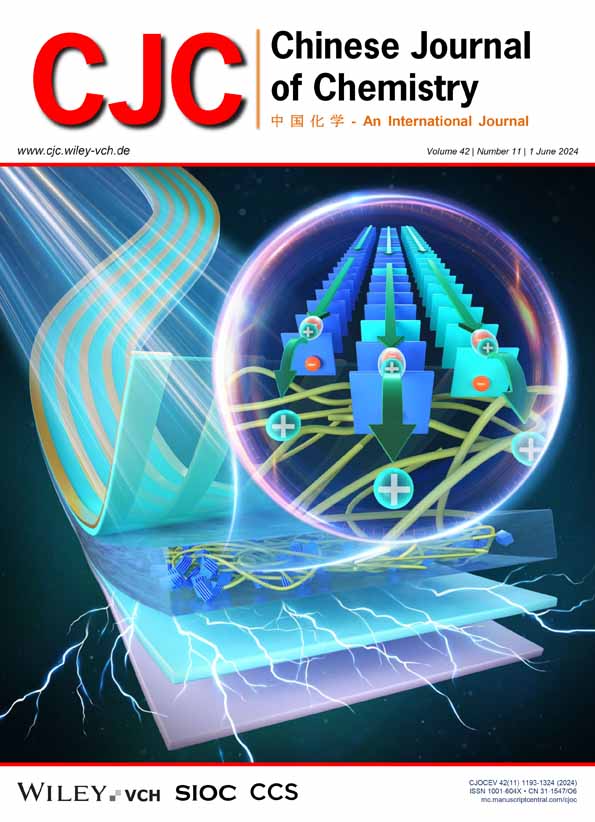
To advance organic solar cells (OSCs) commercialization, high efficiency and stable devices processed in air and eco-friendly conditions are essential. Herein, two siloxane-based additives, Th-SiO incorporating an electron-donating thiophene unit and Qx-SiO incorporating an electron-deficient quinoxaline unit, were developed. The two retained additives exhibited excellent multifunctionality. In the PM6:L8-BO system, they could effectively regulate intermolecular interactions and active layer morphology, optimize charge transport, and suppress charge recombination. The two additives significantly enhanced the photovoltaic performance of devices fabricated under N2 and high-humidity air conditions, while also enabling high-performance air processing with a non-halogenated green solvent. Both additives showed good universality. When using 2PACz as the hole transporting layer material, Th-SiO-processed D18:L8-BO devices achieved an efficiency of 20.39%. In the PM6:L8-BO system, the additives Th-SiO and Qx-SiO improved the light and thermal stabilities of the devices simultaneously, yet exhibited different characteristics: Qx-SiO-processed devices showed superior light stability, whereas Th-SiO-processed devices exhibited better thermal stability. The research provides valuable insights for the chemical structure design of novel multifunctional additives.
期刊介绍:
The Chinese Journal of Chemistry is an international forum for peer-reviewed original research results in all fields of chemistry. Founded in 1983 under the name Acta Chimica Sinica English Edition and renamed in 1990 as Chinese Journal of Chemistry, the journal publishes a stimulating mixture of Accounts, Full Papers, Notes and Communications in English.

 求助内容:
 应助结果提醒方式:


 京公网安备 11010802042870号


