{"title":"[Analysis of the rule of guiding inclinations of maxillary posterior teeth and their correlation with mandibular movement trajectory angles].","authors":"J Y Zhu, J Li, J W Yang, Z N Liu, T Jiang","doi":"10.3760/cma.j.cn112144-20260130-00070","DOIUrl":null,"url":null,"abstract":"<p><p><b>Objective:</b> To analyze the angle of maxillary posterior guiding inclination (referred to as maxillary guiding inclination) during mandibular protrusive and lateral movements, as well as its relationship with the trajectory angle of the corresponding mandibular posterior buccal cusp apex (referred to as mandibular trajectory angle), providing the feasibility of directly using mandibular movement trajectory for occlusal design and pre-adjustment of digital prostheses. <b>Methods:</b> Eighteen medical student volunteers with individual normal occlusion aged 23-27 years were recruited from Peking University School and Hospital of Stomatology. Their maxillary and mandibular dentition models and occlusal relationship data were obtained via intraoral scanning. Mandibular movement trajectories were recorded using a mandibular motion analyzer. Geomagic Studio software aligned coordinate systems between dental models and kinematic data. Using the occlusal plane as a reference, the angles of the guiding inclinations (the distal surfaces and lingual surfaces of the buccal cusps) of each maxillary posterior tooth during protrusive and lateral movements (hereinafter referred to as the guiding inclinations), as well as the trajectory angles of the corresponding mandibular buccal cusp apices during mandibular lateral and protrusive movements (hereinafter referred to as the trajectory angles), were measured respectively. The variation regularity of each angle and the correlation between the angles were analyzed. <b>Results:</b> The guiding inclination varied among different tooth positions and differed from the trajectory angles. The protrusive guiding inclination (16.31°-27.40°) was smaller than the protrusive trajectory angles (34.29°-35.99°). The maxillary guiding inclination decreased first and then increased, while the latter remained relatively stable, with no statistically significant correlation between them (<i>r</i>=0.23, 0.31, 0.30, 0.05, all <i>P</i>>0.05). The lateral guiding inclination gradually decreased from the first premolar to the second molar (31.48°-13.06°), whereas the lateral trajectory angles remained relatively stable (22.32°-17.10°). A positive correlation existed between them (<i>r</i>=0.74, 0.65, 0.61, 0.62, all <i>P</i><0.05). <b>Conclusions:</b> During mandibular protrusion, the guiding inclination varies significantly while the trajectory angles remain relatively stable, with no correlation observed between them. In contrast, during lateral mandibular movement, the guiding inclination and trajectory angles show a positive correlation.</p>","PeriodicalId":23965,"journal":{"name":"中华口腔医学杂志","volume":"61 10","pages":"1491-1496"},"PeriodicalIF":0.0000,"publicationDate":"2026-10-09","publicationTypes":"Journal Article","fieldsOfStudy":null,"isOpenAccess":false,"openAccessPdf":"","citationCount":"0","resultStr":null,"platform":"Semanticscholar","paperid":null,"PeriodicalName":"中华口腔医学杂志","FirstCategoryId":"3","ListUrlMain":"https://doi.org/10.3760/cma.j.cn112144-20260130-00070","RegionNum":0,"RegionCategory":null,"ArticlePicture":[],"TitleCN":null,"AbstractTextCN":null,"PMCID":null,"EPubDate":"","PubModel":"","JCR":"Q4","JCRName":"Medicine","Score":null,"Total":0}
引用次数: 0
Abstract
Objective: To analyze the angle of maxillary posterior guiding inclination (referred to as maxillary guiding inclination) during mandibular protrusive and lateral movements, as well as its relationship with the trajectory angle of the corresponding mandibular posterior buccal cusp apex (referred to as mandibular trajectory angle), providing the feasibility of directly using mandibular movement trajectory for occlusal design and pre-adjustment of digital prostheses. Methods: Eighteen medical student volunteers with individual normal occlusion aged 23-27 years were recruited from Peking University School and Hospital of Stomatology. Their maxillary and mandibular dentition models and occlusal relationship data were obtained via intraoral scanning. Mandibular movement trajectories were recorded using a mandibular motion analyzer. Geomagic Studio software aligned coordinate systems between dental models and kinematic data. Using the occlusal plane as a reference, the angles of the guiding inclinations (the distal surfaces and lingual surfaces of the buccal cusps) of each maxillary posterior tooth during protrusive and lateral movements (hereinafter referred to as the guiding inclinations), as well as the trajectory angles of the corresponding mandibular buccal cusp apices during mandibular lateral and protrusive movements (hereinafter referred to as the trajectory angles), were measured respectively. The variation regularity of each angle and the correlation between the angles were analyzed. Results: The guiding inclination varied among different tooth positions and differed from the trajectory angles. The protrusive guiding inclination (16.31°-27.40°) was smaller than the protrusive trajectory angles (34.29°-35.99°). The maxillary guiding inclination decreased first and then increased, while the latter remained relatively stable, with no statistically significant correlation between them (r=0.23, 0.31, 0.30, 0.05, all P>0.05). The lateral guiding inclination gradually decreased from the first premolar to the second molar (31.48°-13.06°), whereas the lateral trajectory angles remained relatively stable (22.32°-17.10°). A positive correlation existed between them (r=0.74, 0.65, 0.61, 0.62, all P<0.05). Conclusions: During mandibular protrusion, the guiding inclination varies significantly while the trajectory angles remain relatively stable, with no correlation observed between them. In contrast, during lateral mandibular movement, the guiding inclination and trajectory angles show a positive correlation.
期刊介绍:
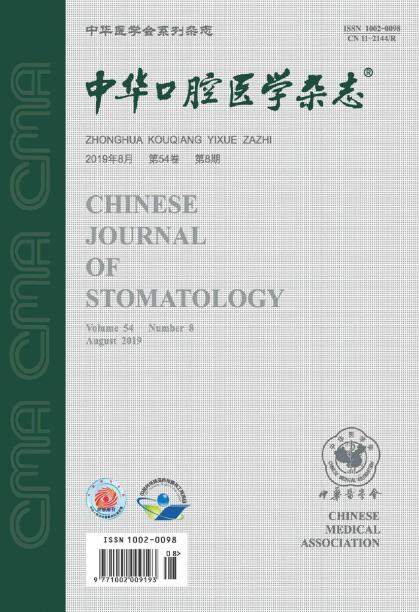
Founded in August 1953, Chinese Journal of Stomatology is a monthly academic journal of stomatology published publicly at home and abroad, sponsored by the Chinese Medical Association and co-sponsored by the Chinese Stomatology Association. It mainly reports the leading scientific research results and clinical diagnosis and treatment experience in the field of oral medicine, as well as the basic theoretical research that has a guiding role in oral clinical practice and is closely combined with oral clinical practice.
Chinese Journal of Over the years, Stomatology has been published in Medline, Scopus database, Toxicology Abstracts Database, Chemical Abstracts Database, American Cancer database, Russian Abstracts database, China Core Journal of Science and Technology, Peking University Core Journal, CSCD and other more than 20 important journals at home and abroad Physical medicine database and retrieval system included.

 求助内容:
 应助结果提醒方式:


 京公网安备 11010802042870号


