{"title":"[Impact of storage conditions on the dimensional stability of peri-implant soft tissue replicas: an <i>in vitro</i> study].","authors":"J Y Han, Z Yu, Y L Wu, J Ma, W J Ma, J Wang","doi":"10.3760/cma.j.cn112144-20260508-00292","DOIUrl":null,"url":null,"abstract":"<p><p><b>Objective:</b> To investigate the effects of storage conditions on the dimensional stability of peri-implant soft tissue (PIST) replicas, and to identify both the time-dependent deformation and the clinically acceptable storage duration. <b>Methods:</b> A patient who had received single dental implant and temporary prosthesis in the anterior aesthetic region undergoing final restoration was selected in October 2020 from Department of Oral Implantation, School of Stomatology, The Fourth Military Medical University. Based on digital impression, twenty-four maxillary die-trimmed arch and PIST replicas were fabricated by a digital light projection three-dimensional (3D) printer, followed by implant-level assembly. The combined models were enrolled into different groups according to storage conditions: light-exposed (<i>n</i>=12); and dark-stored (<i>n</i>=12). Storage times were divided into 0, 3, 5, 7, 14, 28, 60, 90 d. 3D model scanner was performed to obtain standard tessellation language (STL) files of the combined models within 24 h of printing completion, while models saved under experimental conditions were scanned to generate the \".stl\" dataset. The dataset of N-Lit/Box-Tx was then pairwise aligned with the reference file (N-T0) using surface-matching software of Geomagic Control X, with the emergence profile defined as the region of interest (ROI). Root mean square error (RMSE) was used to conduct the dimensional stability of PIST replicas. <b>Results:</b> Two-dimensional deviation analysis using three-way ANOVA revealed that storage time (<i>F</i>=32.89, <i>P</i><0.001) and storage condition (<i>F</i>=18.76, <i>P</i><0.001) significantly influenced the dimensional stability of the emergence profile. The 3D RMSE increased significantly from day 5 onward (<i>P</i><0.05) and did not reach a stable state by 90 d. At 90 d, the RMSE values in both groups reached their maxima, with (55.6±2.5) μm in the light-exposed group and (51.1±5.5) μm in the dark-stored group. <b>Conclusions:</b> The 3D-printed PIST replicas exhibited time-dependent deformation, with early changes being most pronounced. Light exposure accelerated instability in the emergence profile, while dark storage preserved dimensional stability.</p>","PeriodicalId":23965,"journal":{"name":"中华口腔医学杂志","volume":"61 10","pages":"1483-1490"},"PeriodicalIF":0.0000,"publicationDate":"2026-09-30","publicationTypes":"Journal Article","fieldsOfStudy":null,"isOpenAccess":false,"openAccessPdf":"","citationCount":"0","resultStr":null,"platform":"Semanticscholar","paperid":null,"PeriodicalName":"中华口腔医学杂志","FirstCategoryId":"3","ListUrlMain":"https://doi.org/10.3760/cma.j.cn112144-20260508-00292","RegionNum":0,"RegionCategory":null,"ArticlePicture":[],"TitleCN":null,"AbstractTextCN":null,"PMCID":null,"EPubDate":"","PubModel":"","JCR":"Q4","JCRName":"Medicine","Score":null,"Total":0}
引用次数: 0
Abstract
Objective: To investigate the effects of storage conditions on the dimensional stability of peri-implant soft tissue (PIST) replicas, and to identify both the time-dependent deformation and the clinically acceptable storage duration. Methods: A patient who had received single dental implant and temporary prosthesis in the anterior aesthetic region undergoing final restoration was selected in October 2020 from Department of Oral Implantation, School of Stomatology, The Fourth Military Medical University. Based on digital impression, twenty-four maxillary die-trimmed arch and PIST replicas were fabricated by a digital light projection three-dimensional (3D) printer, followed by implant-level assembly. The combined models were enrolled into different groups according to storage conditions: light-exposed (n=12); and dark-stored (n=12). Storage times were divided into 0, 3, 5, 7, 14, 28, 60, 90 d. 3D model scanner was performed to obtain standard tessellation language (STL) files of the combined models within 24 h of printing completion, while models saved under experimental conditions were scanned to generate the ".stl" dataset. The dataset of N-Lit/Box-Tx was then pairwise aligned with the reference file (N-T0) using surface-matching software of Geomagic Control X, with the emergence profile defined as the region of interest (ROI). Root mean square error (RMSE) was used to conduct the dimensional stability of PIST replicas. Results: Two-dimensional deviation analysis using three-way ANOVA revealed that storage time (F=32.89, P<0.001) and storage condition (F=18.76, P<0.001) significantly influenced the dimensional stability of the emergence profile. The 3D RMSE increased significantly from day 5 onward (P<0.05) and did not reach a stable state by 90 d. At 90 d, the RMSE values in both groups reached their maxima, with (55.6±2.5) μm in the light-exposed group and (51.1±5.5) μm in the dark-stored group. Conclusions: The 3D-printed PIST replicas exhibited time-dependent deformation, with early changes being most pronounced. Light exposure accelerated instability in the emergence profile, while dark storage preserved dimensional stability.
期刊介绍:
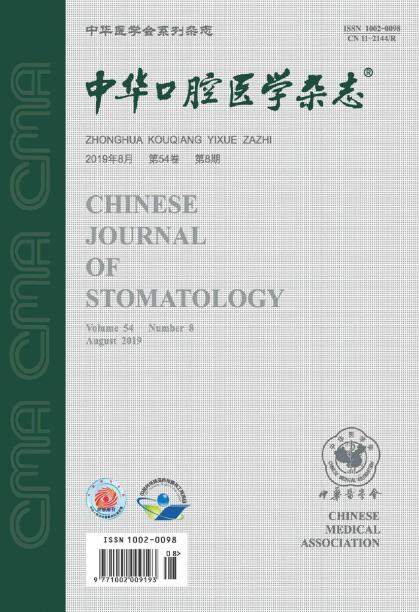
Founded in August 1953, Chinese Journal of Stomatology is a monthly academic journal of stomatology published publicly at home and abroad, sponsored by the Chinese Medical Association and co-sponsored by the Chinese Stomatology Association. It mainly reports the leading scientific research results and clinical diagnosis and treatment experience in the field of oral medicine, as well as the basic theoretical research that has a guiding role in oral clinical practice and is closely combined with oral clinical practice.
Chinese Journal of Over the years, Stomatology has been published in Medline, Scopus database, Toxicology Abstracts Database, Chemical Abstracts Database, American Cancer database, Russian Abstracts database, China Core Journal of Science and Technology, Peking University Core Journal, CSCD and other more than 20 important journals at home and abroad Physical medicine database and retrieval system included.

 求助内容:
 应助结果提醒方式:


 京公网安备 11010802042870号


