{"title":"[Analysis of oral health status in Chinese children with Williams syndrome].","authors":"L H Lyu, X W Ye, F Zhang, C Ji, J M Su","doi":"10.3760/cma.j.cn112144-20251218-00521","DOIUrl":null,"url":null,"abstract":"<p><p><b>Objective:</b> To investigate the oral health status of Chinese children with Williams syndrome (WS), providing a basis for the comprehensive prevention, treatment, and early intervention of oral diseases associated with this syndrome. <b>Methods:</b> This was a cross-sectional descriptive study. A total of 137 children with WS aged 3 to 12 years who visited the Department of Stomatology at the Children's Hospital, Zhejiang University School of Medicine from January 2023 to May 2025 were enrolled and divided into two groups: 81 children aged 3 to 5 years and 56 children aged 6 to 12 years. All participants underwent routine oral examinations. Oral health status was assessed from three aspects: dental caries indicators, dental developmental anomalies, and malocclusion. The distribution of oral phenotypes was compared across age groups and between the sexes. Caries indicators were also compared with those of same-aged children from the Fourth National Oral Health Epidemiological Survey of China (2018). Univariate and multivariate logistic regression analyses were used to explore factors independently associated with malocclusion. <b>Results:</b> Children with WS exhibited prominent oral health problems. Regarding dental caries, in the 3 to 5 years group, the prevalence of caries in primary teeth was 64.2% (52/81), with dmft (decayed, missing, and filled teeth) of 4.48±2.39 and a caries filling ratio of 6.8%(17/249). In the 6 to 12 years group, the prevalence of caries in primary teeth was 76.8% (43/56), with dmft of 4.89±3.12 and a caries filling ratio of 23.7% (65/274); the prevalence of caries in permanent teeth in the same group was 23.2% (13/56), with a mean DMFT (Decayed, Missing, and Filled Teeth) of 0.46±1.05 and a caries filling ratio of 19.2% (5/26). Regarding dental developmental anomalies, congenital tooth agenesis and incisor morphological anomalies were the most common findings. The prevalence of congenital tooth agenesis was 35.8% (29/81) in the 3 to 5 years group and 66.1% (37/56) in the 6 to 12 years group. The prevalence of incisor morphological anomalies was 64.2% (52/81) and 60.7% (34/56) in two groups, respectively. The overall prevalence of malocclusion was 66.7% (54/81) in the 3 to 5 years group, with the top three types being diastema [43.2% (35/81)], crossbite [23.5% (19/81)], and deep overbite [19.8% (16/81)]. In the 6 to 12 years group, the prevalence was 32.1% (18/56), with the top three being increased overjet [35.7% (20/56)], deep overbite [33.9% (19/56)], and diastema [33.9% (19/56)]. Multivariate Logistic regression analysis showed that high caries status [adjusted odds ratio (aOR)=2.26, 95% confidence interval (CI): 1.01-5.05, P=0.046] and congenital tooth agenesis (aOR=2.86, 95%CI: 1.26-6.52, P=0.012) were independently associated with malocclusion. <b>Conclusions:</b> Children with WS exhibit high prevalences of dental caries, developmental anomalies, and malocclusion, along with poorer oral health than typically developing children. A comprehensive management plan should include regular oral check-ups, active caries prevention, monitoring of developmental anomalies, and early orthodontic intervention. In addition, a multidisciplinary team approach is recommended.</p>","PeriodicalId":23965,"journal":{"name":"中华口腔医学杂志","volume":"61 10","pages":"1456-1465"},"PeriodicalIF":0.0000,"publicationDate":"2026-09-30","publicationTypes":"Journal Article","fieldsOfStudy":null,"isOpenAccess":false,"openAccessPdf":"","citationCount":"0","resultStr":null,"platform":"Semanticscholar","paperid":null,"PeriodicalName":"中华口腔医学杂志","FirstCategoryId":"3","ListUrlMain":"https://doi.org/10.3760/cma.j.cn112144-20251218-00521","RegionNum":0,"RegionCategory":null,"ArticlePicture":[],"TitleCN":null,"AbstractTextCN":null,"PMCID":null,"EPubDate":"","PubModel":"","JCR":"Q4","JCRName":"Medicine","Score":null,"Total":0}
引用次数: 0
Abstract
Objective: To investigate the oral health status of Chinese children with Williams syndrome (WS), providing a basis for the comprehensive prevention, treatment, and early intervention of oral diseases associated with this syndrome. Methods: This was a cross-sectional descriptive study. A total of 137 children with WS aged 3 to 12 years who visited the Department of Stomatology at the Children's Hospital, Zhejiang University School of Medicine from January 2023 to May 2025 were enrolled and divided into two groups: 81 children aged 3 to 5 years and 56 children aged 6 to 12 years. All participants underwent routine oral examinations. Oral health status was assessed from three aspects: dental caries indicators, dental developmental anomalies, and malocclusion. The distribution of oral phenotypes was compared across age groups and between the sexes. Caries indicators were also compared with those of same-aged children from the Fourth National Oral Health Epidemiological Survey of China (2018). Univariate and multivariate logistic regression analyses were used to explore factors independently associated with malocclusion. Results: Children with WS exhibited prominent oral health problems. Regarding dental caries, in the 3 to 5 years group, the prevalence of caries in primary teeth was 64.2% (52/81), with dmft (decayed, missing, and filled teeth) of 4.48±2.39 and a caries filling ratio of 6.8%(17/249). In the 6 to 12 years group, the prevalence of caries in primary teeth was 76.8% (43/56), with dmft of 4.89±3.12 and a caries filling ratio of 23.7% (65/274); the prevalence of caries in permanent teeth in the same group was 23.2% (13/56), with a mean DMFT (Decayed, Missing, and Filled Teeth) of 0.46±1.05 and a caries filling ratio of 19.2% (5/26). Regarding dental developmental anomalies, congenital tooth agenesis and incisor morphological anomalies were the most common findings. The prevalence of congenital tooth agenesis was 35.8% (29/81) in the 3 to 5 years group and 66.1% (37/56) in the 6 to 12 years group. The prevalence of incisor morphological anomalies was 64.2% (52/81) and 60.7% (34/56) in two groups, respectively. The overall prevalence of malocclusion was 66.7% (54/81) in the 3 to 5 years group, with the top three types being diastema [43.2% (35/81)], crossbite [23.5% (19/81)], and deep overbite [19.8% (16/81)]. In the 6 to 12 years group, the prevalence was 32.1% (18/56), with the top three being increased overjet [35.7% (20/56)], deep overbite [33.9% (19/56)], and diastema [33.9% (19/56)]. Multivariate Logistic regression analysis showed that high caries status [adjusted odds ratio (aOR)=2.26, 95% confidence interval (CI): 1.01-5.05, P=0.046] and congenital tooth agenesis (aOR=2.86, 95%CI: 1.26-6.52, P=0.012) were independently associated with malocclusion. Conclusions: Children with WS exhibit high prevalences of dental caries, developmental anomalies, and malocclusion, along with poorer oral health than typically developing children. A comprehensive management plan should include regular oral check-ups, active caries prevention, monitoring of developmental anomalies, and early orthodontic intervention. In addition, a multidisciplinary team approach is recommended.
期刊介绍:
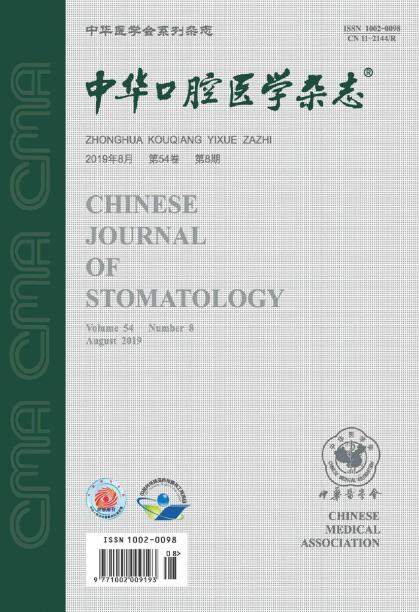
Founded in August 1953, Chinese Journal of Stomatology is a monthly academic journal of stomatology published publicly at home and abroad, sponsored by the Chinese Medical Association and co-sponsored by the Chinese Stomatology Association. It mainly reports the leading scientific research results and clinical diagnosis and treatment experience in the field of oral medicine, as well as the basic theoretical research that has a guiding role in oral clinical practice and is closely combined with oral clinical practice.
Chinese Journal of Over the years, Stomatology has been published in Medline, Scopus database, Toxicology Abstracts Database, Chemical Abstracts Database, American Cancer database, Russian Abstracts database, China Core Journal of Science and Technology, Peking University Core Journal, CSCD and other more than 20 important journals at home and abroad Physical medicine database and retrieval system included.

 求助内容:
 应助结果提醒方式:


 京公网安备 11010802042870号


