{"title":"Visualizing energy transfer across a hexagonal Cs<sub>4</sub>PbBr<sub>6</sub> microdisk using single-particle spectroscopy.","authors":"Soumik De, Mrinal Kanti Panda, Subhadip Ghosh","doi":"10.1039/d6nh00287k","DOIUrl":null,"url":null,"abstract":"<p><p>Micron-scale hexagonal Cs<sub>4</sub>PbBr<sub>6</sub> perovskite microdisks (MDs), comprising a zero-dimensional phase, act as efficient energy donors when interfaced with the organic dye 1,1'-dioctadecyl-3,3,3',3'-tetramethylindocarbocyanine-perchlorate (DiIC<sub>18</sub>). Upon dye binding and selective excitation of the MDs, efficient singlet energy transfer (ET) occurs, as evidenced by the quenching of MD photoluminescence (PL), enhanced dye emission, and the emergence of an ET-induced rise component in the dye lifetime profile. Single-particle measurements under donor-selective excitation show strong ET-induced donor-acceptor PL anticorrelation, marked by a pronounced zero-delay dip [<i>g</i><sup>2</sup>(0)] in the antibunching cross-correlation. Additional evidence for ET comes from single-particle PL trajectory analysis showing strong temporal correlation between donor and acceptor signals, and from simultaneous donor/acceptor-channel imaging under donor-only excitation, where spatially colocalized MD images confirm ET-mediated excitation of dye molecules distributed all over the MDs. Solution-phase ensemble measurements demonstrate relatively high ET efficiency (>50%) even at low bulk dye concentrations (∼1 µM). Spatially-resolved analysis further reveals ∼55% higher ET efficiency at the MD core compared to the edges, indicating preferential dye accumulation within the cavities located mostly in the core region. These results demonstrate that Cs<sub>4</sub>PbBr<sub>6</sub> MDs serve as efficient ET platforms with tunable ET efficiency, providing promising potential for applications in photocatalysis, sensing, and light-harvesting technologies.</p>","PeriodicalId":93,"journal":{"name":"Nanoscale Horizons","volume":" ","pages":""},"PeriodicalIF":6.4000,"publicationDate":"2026-09-30","publicationTypes":"Journal Article","fieldsOfStudy":null,"isOpenAccess":false,"openAccessPdf":"","citationCount":"0","resultStr":null,"platform":"Semanticscholar","paperid":null,"PeriodicalName":"Nanoscale Horizons","FirstCategoryId":"88","ListUrlMain":"https://doi.org/10.1039/d6nh00287k","RegionNum":2,"RegionCategory":"材料科学","ArticlePicture":[],"TitleCN":null,"AbstractTextCN":null,"PMCID":null,"EPubDate":"","PubModel":"","JCR":"Q1","JCRName":"CHEMISTRY, PHYSICAL","Score":null,"Total":0}
引用次数: 0
Abstract
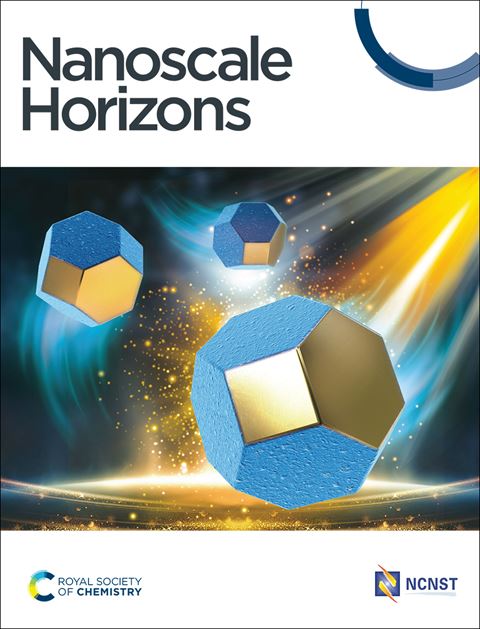
Micron-scale hexagonal Cs4PbBr6 perovskite microdisks (MDs), comprising a zero-dimensional phase, act as efficient energy donors when interfaced with the organic dye 1,1'-dioctadecyl-3,3,3',3'-tetramethylindocarbocyanine-perchlorate (DiIC18). Upon dye binding and selective excitation of the MDs, efficient singlet energy transfer (ET) occurs, as evidenced by the quenching of MD photoluminescence (PL), enhanced dye emission, and the emergence of an ET-induced rise component in the dye lifetime profile. Single-particle measurements under donor-selective excitation show strong ET-induced donor-acceptor PL anticorrelation, marked by a pronounced zero-delay dip [g2(0)] in the antibunching cross-correlation. Additional evidence for ET comes from single-particle PL trajectory analysis showing strong temporal correlation between donor and acceptor signals, and from simultaneous donor/acceptor-channel imaging under donor-only excitation, where spatially colocalized MD images confirm ET-mediated excitation of dye molecules distributed all over the MDs. Solution-phase ensemble measurements demonstrate relatively high ET efficiency (>50%) even at low bulk dye concentrations (∼1 µM). Spatially-resolved analysis further reveals ∼55% higher ET efficiency at the MD core compared to the edges, indicating preferential dye accumulation within the cavities located mostly in the core region. These results demonstrate that Cs4PbBr6 MDs serve as efficient ET platforms with tunable ET efficiency, providing promising potential for applications in photocatalysis, sensing, and light-harvesting technologies.
期刊介绍:
Nanoscale Horizons stands out as a premier journal for publishing exceptionally high-quality and innovative nanoscience and nanotechnology. The emphasis lies on original research that introduces a new concept or a novel perspective (a conceptual advance), prioritizing this over reporting technological improvements. Nevertheless, outstanding articles showcasing truly groundbreaking developments, including record-breaking performance, may also find a place in the journal. Published work must be of substantial general interest to our broad and diverse readership across the nanoscience and nanotechnology community.

 求助内容:
 应助结果提醒方式:


 京公网安备 11010802042870号


