Nico Appold, Timon Citak, Auguste A Palm, Jona Kayser
{"title":"A microbial therapy-mimicry assay shows how spatial resource dynamics control resistance escape.","authors":"Nico Appold, Timon Citak, Auguste A Palm, Jona Kayser","doi":"10.1038/s41559-026-03178-z","DOIUrl":null,"url":null,"abstract":"<p><p>The evolution of therapy resistance in structured populations such as biofilms and solid tumours is shaped by emergent spatial organization, with profound consequences for evolution-based therapies. However, how treatment reshapes these patterns remains poorly understood. Here we show that intermittent treatment pulses transiently reconfigure the resource landscape, reorganize spatial growth zones and can enable resistant mutants to escape spatial confinement and drive therapy failure. We introduce a spatial evolution assay in which populations expand from single, genetically tailored yeast cells, enabling quantitative tracking of the full spatiotemporal trajectories of continually emerging resistant mutants under intermittent treatment. By integrating these observations with a mechanistically interpretable computational model in a real-to-sim-to-real loop, we identify a dynamic phase-transition-like boundary in schedule space that defines a candidate optimal balance between population control and sustained resistance confinement, which we test experimentally. Together, our results establish resource-mediated spatial confinement as a central organizing principle of resistance evolution and provide a mechanistic foundation for spatially informed, evolution-based therapies.</p>","PeriodicalId":18835,"journal":{"name":"Nature ecology & evolution","volume":" ","pages":""},"PeriodicalIF":17.1000,"publicationDate":"2026-09-28","publicationTypes":"Journal Article","fieldsOfStudy":null,"isOpenAccess":false,"openAccessPdf":"","citationCount":"0","resultStr":null,"platform":"Semanticscholar","paperid":null,"PeriodicalName":"Nature ecology & evolution","FirstCategoryId":"99","ListUrlMain":"https://doi.org/10.1038/s41559-026-03178-z","RegionNum":1,"RegionCategory":"生物学","ArticlePicture":[],"TitleCN":null,"AbstractTextCN":null,"PMCID":null,"EPubDate":"","PubModel":"","JCR":"Q1","JCRName":"ECOLOGY","Score":null,"Total":0}
引用次数: 0
Abstract
The evolution of therapy resistance in structured populations such as biofilms and solid tumours is shaped by emergent spatial organization, with profound consequences for evolution-based therapies. However, how treatment reshapes these patterns remains poorly understood. Here we show that intermittent treatment pulses transiently reconfigure the resource landscape, reorganize spatial growth zones and can enable resistant mutants to escape spatial confinement and drive therapy failure. We introduce a spatial evolution assay in which populations expand from single, genetically tailored yeast cells, enabling quantitative tracking of the full spatiotemporal trajectories of continually emerging resistant mutants under intermittent treatment. By integrating these observations with a mechanistically interpretable computational model in a real-to-sim-to-real loop, we identify a dynamic phase-transition-like boundary in schedule space that defines a candidate optimal balance between population control and sustained resistance confinement, which we test experimentally. Together, our results establish resource-mediated spatial confinement as a central organizing principle of resistance evolution and provide a mechanistic foundation for spatially informed, evolution-based therapies.
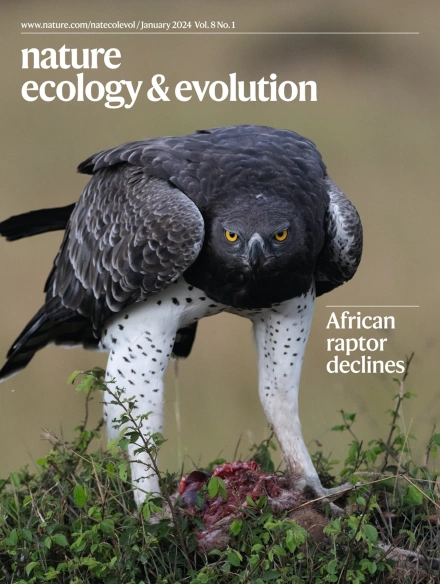
Nature ecology & evolutionAgricultural and Biological Sciences-Ecology, Evolution, Behavior and Systematics
CiteScore
22.20
自引率
2.40%
发文量
282
期刊介绍:
Nature Ecology & Evolution is interested in the full spectrum of ecological and evolutionary biology, encompassing approaches at the molecular, organismal, population, community and ecosystem levels, as well as relevant parts of the social sciences. Nature Ecology & Evolution provides a place where all researchers and policymakers interested in all aspects of life's diversity can come together to learn about the most accomplished and significant advances in the field and to discuss topical issues. An online-only monthly journal, our broad scope ensures that the research published reaches the widest possible audience of scientists.


 求助内容:
 应助结果提醒方式:


 京公网安备 11010802042870号


