Sarah S Dinges, Marita Bosticardo, Anke Hirschfelder, Francesca Pala, Johannes Kopp, Viktor Glaser, Johannes Gru Nhagen, Giuseppe Sangiorgio, Lisa Ehlers, Pawel Durek, Olga Staudacher, Mirjam Völler, Austen Worth, Uwe Kölsch, Zainab M Golwala, Nadine Unterwalder, Erwin Lankes, Karl-Ulrich Schunck, Frederik Heinrich, Kayla Amini, Stavros Loukogeorgakis, Evey Howley, Heather Kenney, Hendrik S Fischer, Sven C Weber, Oliver Blankenstein, Christian Meisel, Anke Wendt, Harald Stachelscheid, Angela Kaindl, Christoph Bu Hrer, Anita Balázs, Mir-Farzin Mashreghi, Julia K Polansky, Dimitrios L Wagner, E Graham Davies, Marcus A Mall, Alexandra Y Kreins, Luigi D Notarangelo, Horst von Bernuth
{"title":"Autosomal recessive HOXA3 deficiency causes congenital athymia and laryngeal malformation.","authors":"Sarah S Dinges, Marita Bosticardo, Anke Hirschfelder, Francesca Pala, Johannes Kopp, Viktor Glaser, Johannes Gru Nhagen, Giuseppe Sangiorgio, Lisa Ehlers, Pawel Durek, Olga Staudacher, Mirjam Völler, Austen Worth, Uwe Kölsch, Zainab M Golwala, Nadine Unterwalder, Erwin Lankes, Karl-Ulrich Schunck, Frederik Heinrich, Kayla Amini, Stavros Loukogeorgakis, Evey Howley, Heather Kenney, Hendrik S Fischer, Sven C Weber, Oliver Blankenstein, Christian Meisel, Anke Wendt, Harald Stachelscheid, Angela Kaindl, Christoph Bu Hrer, Anita Balázs, Mir-Farzin Mashreghi, Julia K Polansky, Dimitrios L Wagner, E Graham Davies, Marcus A Mall, Alexandra Y Kreins, Luigi D Notarangelo, Horst von Bernuth","doi":"10.1016/j.jaci.2026.09.010","DOIUrl":null,"url":null,"abstract":"<p><strong>Background: </strong>Approximately 10% of patients with Severe Combined Immunodeficiency (SCID) phenotype lack a known genetic cause. In particular, the molecular basis of thymic defects is poorly understood. Homeobox (HOX) genes encode conserved transcription factors that control spatial body development. The function of human HOXA3 is undefined.</p><p><strong>Objective: </strong>We characterize the first human with HOXA3 deficiency and investigate the role of HOXA3 in immune system development.</p><p><strong>Methods: </strong>We performed clinical and immunological phenotyping, as well as genetic sequencing. A homozygous nonsense variant in HOXA3 was identified, and functionally validated including RT-PCR, western blot, assessment of transcriptional activity and intracellular localization of HOXA3. We report clinical management and course.</p><p><strong>Results: </strong>The homozygous HOXA3 nonsense variant generates a truncated protein with cytoplasmic retention and reduced transcriptional activity. The clinical phenotype includes craniofacial and cervical anomalies, severe laryngopharyngeal malformation with epiglottic hypoplasia causing dysphagia and aspiration, central breathing disorder, and thymus aplasia. T-cell maturation in artificial thymic organoids (ATO) and recovery after thymus transplantation establish the T-cell defect as non-hematopoietic.</p><p><strong>Conclusion: </strong>Human HOXA3 has non-redundant roles for the development of larynx and thymus. HOXA3 deficiency is a novel, life-threatening multisystem disorder. It is the first human Homeobox-gene disease causing congenital athymia. These findings expand the diagnostic gene panel for patients with a SCID phenotype and indicate epiglottic hypoplasia as a new specific co-morbidity of congenital athymia.</p><p><strong>Key messages: </strong>Homeobox A3 (HOXA3) deficiency is a novel cause of congenital athymia, characterized by craniofacial and cervical anomalies, and life-threatening laryngeal malformation. Human HOXA3, unlike murine Hoxa3, may be redundant for parathyroid and thyroid gland development. The loss of the homeodomain causes cytoplasmic retention of the HOXA3 protein, leading to reduced transcriptional activity.</p><p><strong>Capsule summary: </strong>We describe HOXA3 deficiency as the 8<sup>th</sup> genetically defined cause of congenital athymia, facilitating life-saving thymus transplantation for future patients. Life-threatening laryngeal malformations provide a clinical diagnostic clue for congenital athymia.</p>","PeriodicalId":14936,"journal":{"name":"Journal of Allergy and Clinical Immunology","volume":" ","pages":""},"PeriodicalIF":11.7000,"publicationDate":"2026-09-28","publicationTypes":"Journal Article","fieldsOfStudy":null,"isOpenAccess":false,"openAccessPdf":"","citationCount":"0","resultStr":null,"platform":"Semanticscholar","paperid":null,"PeriodicalName":"Journal of Allergy and Clinical Immunology","FirstCategoryId":"3","ListUrlMain":"https://doi.org/10.1016/j.jaci.2026.09.010","RegionNum":1,"RegionCategory":"医学","ArticlePicture":[],"TitleCN":null,"AbstractTextCN":null,"PMCID":null,"EPubDate":"","PubModel":"","JCR":"Q1","JCRName":"ALLERGY","Score":null,"Total":0}
引用次数: 0
Abstract
Background: Approximately 10% of patients with Severe Combined Immunodeficiency (SCID) phenotype lack a known genetic cause. In particular, the molecular basis of thymic defects is poorly understood. Homeobox (HOX) genes encode conserved transcription factors that control spatial body development. The function of human HOXA3 is undefined.
Objective: We characterize the first human with HOXA3 deficiency and investigate the role of HOXA3 in immune system development.
Methods: We performed clinical and immunological phenotyping, as well as genetic sequencing. A homozygous nonsense variant in HOXA3 was identified, and functionally validated including RT-PCR, western blot, assessment of transcriptional activity and intracellular localization of HOXA3. We report clinical management and course.
Results: The homozygous HOXA3 nonsense variant generates a truncated protein with cytoplasmic retention and reduced transcriptional activity. The clinical phenotype includes craniofacial and cervical anomalies, severe laryngopharyngeal malformation with epiglottic hypoplasia causing dysphagia and aspiration, central breathing disorder, and thymus aplasia. T-cell maturation in artificial thymic organoids (ATO) and recovery after thymus transplantation establish the T-cell defect as non-hematopoietic.
Conclusion: Human HOXA3 has non-redundant roles for the development of larynx and thymus. HOXA3 deficiency is a novel, life-threatening multisystem disorder. It is the first human Homeobox-gene disease causing congenital athymia. These findings expand the diagnostic gene panel for patients with a SCID phenotype and indicate epiglottic hypoplasia as a new specific co-morbidity of congenital athymia.
Key messages: Homeobox A3 (HOXA3) deficiency is a novel cause of congenital athymia, characterized by craniofacial and cervical anomalies, and life-threatening laryngeal malformation. Human HOXA3, unlike murine Hoxa3, may be redundant for parathyroid and thyroid gland development. The loss of the homeodomain causes cytoplasmic retention of the HOXA3 protein, leading to reduced transcriptional activity.
Capsule summary: We describe HOXA3 deficiency as the 8th genetically defined cause of congenital athymia, facilitating life-saving thymus transplantation for future patients. Life-threatening laryngeal malformations provide a clinical diagnostic clue for congenital athymia.
期刊介绍:
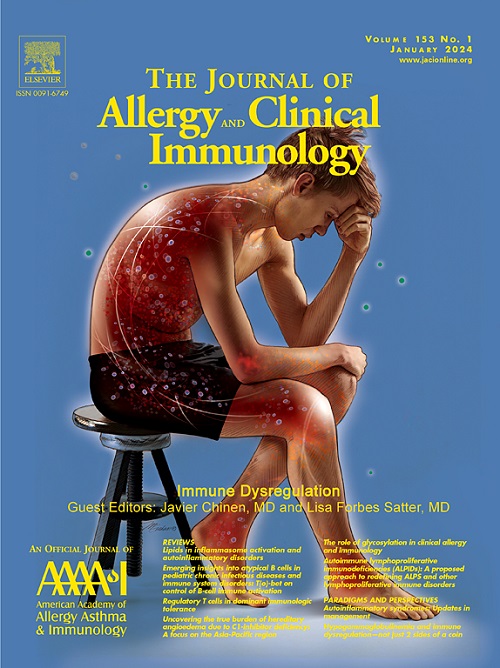
The Journal of Allergy and Clinical Immunology is a prestigious publication that features groundbreaking research in the fields of Allergy, Asthma, and Immunology. This influential journal publishes high-impact research papers that explore various topics, including asthma, food allergy, allergic rhinitis, atopic dermatitis, primary immune deficiencies, occupational and environmental allergy, and other allergic and immunologic diseases. The articles not only report on clinical trials and mechanistic studies but also provide insights into novel therapies, underlying mechanisms, and important discoveries that contribute to our understanding of these diseases. By sharing this valuable information, the journal aims to enhance the diagnosis and management of patients in the future.

 求助内容:
 应助结果提醒方式:


 京公网安备 11010802042870号


