Salik Sultan, Josua Grawitter, Gonçalo C. Antunes, Holger Stark
{"title":"Droplets sitting on thin elastic sheets: a study with the boundary element method","authors":"Salik Sultan, Josua Grawitter, Gonçalo C. Antunes, Holger Stark","doi":"10.1140/epje/s10189-026-00620-9","DOIUrl":null,"url":null,"abstract":"<p>Elasto-capillarity of a droplet wetting an elastic sheet provides an interesting system, both for fundamental and applied research. The droplet sinks into the sheet and assumes the shape of a lens. To determine the equilibrium shape in simulations, we formulate a boundary element method (BEM) extending our earlier approaches, and apply the BEM to three specific protocols for the boundary conditions of the sheet. For a clamped elastic sheet, we use various morphological metrics to demonstrate that the lens shape crucially depends on the sheet thickness. Stretching the sheet isotropically allows for an additional control parameter to influence the droplet shape and the tension in the sheet, which we quantify by radial profiles of the azimuthal and radial elastic stresses. We further demonstrate how the focal length of a liquid lens can be tuned by varying the applied tension. Finally, stretching the sheet along one direction elongates the droplet, and the sheet shows folds and dimples.</p><p>A droplet wetting a clamped elastic sheet assumes a lens shape (bottom); stretching the sheet along one direction, the droplet also elongates and the sheet shows folds and dimples (top) </p>","PeriodicalId":790,"journal":{"name":"The European Physical Journal E","volume":"49 10","pages":""},"PeriodicalIF":2.6000,"publicationDate":"2026-09-28","publicationTypes":"Journal Article","fieldsOfStudy":null,"isOpenAccess":false,"openAccessPdf":"https://www.ncbi.nlm.nih.gov/pmc/articles/PMC13619792/pdf/","citationCount":"0","resultStr":null,"platform":"Semanticscholar","paperid":null,"PeriodicalName":"The European Physical Journal E","FirstCategoryId":"4","ListUrlMain":"https://link.springer.com/article/10.1140/epje/s10189-026-00620-9","RegionNum":4,"RegionCategory":"物理与天体物理","ArticlePicture":[],"TitleCN":null,"AbstractTextCN":null,"PMCID":null,"EPubDate":"","PubModel":"","JCR":"Q4","JCRName":"CHEMISTRY, PHYSICAL","Score":null,"Total":0}
引用次数: 0
Abstract
Elasto-capillarity of a droplet wetting an elastic sheet provides an interesting system, both for fundamental and applied research. The droplet sinks into the sheet and assumes the shape of a lens. To determine the equilibrium shape in simulations, we formulate a boundary element method (BEM) extending our earlier approaches, and apply the BEM to three specific protocols for the boundary conditions of the sheet. For a clamped elastic sheet, we use various morphological metrics to demonstrate that the lens shape crucially depends on the sheet thickness. Stretching the sheet isotropically allows for an additional control parameter to influence the droplet shape and the tension in the sheet, which we quantify by radial profiles of the azimuthal and radial elastic stresses. We further demonstrate how the focal length of a liquid lens can be tuned by varying the applied tension. Finally, stretching the sheet along one direction elongates the droplet, and the sheet shows folds and dimples.
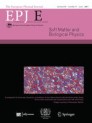
A droplet wetting a clamped elastic sheet assumes a lens shape (bottom); stretching the sheet along one direction, the droplet also elongates and the sheet shows folds and dimples (top)
期刊介绍:
EPJ E publishes papers describing advances in the understanding of physical aspects of Soft, Liquid and Living Systems.
Soft matter is a generic term for a large group of condensed, often heterogeneous systems -- often also called complex fluids -- that display a large response to weak external perturbations and that possess properties governed by slow internal dynamics.
Flowing matter refers to all systems that can actually flow, from simple to multiphase liquids, from foams to granular matter.
Living matter concerns the new physics that emerges from novel insights into the properties and behaviours of living systems. Furthermore, it aims at developing new concepts and quantitative approaches for the study of biological phenomena. Approaches from soft matter physics and statistical physics play a key role in this research.
The journal includes reports of experimental, computational and theoretical studies and appeals to the broad interdisciplinary communities including physics, chemistry, biology, mathematics and materials science.

 求助内容:
 应助结果提醒方式:


 京公网安备 11010802042870号


