
Current-Dependent Pathway Switching in Electrochemical Oxidative Dehydrogenation of Ethane Over an LSC Electrode in SOEC

IF 4.1 3区 化学 Q2 CHEMISTRY, PHYSICAL
ChemCatChem Pub Date : 2026-09-30 DOI:10.1002/cctc.202600023
Zhijie Wang, Jinxuan Hao, Hongpeng Fan, Xiao Lin, Linjuan Zhang, Jian-Qiang Wang
{"title":"Current-Dependent Pathway Switching in Electrochemical Oxidative Dehydrogenation of Ethane Over an LSC Electrode in SOEC","authors":"Zhijie Wang,&nbsp;Jinxuan Hao,&nbsp;Hongpeng Fan,&nbsp;Xiao Lin,&nbsp;Linjuan Zhang,&nbsp;Jian-Qiang Wang","doi":"10.1002/cctc.202600023","DOIUrl":null,"url":null,"abstract":"<div>\n \n <p>Electrochemical oxidative dehydrogenation (ODH) of ethane in solid oxide electrolysis cells (SOECs) offers a promising alternative to energy-intensive steam cracking. This work investigates the ODH mechanism using an LSC (La<sub>0.6</sub>Sr<sub>0.4</sub>CoO<sub>3-δ</sub>) anode in a 5 cm*5 cm single cell, achieving high ethylene selectivity (∼44%) at 650°C. In contrast, operation at elevated temperatures (e.g., 700°C) leads to anode degradation and a shift in selectivity. Through a combination of electrochemical impedance spectroscopy with distribution of relaxation times (EIS-DRT) and detailed product analysis, we reveal a decisive shift in the dominant reaction pathway governed by the applied current density. At low current densities, the direct electrochemical oxidation of ethane by surface oxygen species prevails. As the current increases, the mechanism transitions to a tandem process where the oxygen evolution reaction occurs first, followed by the thermochemical ODH of ethane. This mechanistic crossover is rationalized by the competition between ethane diffusion to active sites and the rate of electrochemical oxygen supply. These findings provide fundamental insights into the interplay of electrochemical and thermochemical steps in high-temperature alkane electrolysis, highlighting current density as a key lever for controlling selectivity.</p>\n </div>","PeriodicalId":141,"journal":{"name":"ChemCatChem","volume":"18 19","pages":""},"PeriodicalIF":4.1000,"publicationDate":"2026-09-30","publicationTypes":"Journal Article","fieldsOfStudy":null,"isOpenAccess":false,"openAccessPdf":"","citationCount":"0","resultStr":null,"platform":"Semanticscholar","paperid":null,"PeriodicalName":"ChemCatChem","FirstCategoryId":"92","ListUrlMain":"https://onlinelibrary.wiley.com/doi/10.1002/cctc.202600023","RegionNum":3,"RegionCategory":"化学","ArticlePicture":[],"TitleCN":null,"AbstractTextCN":null,"PMCID":null,"EPubDate":"","PubModel":"","JCR":"Q2","JCRName":"CHEMISTRY, PHYSICAL","Score":null,"Total":0}
引用次数: 0

Abstract

Electrochemical oxidative dehydrogenation (ODH) of ethane in solid oxide electrolysis cells (SOECs) offers a promising alternative to energy-intensive steam cracking. This work investigates the ODH mechanism using an LSC (La0.6Sr0.4CoO3-δ) anode in a 5 cm*5 cm single cell, achieving high ethylene selectivity (∼44%) at 650°C. In contrast, operation at elevated temperatures (e.g., 700°C) leads to anode degradation and a shift in selectivity. Through a combination of electrochemical impedance spectroscopy with distribution of relaxation times (EIS-DRT) and detailed product analysis, we reveal a decisive shift in the dominant reaction pathway governed by the applied current density. At low current densities, the direct electrochemical oxidation of ethane by surface oxygen species prevails. As the current increases, the mechanism transitions to a tandem process where the oxygen evolution reaction occurs first, followed by the thermochemical ODH of ethane. This mechanistic crossover is rationalized by the competition between ethane diffusion to active sites and the rate of electrochemical oxygen supply. These findings provide fundamental insights into the interplay of electrochemical and thermochemical steps in high-temperature alkane electrolysis, highlighting current density as a key lever for controlling selectivity.
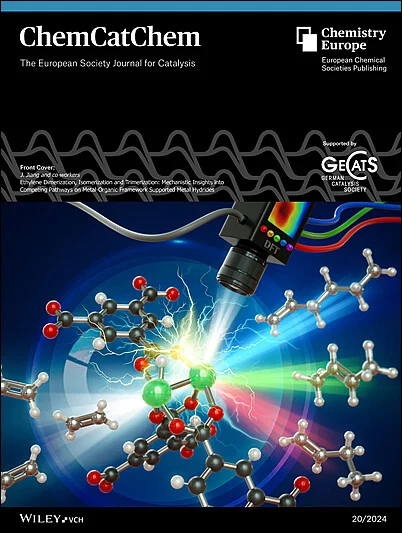

SOEC中LSC电极上乙烷氧化脱氢的电流依赖通路切换
固体氧化物电解电池(SOECs)中乙烷的电化学氧化脱氢(ODH)是一种有前途的替代能源密集型蒸汽裂解的方法。本研究使用LSC (La0.6Sr0.4CoO3-δ)阳极在5 cm*5 cm的单胞中研究ODH机理,在650°C下获得高乙烯选择性(~ 44%)。相反,在高温下操作(例如,700°C)会导致阳极降解和选择性的变化。通过结合电化学阻抗谱与弛豫时间分布(EIS-DRT)和详细的产品分析,我们揭示了由施加电流密度控制的主导反应途径的决定性转变。在低电流密度下,乙烷被表面氧直接电化学氧化。随着电流的增大,反应机制转变为先发生析氧反应,再发生乙烷的热化学ODH的串联过程。乙烷扩散到活性位点和电化学供氧速率之间的竞争使这种机械交叉变得合理。这些发现为高温烷烃电解中电化学和热化学步骤的相互作用提供了基本的见解,强调了电流密度是控制选择性的关键杠杆。
本文章由计算机程序翻译,如有差异,请以英文原文为准。
求助全文
约1分钟内获得全文 求助全文
来源期刊
ChemCatChem
ChemCatChem 化学-物理化学
CiteScore
8.10
自引率
4.40%
发文量
511
审稿时长
1.3 months
期刊介绍: With an impact factor of 4.495 (2018), ChemCatChem is one of the premier journals in the field of catalysis. The journal provides primary research papers and critical secondary information on heterogeneous, homogeneous and bio- and nanocatalysis. The journal is well placed to strengthen cross-communication within between these communities. Its authors and readers come from academia, the chemical industry, and government laboratories across the world. It is published on behalf of Chemistry Europe, an association of 16 European chemical societies, and is supported by the German Catalysis Society.
×
引用
GB/T 7714-2015
复制
MLA
复制
APA
复制
导出至
BibTeX EndNote RefMan NoteFirst NoteExpress
×
提示
您的信息不完整,为了账户安全,请先补充。
现在去补充
×
提示
您因"违规操作"
具体请查看互助需知
我知道了
×
提示
确定
请完成安全验证×
copy
已复制链接
快去分享给好友吧!
我知道了
右上角分享
点击右上角分享
0
联系我们:info@booksci.cn Book学术提供免费学术资源搜索服务,方便国内外学者检索中英文文献。致力于提供最便捷和优质的服务体验。 Copyright © 2023 布克学术 All rights reserved.
京ICP备2023020795号-1
ghs 京公网安备 11010802042870号
Book学术文献互助
Book学术文献互助群
群 号:604180095
Book学术官方微信
小红书


