{"title":"Rapid Clinical Improvement Temporally Associated with Off-Label LetiFend<sup>®</sup> Vaccination in Canine Leishmaniasis: A Case Report.","authors":"Tobias Werner, Marius Rămneanţu, Torsten J Naucke","doi":"10.3390/vaccines14090818","DOIUrl":null,"url":null,"abstract":"<p><p>Canine leishmaniasis (CanL), caused by <i>Leishmania infantum</i>, can be difficult to manage in dogs with severe clinical disease, particularly when established treatments are impractical or poorly tolerated. We report an approximately 3-year-old mixed-breed dog from Sardinia with clinically manifest CanL, anemia, thrombocytopenia, marked hyperglobulinemia, and an immunofluorescence antibody test titer of 1:4000. The dog's condition deteriorated during allopurinol treatment, with profound lethargy, vomiting, diarrhea, and complete refusal of food and water. Because escalation to combination leishmanicidal therapy (meglumine antimoniate or miltefosine) was considered clinically unsuitable in the severely debilitated patient, allopurinol monotherapy was discontinued after 18 days without clinical improvement, and one full commercial dose of the recombinant vaccine LetiFend<sup>®</sup> was administered subcutaneously off-label. No immediate adverse reaction was observed. Clinical improvement became apparent within approximately 10 days, and near-normal activity returned within three weeks. During follow-up, hematological parameters normalized and serum protein electrophoresis showed an increased albumin/globulin ratio and a reduced gamma-globulin fraction. Domperidone was subsequently introduced as long-term immunomodulatory follow-up, and allopurinol was temporarily reintroduced after transient laboratory deterioration in 2024; the dog remained clinically healthy through July 2026. The close temporal association is clinically noteworthy but cannot establish causality. This hypothesis-generating observation supports controlled investigation of therapeutic vaccination as a potential complementary approach in canine leishmaniasis.</p>","PeriodicalId":23634,"journal":{"name":"Vaccines","volume":"14 9","pages":""},"PeriodicalIF":3.5000,"publicationDate":"2026-09-17","publicationTypes":"Journal Article","fieldsOfStudy":null,"isOpenAccess":false,"openAccessPdf":"https://www.ncbi.nlm.nih.gov/pmc/articles/PMC13611871/pdf/","citationCount":"0","resultStr":null,"platform":"Semanticscholar","paperid":null,"PeriodicalName":"Vaccines","FirstCategoryId":"3","ListUrlMain":"https://doi.org/10.3390/vaccines14090818","RegionNum":3,"RegionCategory":"医学","ArticlePicture":[],"TitleCN":null,"AbstractTextCN":null,"PMCID":null,"EPubDate":"","PubModel":"","JCR":"Q1","JCRName":"IMMUNOLOGY","Score":null,"Total":0}
引用次数: 0
Abstract
Canine leishmaniasis (CanL), caused by Leishmania infantum, can be difficult to manage in dogs with severe clinical disease, particularly when established treatments are impractical or poorly tolerated. We report an approximately 3-year-old mixed-breed dog from Sardinia with clinically manifest CanL, anemia, thrombocytopenia, marked hyperglobulinemia, and an immunofluorescence antibody test titer of 1:4000. The dog's condition deteriorated during allopurinol treatment, with profound lethargy, vomiting, diarrhea, and complete refusal of food and water. Because escalation to combination leishmanicidal therapy (meglumine antimoniate or miltefosine) was considered clinically unsuitable in the severely debilitated patient, allopurinol monotherapy was discontinued after 18 days without clinical improvement, and one full commercial dose of the recombinant vaccine LetiFend® was administered subcutaneously off-label. No immediate adverse reaction was observed. Clinical improvement became apparent within approximately 10 days, and near-normal activity returned within three weeks. During follow-up, hematological parameters normalized and serum protein electrophoresis showed an increased albumin/globulin ratio and a reduced gamma-globulin fraction. Domperidone was subsequently introduced as long-term immunomodulatory follow-up, and allopurinol was temporarily reintroduced after transient laboratory deterioration in 2024; the dog remained clinically healthy through July 2026. The close temporal association is clinically noteworthy but cannot establish causality. This hypothesis-generating observation supports controlled investigation of therapeutic vaccination as a potential complementary approach in canine leishmaniasis.
VaccinesPharmacology, Toxicology and Pharmaceutics-Pharmacology
CiteScore
8.90
自引率
16.70%
发文量
1853
审稿时长
18.06 days
期刊介绍:
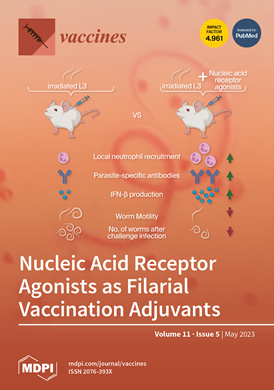
Vaccines (ISSN 2076-393X) is an international, peer-reviewed open access journal focused on laboratory and clinical vaccine research, utilization and immunization. Vaccines publishes high quality reviews, regular research papers, communications and case reports.

 求助内容:
 应助结果提醒方式:


 京公网安备 11010802042870号


