Pauline Schütt, Boaz Izelaar, Jakob Kibsgaard, Alexander Bagger
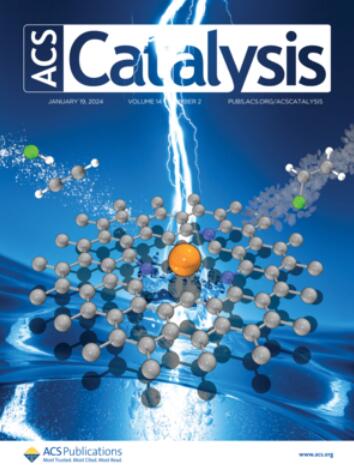
{"title":"Selectivity Maps for Electrochemical Ethylene Oxidation to Ethylene Oxide and Ethylene Glycol","authors":"Pauline Schütt, Boaz Izelaar, Jakob Kibsgaard, Alexander Bagger","doi":"10.1021/acscatal.6c05457","DOIUrl":null,"url":null,"abstract":"<p>Electrochemical ethylene oxidation can produce ethylene oxide and ethylene glycol, but selectivity is limited by competition with the oxygen evolution reaction and overoxidation. At the same time, the mechanistic literature is fragmented across oxo-, peroxo-, and hydroxyl-mediated pathways, creating ambiguity and hindering systematic improvement. Using density functional theory (DFT) and scaling relations, we build a unified descriptor-based framework comparing the three pathways across fcc metals, metal(II) oxides, and rutile-structured oxides. The oxygen binding strength is found to control ethylene activation via oxo and peroxo species, while a carbon-based descriptor describes the hydroxyl pathway, and product binding defines an overoxidation limit. The resulting selectivity maps identify the catalyst properties required for each route, rationalize the high performance of individual catalysts such as oxidized Pd, and provide transferable guidelines for designing selective alkene oxidation catalysts.</p>","PeriodicalId":9,"journal":{"name":"ACS Catalysis ","volume":"16 20","pages":"20551–20561"},"PeriodicalIF":13.6000,"publicationDate":"2026-10-16","publicationTypes":"Journal Article","fieldsOfStudy":null,"isOpenAccess":false,"openAccessPdf":"","citationCount":"0","resultStr":null,"platform":"Semanticscholar","paperid":null,"PeriodicalName":"ACS Catalysis ","FirstCategoryId":"92","ListUrlMain":"https://pubs.acs.org/doi/10.1021/acscatal.6c05457","RegionNum":1,"RegionCategory":"化学","ArticlePicture":[],"TitleCN":null,"AbstractTextCN":null,"PMCID":null,"EPubDate":"2026/9/25 0:00:00","PubModel":"Epub","JCR":"Q1","JCRName":"CHEMISTRY, PHYSICAL","Score":null,"Total":0}
引用次数: 0
Abstract
Electrochemical ethylene oxidation can produce ethylene oxide and ethylene glycol, but selectivity is limited by competition with the oxygen evolution reaction and overoxidation. At the same time, the mechanistic literature is fragmented across oxo-, peroxo-, and hydroxyl-mediated pathways, creating ambiguity and hindering systematic improvement. Using density functional theory (DFT) and scaling relations, we build a unified descriptor-based framework comparing the three pathways across fcc metals, metal(II) oxides, and rutile-structured oxides. The oxygen binding strength is found to control ethylene activation via oxo and peroxo species, while a carbon-based descriptor describes the hydroxyl pathway, and product binding defines an overoxidation limit. The resulting selectivity maps identify the catalyst properties required for each route, rationalize the high performance of individual catalysts such as oxidized Pd, and provide transferable guidelines for designing selective alkene oxidation catalysts.
期刊介绍:
ACS Catalysis is an esteemed journal that publishes original research in the fields of heterogeneous catalysis, molecular catalysis, and biocatalysis. It offers broad coverage across diverse areas such as life sciences, organometallics and synthesis, photochemistry and electrochemistry, drug discovery and synthesis, materials science, environmental protection, polymer discovery and synthesis, and energy and fuels.
The scope of the journal is to showcase innovative work in various aspects of catalysis. This includes new reactions and novel synthetic approaches utilizing known catalysts, the discovery or modification of new catalysts, elucidation of catalytic mechanisms through cutting-edge investigations, practical enhancements of existing processes, as well as conceptual advances in the field. Contributions to ACS Catalysis can encompass both experimental and theoretical research focused on catalytic molecules, macromolecules, and materials that exhibit catalytic turnover.

 求助内容:
 应助结果提醒方式:


 京公网安备 11010802042870号


